
1. Introduction: The Paradox of Fear
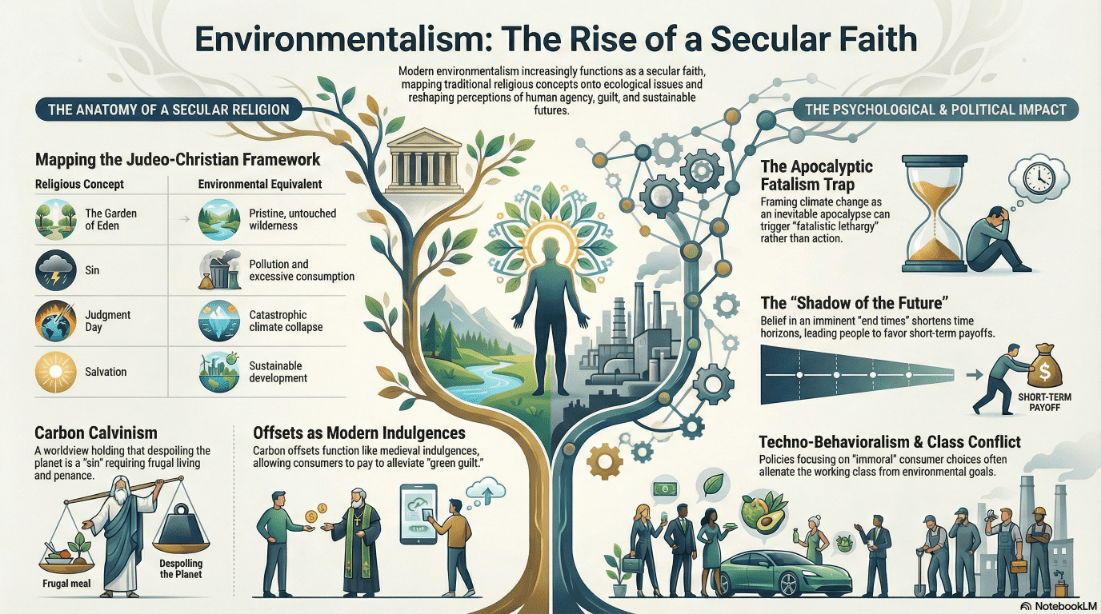
We are currently drowning in data, yet we are starving for consensus. As scientific reports grow increasingly granular and news headlines more apocalyptic, a strange phenomenon has emerged: the louder the warnings, the more some segments of the public tune out. You would think that a clear and present danger to the planet would be the ultimate motivator, but in many cases, it acts as a sedative or a polarizing agent.
This is the “Paradox of Fear.”
The hurdle isn’t a lack of information. We have the facts; the problem is the human operating system. Our brains are not dispassionate calculators; they are ancient biological machines governed by social identity, cultural filters, and psychological defense mechanisms. To understand why climate warnings backfire, we have to look past the spreadsheets and into the architecture of the human mind and the digital platforms that manipulate it.
2. The “Just-World” Trap: Why Scary News Makes Some People Tune Out
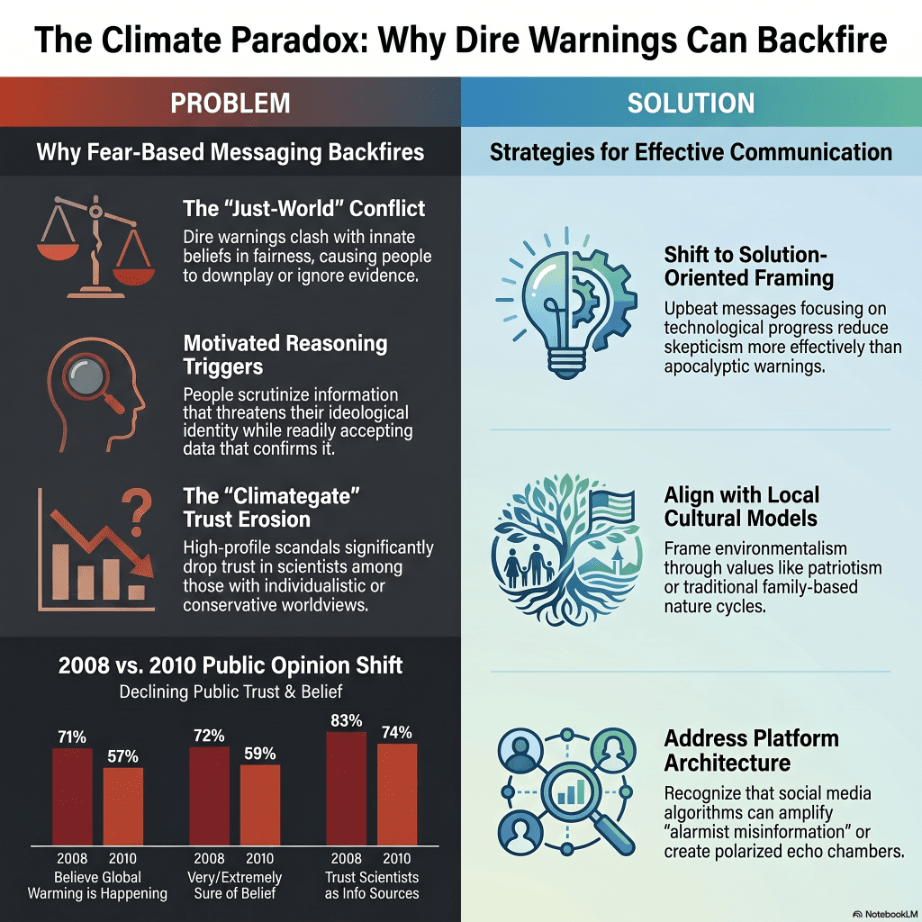
Most people believe, at an almost atomic level, that the world is inherently fair—that good things happen to good people and bad things are reserved for the deserving. Psychologists Matthew Feinberg and Robb Willer refer to this as the “just-world belief.” It is a vital psychological anchor that provides a sense of order and safety in a chaotic world.
According to research highlighted by the British Psychological Society, when individuals with strong just-world beliefs are confronted with “shocking” or “apocalyptic” climate messaging, it creates an intolerable internal conflict. If the planet is on the brink of collapse, the world is no longer fair or predictable. To protect their worldview, these individuals don’t change their behavior; they change their belief in the science. They become more skeptical of global warming to resolve the cognitive dissonance.
In contrast, the researchers found that solution-focused, “upbeat” messaging regarding technological innovation bypassed this defense mechanism entirely.
Fear, when used as a blunt instrument, does not inspire action; it triggers a psychological lockdown.
“Those participants with stronger just-world beliefs were actually made more sceptical about global warming by the more shocking newspaper article.”
3. The Alarmism Mirror: When Extreme Warnings Become Misinformation
We often think of climate misinformation as the realm of the “contrarian” or the “denier.” However, research from the University of Exeter identifies a rising, equally counter-productive category: climate alarmist misinformation. This isn’t just about being worried; it involves “scientifically inaccurate claims that suggest a level of imminent doom” not supported by the data.
This brand of doomism is often a direct, tragic reaction to the rise of climate activism. In an attempt to spur radical urgency, some messengers lean into hyperbole that suggests the end is already written. This is the “Alarmism Mirror.” While its intent is the opposite of denial, its outcome is strikingly similar: it creates a sense of hopelessness that paralyzes the public and provides skeptics with the perfect excuse to dismiss legitimate science as mere exaggeration.
Exaggerated doom serves the same end as denial: it ensures that nothing gets done.
4. The Architecture of the Argument: Reddit vs. YouTube Algorithms
The quality of our climate discourse is often determined by the digital “architecture” through which we view it. Analysis from the University of Exeter shows that platform design—not just what we want to see—is a primary driver of how we process the climate crisis. It isn’t just about us choosing echo chambers; it is about the platforms building them for us.
On Reddit, the structure frequently allows for “deliberative debate,” where nuanced sub-communities can exchange diverse information sources. YouTube, however, operates on a different logic. Its “Up Next” recommendation algorithm accounts for over 70% of viewing hours, and it is a master of “homophily”—the tendency for us to bond with similar others and information.
The platform’s architecture creates a cage of pre-existing values.
If you begin with a skeptical or alarmist video, the algorithm doesn’t offer a “balanced” alternative. Instead, it amplifies your existing position, serving up increasingly extreme content that reinforces your bias. Social media doesn’t just show us what we like; it builds a technological feedback loop that hardens our identities and makes encounter with the “other side” almost impossible.
5. The “Climategate” Rorschach Test: Facts as Mirrors for Identity
Information is never processed in a vacuum; it is filtered through “motivated reasoning.” This is the psychological process where our values, wishes, and preferences dictate how we evaluate data. A landmark Yale and George Mason University study on the 2009 “Climategate” email leak showed that facts often function like a Rorschach test: they reveal the identity of the observer rather than the reality of the situation.
The leaked emails were used by both sides not to change their minds, but to solidify their prior positions. Individuals who valued social equity (Egalitarians) saw out-of-context snippets; those who valued individual liberty and small government (Individualists) saw a global conspiracy.
| Worldview Type | Response to Scandal |
| Individualists | Viewed emails as proof of scientific conspiracy and government overreach; led to a significant, solidified decline in trust. |
| Egalitarians | Viewed emails as out-of-context; maintained or even increased trust in the scientific process as a defense. |
“People are not dispassionate consumers of information. Instead, their motivational states—their values, wishes and preferences—influence what information they pay attention to…”
6. Tradition Over Textbooks: Why Local Experience Beats Global Data
Environmental skepticism is rarely the result of a scientific “deficit.” Often, it is a conflict between two different ways of knowing: the “Textbook/Industrial” model of global data and the “Lived/Cyclical” model of local experience. This was perfectly illustrated in a cultural study of residents on Maryland’s Eastern Shore.
To the farmers and fishermen there, climate change is not a new phenomenon that began with the Industrial Revolution. Instead, based on generational storytelling and family tradition, they view the environment as a series of “natural cycles” that have existed “from the beginning of time.” Their identity is built on “living with the climate” rather than trying to “conquer” it.
For many, family history carries more authority than a scientific model.
When top-down regulations are imposed, these communities don’t see “climate action”; they see an attack on their way of life by outsiders who don’t understand the cycles they have lived for decades. Effective policy must move away from the “top-down” dismissal of local knowledge and instead work within these traditional cultural models. To these residents, the fear isn’t the changing water level—it’s the regulation that follows it.
7. Conclusion: Beyond the Apocalypse
The common thread across all these backfires is that climate change is a psychological and cultural challenge, not just a scientific one. Facts are not neutral tools; they are filters. If a warning threatens our sense of a “Just World,” our “Local Traditions,” or our “Motivated Reasoning,” our brains will find a way to reject it.
We have spent decades perfecting the science of the climate, but we have barely begun to master the science of the communicator. Moving forward requires us to stop relying on the language of the apocalypse and start engaging with the language of identity, local values, and practical solutions.
If fear is the lock, and solutions are the key, how can we change our own “climate filters” to see the path forward?