
1. The Hidden Acoustic World of Predators
Human perception is biologically confined to a narrow slice of the acoustic environment, typically ranging from 20 Hz to 20,000 Hz. While we easily register the sharp crack of a gunshot or the high-pitched whine of an engine, this represents a limited sensory window. In contrast, wildlife species occupy an expanded acoustic niche, navigating a world of “hidden” frequencies that remain entirely inaudible to the human ear.
At the lower end of the spectrum lies infrasound, consisting of frequencies below 20 Hz. Because these wavelengths are so long, they are experienced not as “sound” in the traditional sense, but as a visceral physical sensation—a vibration felt in the chest or through the ground. To an engineer, the objective is to exploit this window. By targeting the 5 Hz to 20 Hz operational window, we can maximize impact on species with specialized low-frequency capabilities while remaining sub-audible to humans.
The sensory thresholds of target species define our hardware requirements:
- Elephants: Capable of detecting infrasonic rumbles as low as 5 Hz, using them for long-distance communication and seismic sensing.
- Canids (Wolves/Foxes): While they possess sensitive hearing into the ultrasonic range (up to 45 kHz), they are highly responsive to low-frequency tactile vibrations that signal geological or atmospheric instability.
- Reptilian Comparisons: Species like alligators have evolved special sound-producing sacs in their chins to generate powerful infrasonic bellows, illustrating the biological effectiveness of low-frequency signaling in nature.
2. The Biology of Survival: Why Infrasound Triggers Flight
For many species, the detection of infrasound is an evolutionary command for immediate evasion. Low-frequency waves are inextricably linked to the “survival instinct,” as they are the primary acoustic signatures of natural disasters.
Beyond simple vibration, research into human and animal responses reveals that infrasound induces an affective state of “ghostly” anxiety. It triggers feelings of uneasiness, sorrow, fear, and even physical chills. This is the foundation of the Landscape of Fear: a high-tech deterrent does not just create noise; it simulates an emotional and physical environment of imminent danger.
Historical Precedents of Infrasonic Survival Responses:
- Tsunami Signatures: Before the 2004 Indian Ocean tsunami, elephants in Thailand broke their chains and fled inland hours before the wave hit, reacting to infrasonic pulses that travel faster than water.
- Seismic Restlessness: Dogs and cats frequently display intense anxiety and trembling hours before major earthquakes (such as those documented in Haicheng and Japan), detecting underground vibrations and electromagnetic shifts.
- Atmospheric Pressure Shifts: White-crowned sparrows respond to the barometric drops and infrasonic signatures of incoming snowstorms by increasing foraging and seeking shelter up to 24 hours in advance.
By exploiting these evolutionary algorithms, we can trigger an automatic “escape” command without the use of physical pain or chemical intervention.
3. Engineering the Infrasonic Deterrent System
Creating a functional “Landscape of Fear” requires specialized hardware capable of producing the powerful, high-displacement waves necessary to trigger a vestibular response.
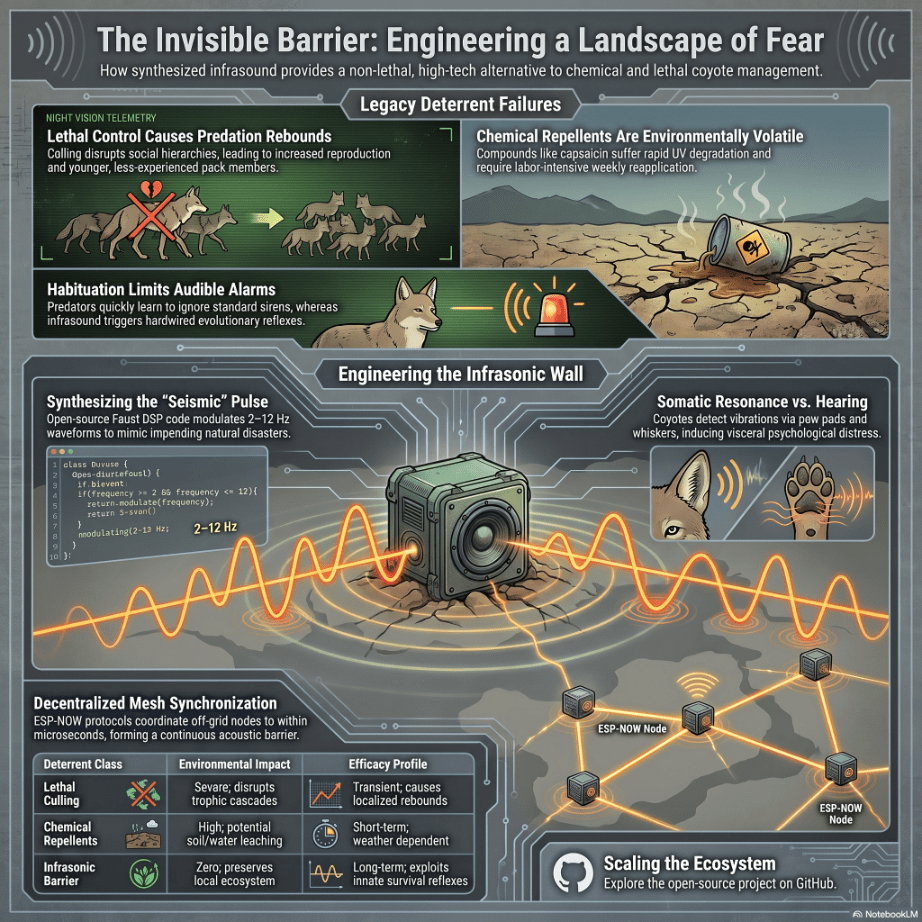
Specialized Transducers Conventional loudspeakers lack the excursion required to move sufficient air at sub-audible frequencies. We utilize mechanical rotary woofers to generate high-displacement infrasonic pulses. This hardware provides the “grit” necessary to induce a tactile vestibular response, mimicking the deep rumbles found in the natural world.
Signal Processing: The NatAmbio Framework To manage these signals, we employ an adapted NatAmbio open-source DSP framework. This system utilizes three critical stages:
- NAE (NatAmbio Ambient Extractor): Uses Principal Component Analysis (PCA) to decompose the signal, isolating the “ambient” components that contribute to environmental immersion.
- XTC (Crosstalk Cancellation): This is the core of the spatial deterrent. XTC allows for the precise “spatialization” of the fear-triggering sound, delivering it to a specific coordinate in the field to steer a predator’s flight path.
- PCA4DRC: Adapted from digital room correction, this method generates a representative impulse response to ensure the signal remains coherent across varying field topographies.
- FIR Convolutions: The system utilizes Finite Impulse Response (FIR) filters because they maintain linear phase, which is critical for preserving the physical “impact” and timing of an infrasonic pulse.
Strategic Hardware Comparison
| Parameter | Conventional Deterrents (Lethal/Chemical) | High-Tech Acoustic Deterrents |
| Ecological Impact | High (Non-target kills, chemical runoff) | Negligible (Non-invasive, no residue) |
| Maintenance | High (Trap checks, baiting, disposal) | Low (Remote sensing, self-powered) |
| Sensory Mechanism | Physical pain or injury | Evolutionary Algorithmic Triggers |
| Monitoring | Manual, labor-intensive inspection | Automated AI validation/Remote sensing |
4. Decentralized Infrastructure: Solar-Powered Mesh Networks
Deployment in harsh agricultural perimeters requires utility-grade resilience. We utilize turnkey solar microgrids, such as those provided by BoxPower, to ensure 99.9% reliability.
The power and communications infrastructure follows a tri-phase model:
- Design: Using EASI software to conduct site-specific energy audits, configuring the microgrid for extreme conditions like wildfire zones or sub-zero climates.
- Deploy: Utilizing prefabricated, modular kits (SolarContainers or MiniBoxes) for rapid, standardized installation that eliminates construction delays.
- Manage: Remote monitoring and optimized battery configurations allow for centralized fleet management.
By integrating these units into a mesh network, multiple deterrent nodes communicate in real-time, ensuring that a detection at the north perimeter triggers a spatialized infrasonic response that coordinates with nodes across the entire boundary.
5. Validation and Intelligence: The Role of AI and Camera Traps
While much of our monitoring technology was validated on small mammals (shrews, voles, mice) in research settings—such as the Mostela tunnel and Modified Littlewood designs—we have scaled these techniques for predator-specific intelligence.
The Validation Loop
- Visual Detection: Modified camera traps are used to identify predators. The Mostela tunnel design is leveraged to ensure high-quality data while reducing non-target triggers from vegetation.
- Acoustic Monitoring: Passive Acoustic Monitoring (PAM) units, such as AudioMoths, record vocalizations. Technologist’s Note: To ensure 99.9% reliability, units must be fitted with industrial-grade 128GB or 64GB SD cards, as high-resolution recording often makes storage capacity the limiting factor.
- AI Processing: We utilize machine learning pipelines, similar to the BTO Acoustic Pipeline, to classify species and confirm “flight” responses.
Action Workflow
- Perimeter Detection: A predator is detected via camera trap or PAM unit.
- Identification: AI software classifies the species (e.g., Wolf vs. Coyote).
- Signal Decomposition: The system applies PCA-based extraction via the NAE stage to prepare the deterrent signal.
- Spatial Trigger: Using XTC (Crosstalk Cancellation) and FIR processing, the system delivers a linear-phase infrasonic pulse to the animal’s exact location.
- Confirmation: The Validation Loop monitors the animal’s response to ensure successful repulsion from the protected area.
6. Ecological Benefits and the Future of Coexistence
The transition toward non-lethal, infrasonic management is an ethical and ecological necessity. By moving away from lethal trapping, we eliminate the accidental “kill-trapping” of non-target shrews and small mammals, while preventing chemical runoff from traditional deterrents.
Systemic Scalability Prefabricated, modular systems and standardized EASI-based design software eliminate the delays of traditional trapping programs. This allows for utility-grade reliability across diverse landscapes, from remote agricultural hubs to government conservation zones.
Ethical Non-Lethal Intervention By simulating the affective states associated with natural rumbles—anxiety and uneasiness—we manage predator-human conflict through evolutionary biology rather than physical trauma.
Optimized Efficiency and Reliability The integration of NatAmbio-based signal processing and BoxPower hardware creates a self-sustaining, intelligent perimeter. This is not just a deterrent; it is a scalable model for a future where technology facilitates the coexistence of industry and wildlife.