
1. Introduction: The Rangeland Paradox
The sight of cracked, bare earth and encroaching desert is traditionally framed as an inevitable symptom of climate change or the direct result of “too many cows.” For decades, reductionist thinking has cast livestock as the primary villain in the story of land degradation, seeking to solve the problem by simply removing the animals. However, a modern “New Agrarian” perspective reveals a provocative counter-intuitive premise: the very animals blamed for environmental decay are actually the biological engines required for its restoration.
This shift moves us away from looking at isolated variables toward true systems thinking, where the landscape is viewed as a complex, living whole. We are discovering that the “Rangeland Paradox” is not about the presence of livestock, but the total absence of their historic, migratory movement. To save our watersheds, we must stop viewing the cow as an environmental liability and start seeing it as a high-functioning land management technology.
2. The 40,000-Elephant Blunder: A Lesson in Complexity
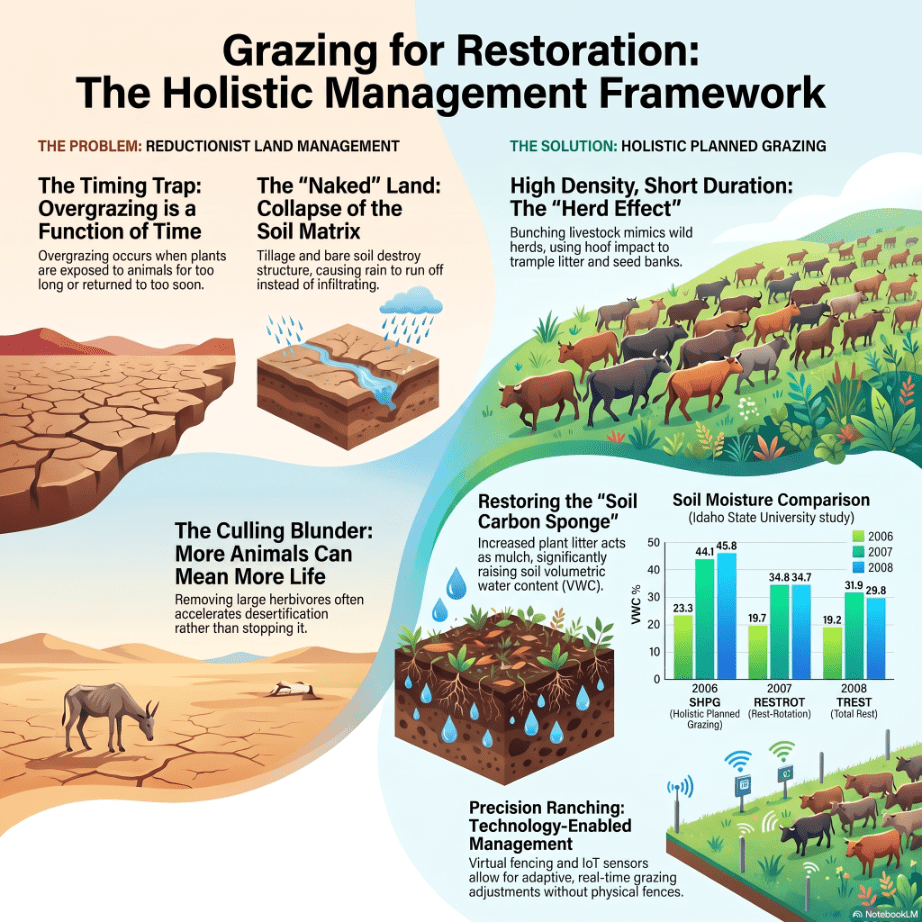
The dangers of narrow, data-driven reductionism are best illustrated by what ecologist Allan Savory calls the “saddest and greatest blunder” of his life. In the 1960s, Savory concluded that a surplus of elephants in Rhodesia was destroying the habitat, leading to a government-sanctioned culling of 40,000 animals to stop desertification. The results were catastrophic: without the herbivores to cycle nutrients and stimulate the soil, the land degradation actually accelerated.
Savory realized that in brittle environments, removing the animals causes the system to stall, leading grass to die “from the top down” because it cannot be biologically processed. This proved that the problem wasn’t the number of animals, but the loss of the “animal impact” necessary for soil health. The lesson is clear: interpreting research data to fit a “too many animals” worldview can lead to the destruction of the very ecosystems we intend to protect.
“I made the saddest and greatest blunder of my life. I recommended that we would have to cull 40,000 elephants to stop the habitat being destroyed… This preventable loss of life was the result of interpreting research data to fit the prevailing world-view that too many animals causes overgrazing.” — Allan Savory
3. The “Soil Carbon Sponge”: Why Your Land Should Look Like Bread, Not Flour
Healthy rangeland functions through what the FAO calls the “Soil Carbon Sponge,” a living matrix of organic carbon that constitutes “the living, the dead, and the very dead.” To visualize this, imagine pouring water onto a plate of flour; the water sits on the surface, runs off the edges, and leaves the powder underneath bone-dry. Now, imagine pouring that same water onto a piece of bread, which instantly soaks up the liquid while remaining intact and moist.
Degraded soil is like flour—inert mineral particles of sand and clay that have lost their biological architecture. A true soil sponge is a “bread-like” matrix created when plants and microorganisms produce glues and slimes that stick rock fragments together. This structure allows water to infiltrate deep into the earth, replenishing drinking wells and aquifers rather than fueling destructive run-off and algae blooms.
4. The 800,000-Pound “Magic” of Stocking Density
The secret to building this sponge lies in the surprising biophysics of Ultra-High Density Grazing (UHDG). In nature, ancient bison and wildebeest herds moved in dense, tightly packed groups to avoid predators, a behavior modern ranchers mimic by “bunching and moving” cattle. When practitioners concentrate 600,000 to 800,000 pounds of animal weight on a single acre for just a few hours, they trigger a massive biological “reset.”
While the density sounds extreme, scientific validation from Idaho State University (ISU) proves the mechanism works. The ISU study found that “simulated holistic planned grazing” resulted in a 10% increase in soil moisture compared to ungrazed land. The researchers concluded that the high density of animals created a thick layer of “litter”—trampled down dead grasses—that acted as a mulch to shade the soil and retain moisture.
5. Weeds as “Scabs”: The Counter-Intuitive Role of Pioneers
In the traditional ranching paradigm, thistles and invasive weeds are enemies to be chemically assassinated with pesticides. A systems-thinking model instead views these plants as “nature’s repair crew” or “scabs on a wound” that appear only when the soil is unbalanced. Thistles use deep taproots to bring up calcium and build fungal networks in poor, compacted soil that has lost its water infiltration capacity.
“These pioneer species are almost like a scab on a wound. I don’t fight the weeds; I let the weeds come in… your best soil aggregates are going to be where the thistles are.” — YouTube Transcript, The Regenaissance
Once these pioneers have “healed” the ground, they naturally create an environment where more palatable grasses can flourish. Rather than fighting succession with chemicals, ranchers use a “hard graze” with high-density livestock to recycle the weeds back into the soil. This allows the next stage of beneficial species to move in, effectively hiring the weeds to do the heavy lifting of soil restoration.
6. Precision Ranching: The End of the Barbed Wire Era
The primary barrier to scaling this management has been the exhausting labor of moving physical fences. We are now entering the era of “Precision Ranching,” where we can decouple labor from land management through biological infrastructure and IoT. Technologies like “Vence” use GPS collars to create fenceless boundaries, allowing ranchers to manage grazing with a tablet.
- LoRaWAN US915 Protocol: Solar-powered gateways provide 15 km of connectivity, collecting millions of data packets from cattle tracking collars and soil moisture probes.
- AI-Behavior Classification: Neural network models now classify whether an animal is grazing, walking, or resting with a staggering 94% accuracy (F1 = 0.94).
- Automated Watershed Monitoring: Real-time visualizations of water levels and precipitation allow ranchers to make adaptive decisions that optimize resource use.
7. Conclusion: Standing on the Right Side of the Fence
We are no longer just raising cattle; we are hiring them to rebuild the planet’s hydrological heart. The proof is visible in the famous fence-line contrast of the Karoo: on one side, a bare, dusty landscape under traditional management; on the other, a lush, green grassland restored through holistic movement. Both sides share the same rain and the same sun, yet only one side has the biological infrastructure to capture it.
This shift in thinking has reached the highest levels of global leadership, with figures like Prince Charles noting that “the land needs the presence of feeding animals… if you take grazers off the land and lock them away in vast feedlots, the land dies.” As we face a future of climate volatility, we must support a regenerative economy that values the “quiet workers of the underground world.” The question for every land manager and consumer is simple: on which side of the fence do you want to live?