
5 Truths About Modern Farming That Point to a Better Future
When we think of a farm, a specific image often comes to mind: the “Ma and Pa” operation, a pastoral painting of hardworking families feeding the nation. It’s a powerful and sympathetic picture. Yet, it clashes with the modern reality of corporate agriculture, where government subsidies and land speculation drive the business, leaving many of us with a nagging feeling that the food system is entirely out of our control.
This disconnect between the ideal and the reality is where the real story begins. By peeling back the layers of the current agricultural system, we can uncover several surprising and impactful truths. These truths don’t just expose a broken model; they point toward a more resilient, accessible, and regenerative way of thinking about our food supply.
The “Family Farm” Isn’t What You Think It Is.
The sympathetic image of the hardworking poor family is often a facade for what many critics bluntly call “mooching corporate farms”—operations existing primarily for USDA paychecks and land speculation. What this disconnect reveals is a fundamental misunderstanding of who is actually working the land. This reality forces us to ask the critical question posed by industry observers: Is an operation with 50 employees and $10 million in revenue truly a ‘family farm,’ or is it an industrial enterprise hiding behind a romantic myth?
Understanding this bait-and-switch is the first step toward diagnosing the real problems in our food system. The romanticized myth distracts from an industrial reality, preventing a clear-eyed conversation about the corporate capture of American agriculture.
Today’s Farming Is Rigged for Industrial Giants.
The modern agricultural system is not a level playing field. The critical implication here is that it has been intentionally engineered to favor large-scale, industrial operations through a toxic alliance of government programs, powerful corporations, and monopolistic processors.
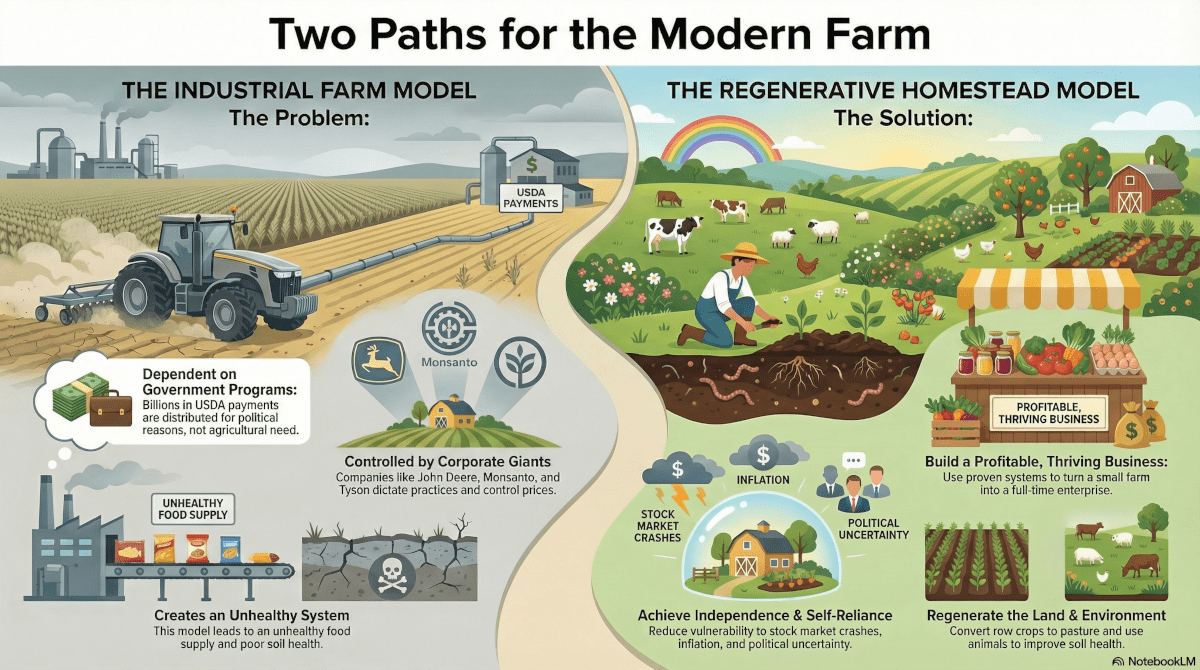
Governmental bodies like the USDA distribute billions in subsidies, often for purely political reasons. This financial structure is welded to corporations like John Deere, Monsanto, and Tyson Foods, which create a punishing cycle of dependency. A small farmer is immediately out of the game when you “have to have half million dollar tractor to spray those roundup ready soybeans.” This is the world of the corporate “family farm.” To complete the cycle, monopolistic food processors control market prices, further squeezing the margins of any true independent producer who dares to compete.
Real Self-Reliance Is an Investment in Know-How.
Faced with a system rigged for giants, it’s easy to feel powerless. But what if the path to true security lies not in fighting the system on its own terms, but in exiting it altogether? This is where the conventional wisdom begins to crumble. A growing movement suggests that true resilience isn’t found in traditional financial instruments but in tangible, practical abilities. The conventional path to security involves entrusting our future to abstract financial systems. The regenerative path involves reclaiming that future by investing in the most stable asset of all: personal capability.
This philosophy represents a radical redefinition of personal investment, as the course materials for Joel Salatin’s farming program powerfully articulate:
Many of us are realizing that rather than pumping more money into a 401k, or Roth IRA, or buying gold, what we really need to be doing is leveraging our equity into skill, know-how, and relationships.
This mindset is powerful because it relocates the source of security from external, fragile systems to internal, durable capability. It’s a philosophy centered on gaining the independence and know-how to “survive and thrive” regardless of stock market crashes, hyperinflation, or political turmoil.
You Don’t Need a Million-Dollar Tractor to Be a Successful Farmer.
Here, the contrast between the two farming models becomes stark. The industrial operator depends on a half-million-dollar tractor and government paychecks. The regenerative farmer, however, follows a completely different path. Directly countering the high-capital, debt-driven industrial model, innovators like Joel Salatin have developed proven systems designed specifically for the small farmer with “small acreage and small capital.”
These accessible models empower people to build profitable enterprises without relying on the industrial ecosystem. Examples of these systems include:
- Pastured Broilers: A model for developing a full-time poultry enterprise on a small scale.
- Pastured Pigs: A method for turning marginal farmland into a high-profitability operation with small capital investment.
- Farm Direct Marketing: A strategy for building a stable income and a community-focused brand that serves to “eliminate the dependency on middlemen.”
These approaches prove that a different kind of farmer can thrive—one who builds a viable, profitable business without the massive debt or corporate dependence that defines the industrial giants.
Farming Can Be a Force for Regeneration, Not Extraction.
Perhaps the most hopeful truth is that the best farming practices go beyond simply producing food; they actively regenerate the environment. The most powerful solution proposed by critics of industrial agriculture—converting the majority of row crops into grass and using ruminants to convert that forage into food—is not a theoretical fantasy. It is the practical, profitable, and proven foundation of Joel Salatin’s “Salad Bar Beef” and “Cattle Grazing Management” systems.
This approach goes “beyond organic” by requiring fewer chemicals and actively creating better soil health. This model’s power lies in its ability to heal both the ecosystem and the person working it, a duality captured perfectly by filmmaker John Chester in his praise for Salatin’s teachings:
He’s especially good for those interested in understanding unique methods of farming that regenerate both the land of the farm and the spirit of the farmer.
Replanting Our Future
The journey from the myth of the “Ma and Pa” farm to the reality of industrial agriculture reveals a broken system. However, it also illuminates a clear path toward a more hopeful and resilient future. The central counter-intuitive idea is this: real strength in our food system comes from decentralization, skill-building, and ecological harmony—not from scale, subsidies, and industrial might. This new model proves that a different future for food is not only possible but is already being cultivated by those willing to think differently.
As we look to the future, what is one step we could each take to support a food system that nourishes both us and the planet?