
Introduction: Beyond the Pasture
Picture a flock of sheep. You likely see a serene, pastoral scene: fluffy animals dotting a green hillside, peacefully grazing under a blue sky. It’s an image of simple, rustic beauty that has captivated us for centuries. But this idyllic picture, while true on the surface, conceals a world of surprising complexity.
That peaceful scene is underpinned by a remarkable depth of science, strategy, and animal psychology that most people never see. The health of the flock, the quality of the pasture, and the very dynamics of the group are the result of careful, calculated management. Raising sheep isn’t just about opening a gate; it’s about understanding biology, social structures, and even new federal regulations.
This article pulls back the curtain on the world of shepherding to reveal some of the most impactful and unexpected lessons learned from working with these incredible animals. What you learn might just change the way you see that simple pasture forever.
——————————————————————————–
1. They’re Not Mindless Followers; They’re Surprisingly Brilliant.
The most pervasive stereotype about sheep is that they are unintelligent, blindly following one another without a thought. The science, however, tells a completely different story. Research has shown that sheep possess cognitive abilities that are far more sophisticated than commonly believed.
- They have robust spatial memory. Studies show they can learn and remember how to navigate complex mazes for over 22 weeks.
- Their facial recognition skills are on par with humans. A sheep can memorize the faces of fifty other sheep and recognize them two years later, even from photographs. This remarkable ability also extends to recognizing human faces.
- They are self-aware. Sheep have demonstrated the ability to recognize themselves in a mirror, a sign of higher-level consciousness shared by only a handful of species.
- They can learn and show complex emotions. Individual sheep can learn a series of behaviors to get a reward and will show emotions akin to frustration if their expectations aren’t met.
- They yawn contagiously. Just like humans and other primates, seeing another sheep yawn can trigger one of their own, a behavior linked to empathy.
This intelligence means that managing a flock requires more than just physical herding. It’s a task that demands a psychological understanding of the animals, respecting their cognitive abilities and individual personalities.
2. Flock Dynamics are a Complex Social Drama.
The idea of a single “leader” with a flock of followers is another oversimplification. Within any flock, a complex and fluid social structure is constantly at play. Observers have noted distinct social roles that members of a flock adopt. There are “Leaders” who tend to stay near the front, “Middlers” who find comfort in the center, and “Tailers” who lollygag at the back.
The social dynamics get even more interesting. Research has shown that a single flock can have multiple leaders, with different individuals stepping up to guide the group under different conditions. This leadership is not always absolute and can be subject to the group’s approval, leading to behaviors that seem astonishingly human.
Even more intriguing: occasionally a flock would stop following a leader, and move off in a different direction. Sometimes the leader who had just been abandoned would scurry to rejoin the group at the front and pretend to lead in the new direction. They seemed to crave the appearance of leadership in the way a politician might shift his platform in order to stay ahead of a fickle electorate.
This observation reveals a flock that is less like a mindless mob and more like a society with shifting alliances and a “popular vote.” It’s a striking parallel to human social and political behavior, found right in the middle of the pasture.
3. Parasites are the Shepherd’s Constant, Invisible Enemy.
Of all common livestock, sheep are perhaps the most prone to problems with internal parasites. This vulnerability isn’t a sign of weakness but a consequence of their natural behavior. Sheep graze very close to the ground, right where they have left their manure. This puts them in direct contact with parasite larvae, creating a constant cycle of reinfection.
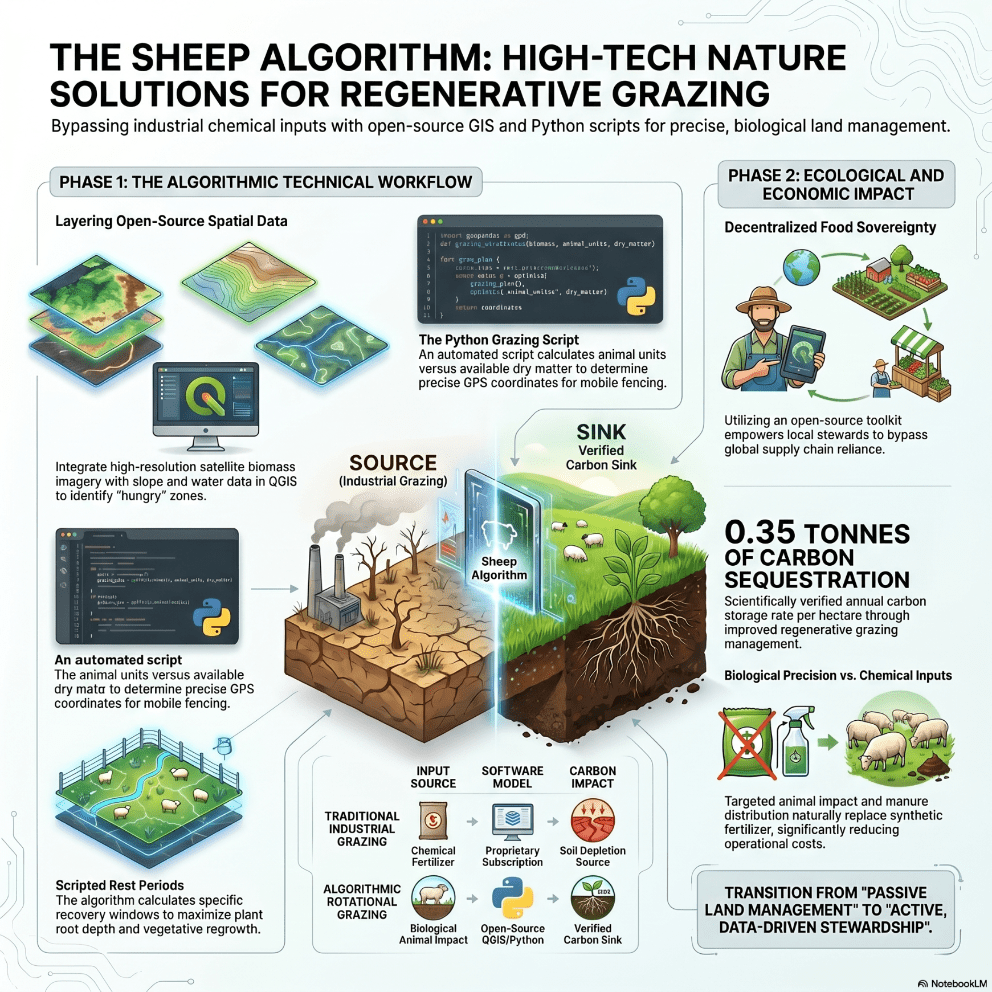
Your primary strategy to combat this is rotational grazing. Research has shown that it takes about 3-4 days for parasite larvae in manure to hatch and become infectious. By moving sheep to a fresh paddock every few days, you can break this life cycle, leaving the parasites behind before they become a threat.
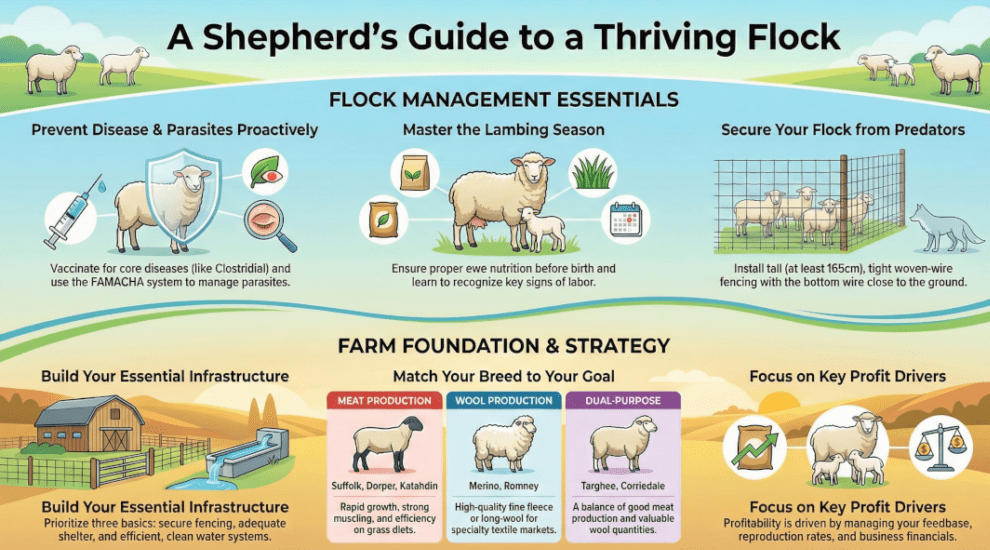
A clever tool for managing this threat is the FAMACHA system. This method involves checking the color of a sheep’s inner eyelid to gauge the level of anemia caused by the blood-sucking barber’s pole worm, Haemonchus contortus. A pale membrane (rated 4 or 5 on the official chart) indicates a dangerous parasite load requiring immediate treatment, while a healthy red one (rated 1 or 2) suggests the sheep’s immune system is handling the challenge. This allows you to treat only the animals that need it, avoiding the cost and resistance-building problems of deworming the entire flock unnecessarily.
4. Healthy Pastures Don’t Happen by Accident.
While rotational grazing is the shepherd’s most effective weapon against parasites, its true power comes from a shift in perspective: you must stop managing your sheep and start managing your grass. This is the core of effective shepherding. A healthy flock is a byproduct of a healthy pasture, and that requires a scientific approach called management intensive rotational grazing.
A key principle is that your rotations should be based on the growth rate of the forage, not on a rigid time schedule. The pasture dictates the pace. The consequences of mismanaging this are severe. One study revealed a startling data point about overgrazing: allowing sheep to remove 80-90% of a plant’s material can cause 100% of its root growth to stop.
Proper grazing management isn’t just about avoiding overgrazed dirt patches. It’s a holistic strategy that prevents parasites, improves pasture yields, builds rich and healthy soil, and ultimately makes your entire farm more efficient and sustainable.
5. “Just Living on the Land” Isn’t Enough for Their Diet.
There is a common and romantic misconception that sheep can get all the minerals they need simply from grazing on pasture. While forage provides the bulk of their nutrition, this belief overlooks a critical fact: every farm’s soil has a unique mineral profile. Your pasture might have an excess of one mineral while being completely devoid of another.
Relying on the soil alone is a gamble with your flock’s health. The reality is that no pasture is perfectly balanced. Providing a free-choice mineral supplement is an inexpensive and absolutely essential part of responsible sheep care. A proper mineral balance ensures sheep grow to healthy weights, strengthens their immune systems, and can prevent serious health problems like white muscle disease, an all too common and debilitating condition in newborn lambs caused by a selenium deficiency in the ewe’s diet.
6. The Rules for Animal Healthcare are Changing.
For generations, you could walk into a farm supply store and buy common antibiotics like penicillin over the counter. This reality has fundamentally changed. In a major regulatory shift, as of June 2023, many medically-important antibiotics that were previously available OTC now require a veterinary prescription.
This new rule affects some of the most common medications used on a sheep farm, including penicillin and oxytetracycline. And here’s a piece of hard-won wisdom for you: many of these OTC antibiotics were often used in an extra-label manner, which already required veterinary involvement, even if you haven’t been following the rules. This change makes that requirement official and unavoidable. The critical implication for you as a shepherd is clear: you must now have a valid veterinarian-client-patient-relationship (VCPR) to legally access these drugs.
This isn’t just a bureaucratic hurdle. It represents a broader, necessary shift in livestock management. The era of casually using antibiotics is over. The new emphasis is on proactive health through better management, strategic rotational grazing, and strong genetics to reduce your overall dependence on medication.
——————————————————————————–
Conclusion: The Thinking Shepherd
Raising sheep is far more than just a pastoral hobby; it is a complex and intellectually engaging endeavor. The modern shepherd must be a thinker, capable of understanding the surprising intelligence of an individual sheep while managing the intricate politics of the flock. Success demands being a grass farmer, a parasite expert, and a navigator of changing federal regulations. The work proves that some of the most profound lessons in science and strategy can be found not in a lab, but in a quiet pasture.
What other aspects of the natural world do we oversimplify, and what complex realities are we missing just beneath the surface?