
Introduction: More Than Just Green Pastures
Picture a herd of cattle grazing peacefully in a wide, green field. It’s a timeless, simple image of agriculture. But beneath this tranquil surface, a quiet revolution is taking place in land management. Modern grazing is becoming a sophisticated discipline that blends deep ecological science, innovative landscape design, and rigorous strategic planning to build healthier, more resilient, and more profitable land.
This is not just about moving cows from one field to another. It is about intentionally managing the complex interactions between animals, plants, and soil to achieve specific, measurable outcomes. These insights reveal a system designed for resilience at every level—from the microbial stability in the soil to the economic stability of the farm and the institutional stability of the planning process. This post distills some of the most surprising and impactful takeaways from scientific research and expert handbooks on these advanced grazing practices, revealing a world of strategy and potential that goes far beyond the pasture fence.
——————————————————————————–
1. It Builds Climate-Resilient Soil for the Long Haul—And Science Can Prove It.
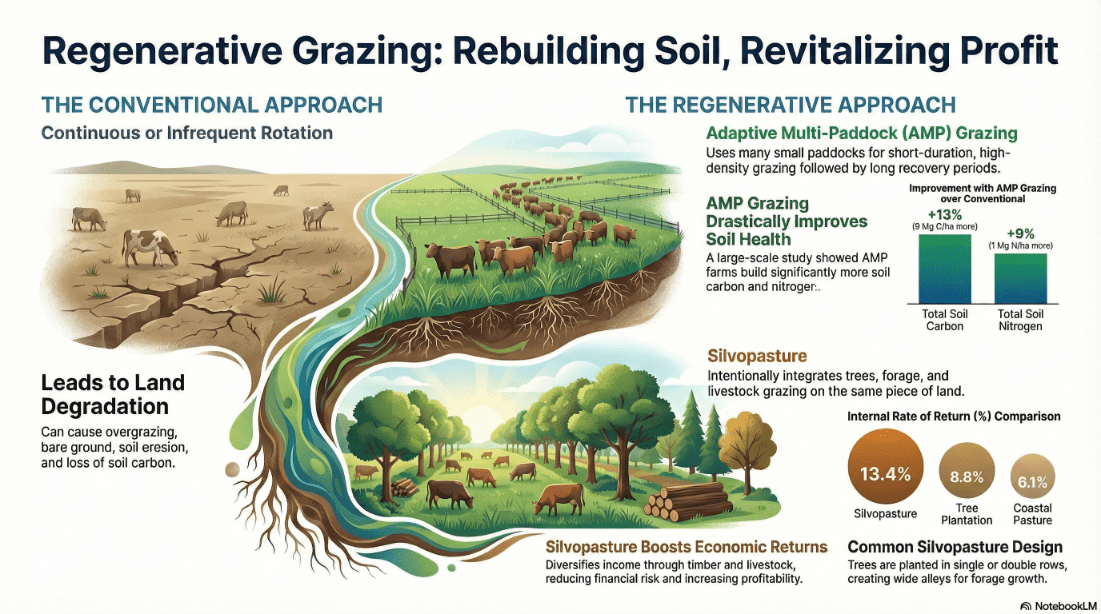
One of the most powerful findings from recent research is the significant and lasting impact of advanced grazing on soil health. At the forefront of this is a practice known as Adaptive Multi-Paddock (AMP) grazing, a system that uses short-duration, high-density grazing followed by long recovery periods for the pasture.
A large-scale scientific study of farms in the southeastern U.S. delivered a clear verdict: on average, AMP grazing sites stored 13% more soil carbon (an average of 9 Mg C ha-1) and 9% more soil nitrogen (1 Mg N ha-1) compared to neighboring conventionally grazed sites, measured down to a one-meter depth. This was achieved through superior management, not chemical inputs; in fact, none of the AMP farms in the study added synthetic nitrogen fertilizers, whereas some of their conventional neighbors did. The key mechanism is how the animals are managed: higher concentrations of cattle for shorter periods more evenly distribute the organic nitrogen from feces and urine, feeding the soil without overloading it.
What makes this finding so impactful is where that extra carbon is stored. The majority was found in the mineral-associated organic matter (MAOM) fraction. In simple terms, think of it as carbon being chemically “glued” to clay and silt particles, locking it away from the atmosphere for long periods. This isn’t a temporary boost; it’s a fundamental change in the soil’s structure and its capacity to contribute to climate change mitigation.
——————————————————————————–
2. It’s Not Just ‘Cows in the Woods’—It’s a Powerfully Diversified Economic Engine.
The term “silvopasture” often conjures a vague image of cows wandering in the woods. The reality is a far more disciplined and economically powerful system of agroforestry that strategically integrates livestock, forage, and forestry on the same piece of land. The primary goal is to produce high-value timber, like sawtimber from fast-growing Southern pines like Loblolly, in the long term, while generating consistent, short-term income from the livestock component.
The economic case is compelling. One analysis shows that a silvopasture system can have a significantly higher internal rate of return (13.4%) compared to a traditional pine plantation (8.8%) or an open coastal pasture (6.1%). By producing multiple products with different market cycles—annual income from grazing and long-term profits from trees—the system responds to different market pressures and significantly reduces a farm’s overall economic risk.
Beyond the direct income, a well-managed silvopasture system creates numerous “stacked benefits” that enhance the entire operation:
- Animal Welfare: Provides critical shade for livestock, which reduces heat stress.
- Environmental Health: Improves water quality and aids in erosion control.
- Biodiversity: Increases wildlife populations by creating valuable habitat for species like turkey and quail.
- Land Value: Enhances aesthetics and can increase overall property values.
The key to unlocking these benefits is intentional design. Success depends on strategic decisions about tree spacing, such as using single or double rows to create forage alleys, and careful canopy management to ensure enough sunlight reaches the pasture floor.
——————————————————————————–
3. More Roots Don’t Always Mean More Soil Carbon.
Here is one of the most counter-intuitive findings from the scientific study on grazing impacts. Researchers discovered that two of the five conventionally grazed farms had significantly more standing root carbon stocks than their AMP-managed neighbors. This seems to defy a common assumption: that more root biomass directly translates to more carbon being stored in the soil.
The study’s interpretation suggests the difference lies not in the quantity of roots, but in their quality and turnover. This process explains how AMP systems achieve the long-term carbon storage mentioned earlier. Researchers found that the organic matter in AMP systems had a lower carbon-to-nitrogen (C:N) ratio, a key indicator of higher-quality, more nutrient-rich food for soil microbes. This likely leads to a faster turnover of roots and other organic material, allowing microbes to more efficiently transform that carbon into the stable, mineral-associated soil carbon (MAOM).
In contrast, the higher root mass found in some conventional systems might represent a less efficient cycle. The roots may be slower to decompose and may not be forming stable soil organic matter as effectively. It’s a powerful lesson: in soil health, a fast and efficient recycling system is better than a big pile of raw materials that never gets processed.
——————————————————————————–
4. Serious Conservation Grazing is a Team Sport, Not a Solo Act.
Given the sophisticated soil science and long-term economic strategy involved in practices like AMP grazing and silvopasture, it’s no surprise that implementation has moved beyond the solo farmer. Success requires a formal, collaborative framework to create a science-based plan.
The USDA’s framework for a Grazing Management Plan illustrates this team-based approach. The key players include the participant (the farmer or landowner), a certified Technical Service Provider (TSP), and the Natural Resource Conservation Service (NRCS). This formal triad ensures that plans are grounded in federal conservation standards (NRCS), informed by certified expertise (TSP), and tailored to the practical realities of the landowner (participant).
This collaboration is part of a rigorous, multi-step planning process designed to ensure the best possible outcomes. It involves an on-site inventory of resources, the use of NRCS-approved assessment tools, and the development and evaluation of multiple alternatives—including a “no-action” alternative to provide a clear benchmark against which the benefits of any changes can be measured. The final result is not a simple recommendation, but a set of detailed deliverables, including maps, soil data, and a scheduled plan of conservation practices. This structured, team-based approach is crucial for making sure these advanced practices are successful, sustainable, and capable of meeting clear conservation and production goals.
——————————————————————————–
Conclusion: The Future of the Field
From the microscopic alchemy that turns root turnover into stable soil carbon, to the macroeconomic wisdom of diversifying income with silvopasture, and the institutional support that guides it all, modern grazing is a discipline of intentional, multi-scale design. The evidence demonstrates that these systems can build healthier and more climate-resilient soil, diversify farm income, and create a host of ecological co-benefits.
Seeing the proven potential for these systems to build healthier soil, diversify farm income, and contribute to a more resilient environment, the real question is: what will it take to make this the new standard for our working landscapes?