
In the dominant environmental discourse, the cow has been cast as a climate pariah. The data, at first glance, seems to justify the trial: livestock contribute more than one-third of all agricultural greenhouse gas emissions. Between the enteric methane produced during digestion and the carbon-intensive infrastructure of industrial feedlots, the “carbon footprint” of a steak is often presented as an insurmountable ecological debt.
But as an investigative journalist looking through an agroecological lens, I’ve found that this narrative ignores a vital nuance: the animal is not the problem; the system is. Emergent data suggests that by reimagining livestock as “biological up-cyclers” rather than mere industrial units, we can transform them from climate villains into essential tools for planetary cooling. Through the concept of regenerative agriculture—pioneered by figures like Gabe Brown and rigorously studied at White Oak Pastures—we are discovering that the secret to a stable climate may involve a partnership with the very animals we’ve been told to eliminate.
The “Negative-Carbon” Steak: When Beef Becomes a Sink
The most disruptive evidence against the “villain” narrative comes from a comprehensive whole-farm life cycle assessment (LCA) conducted at White Oak Pastures (WOP) in Georgia. Researchers scrutinized a Multi-Species Pasture Rotation (MSPR) system—a sophisticated model where cattle, sheep, poultry, and pigs are symbiotically “stacked” on the same landscape.
The findings were a radical departure from conventional wisdom: the MSPR system reduced net greenhouse gas emissions by 80% compared to conventional commodity models. Most strikingly, when soil carbon sequestration was integrated into the LCA, the beef produced in this system acted as a net sink, sequestering -4.4 kg CO2-e per kg of carcass weight annually. In this context, the act of raising cattle actually removes more carbon from the atmosphere than the animals emit.
This shift requires moving away from what Gabe Brown calls the “conventional treadmill”—a mindset obsessed with extraction. As Brown reflects in his book, Dirt to Soil:
“I chased higher yield when growing crops and more pounds when raising beef. Everywhere I turned, the message of increasing production was pounded into me… everyone was telling me that I had to produce more ‘to feed the world.’… It is the same with livestock… all designed to produce more, more, more!”
Soil as a Super-Sponge: Beyond Just “Dirt”
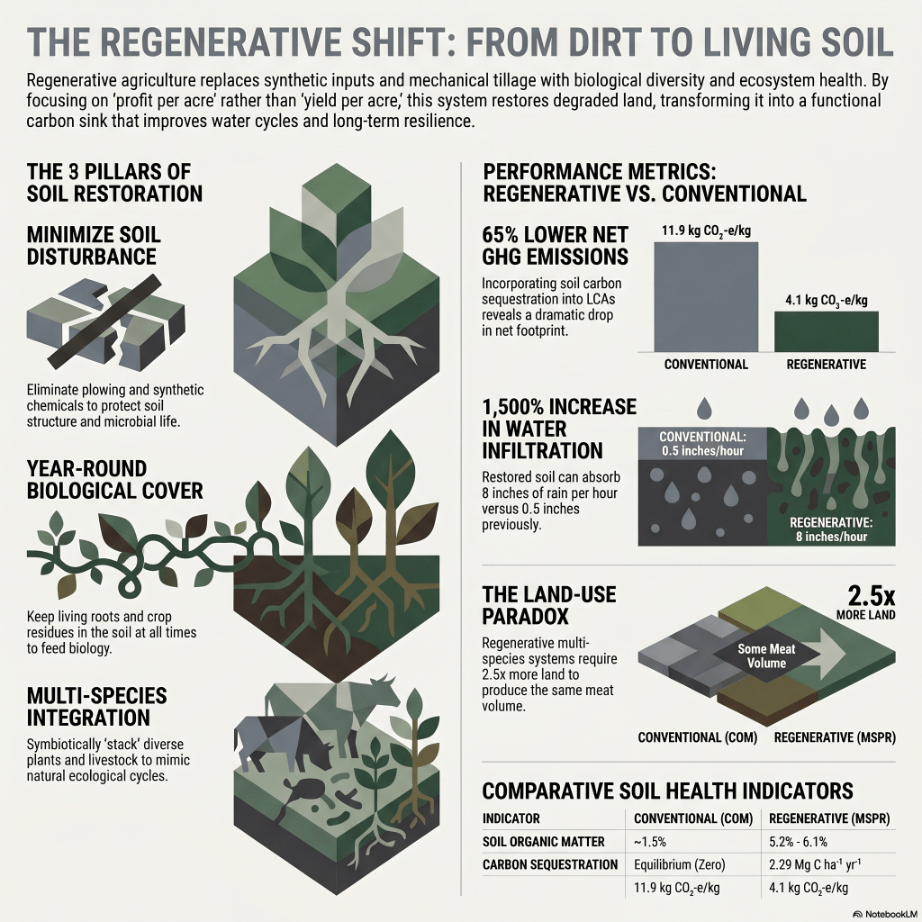
The engine of this carbon-negative steak is the soil. To understand this transition, researchers often use a “space-for-time substitution,” comparing degraded plots to those that have undergone years of regeneration. At Gabe Brown’s ranch in North Dakota, the results of this biological restoration are stark: his regenerative fields have achieved 6.9% organic matter, a massive leap from the 1.5% to 1.7% found on neighboring conventional farms.
This organic matter creates what agroecologists call a “super-sponge.” In a miracle of soil physics, Brown has increased his land’s water infiltration rates from a mere 0.5 inches per hour to a staggering 30 inches per hour. When the soil can absorb several feet of rain in sixty minutes, the farm becomes functionally immune to the erosion and runoff that devastate conventional operations during extreme weather. This is climate resilience in its most literal, grounded form.
The “Profit per Acre” Trap: A Narrative of Absence
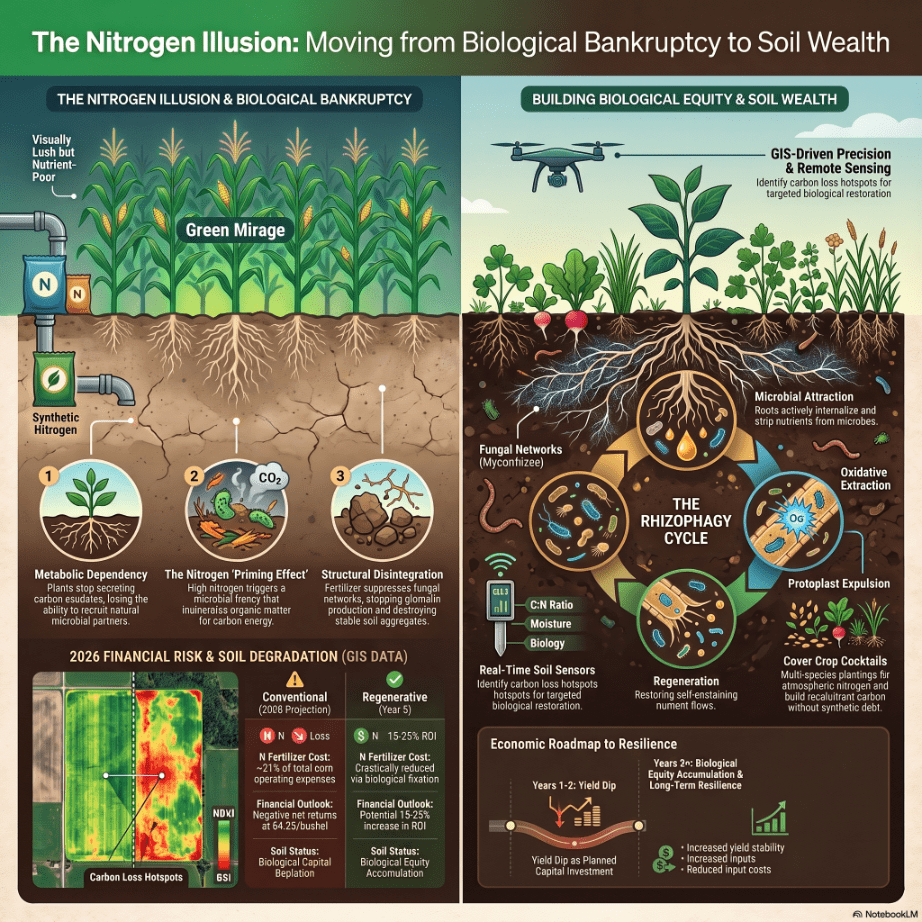
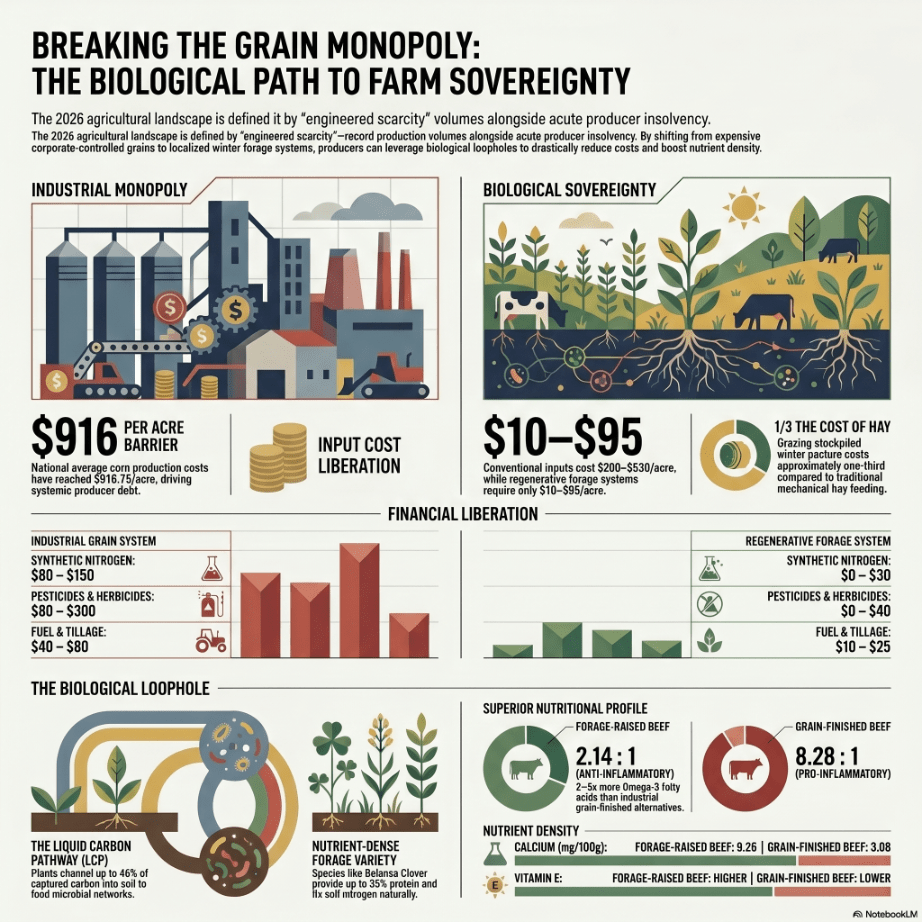
In the conventional model, a farmer’s success is measured by the sheer volume of “yield per acre,” a metric that often masks deep financial fragility. Gabe Brown’s pivot toward “profit per acre” reveals a liberating truth: by letting the ecosystem perform the labor, the farmer can step off the treadmill of expensive synthetic inputs.
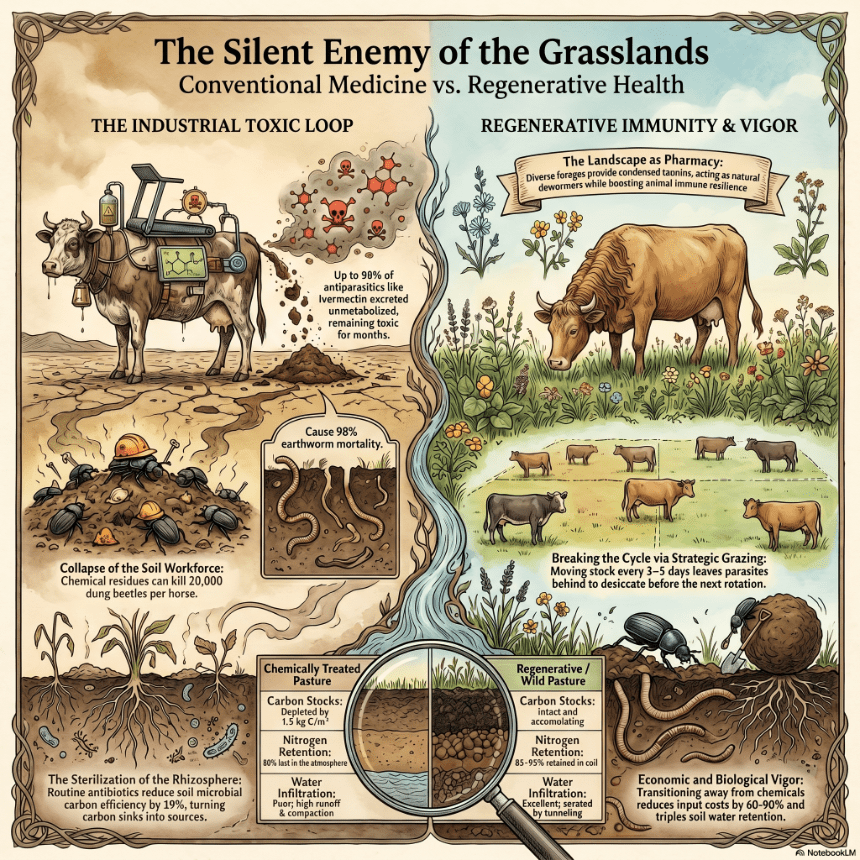
In a truly regenerative system, one notices a profound silence—the absence of the tractor’s hum and the syringe’s needle. There is no need for the mechanical application of synthetic fertilizers, pesticides, or fungicides, as the soil’s own biology provides the necessary nutrients and defense. The labor of hauling manure from corrals is replaced by the animals themselves, who distribute fertility as they graze. Even the winter chore of hauling feed is mitigated by managed grazing techniques. By honoring ecological resources rather than chasing short-term gain, these farms remain profitable even if their total volume of meat is lower than that of an intensive industrial operation.
Agromutualism and the “Stacked” Enterprise
This self-regulating success is driven by “Agromutualism”—the strategic stacking of enterprises to create biological synergy. This isn’t just a collection of different animals; it is a calculated mimicry of natural ecosystems.
Agromutualism operates on five core principles: limiting mechanical and chemical disturbance, keeping soil covered, maintaining living roots year-round, increasing species diversity, and integrating animals. In practice, this looks like a choreographed dance: cattle graze the tall grasses, followed by sheep that prefer different forages, and finally, poultry. The chickens act as the ecosystem’s sanitizers, scratching through manure to eat fly larvae—thereby reducing parasite loads for the ruminants—while adding high-nitrogen fertilizer back to the earth. This turns “waste” into high-quality protein and soil health.
The Land-Sharing Paradox
However, the transition to these ecologically functional systems presents a significant “Catch-22.” The White Oak Pastures study identified a clear land-use tradeoff: the regenerative MSPR system required 2.5 times more land than conventional commodity systems to produce the same volume of meat.
This brings us to a high-level policy debate: Land-sparing vs. Land-sharing.
- Land-sparing (The Industrial Model): Produces maximum food on a minimal footprint, but leaves behind a degraded, chemical-dependent landscape.
- Land-sharing (The Regenerative Model): Produces less food per acre but restores the land’s ability to sequester carbon, filter water, and host biodiversity.
This is a profound societal choice. Do we prioritize a smaller footprint on a dying planet, or a larger footprint on a living one?
Methane Math and the Closed Carbon Loop
A critical point of investigative rigor involves the “Methane Math.” Methane is a potent but short-lived gas, persisting in the atmosphere for about a decade. In contrast, carbon dioxide is a “permanent pollutant” that accumulates over centuries.
Crucially, the methane from a cow is part of a biogenic closed carbon loop. Through photosynthesis, plants pull CO2 from the sky; the cow eats the grass, releases methane, and within ten years, that methane oxidizes back into CO2, which the grass then re-absorbs. No new carbon is added to the atmosphere, unlike the ancient carbon released by burning fossil fuels.
To reflect this reality, scientists are increasingly using GWP* (Global Warming Potential Star). Unlike standard metrics, GWP* measures the rate of change in emissions rather than just cumulative mass. It accounts for the “thermal adjustment” of the climate, showing that a stable herd of cattle does not cause additional ongoing warming in the same way that a constant stream of CO2 does.
According to modeled benchmarks from the New Zealand Climate Change Research Institute, this warming can be completely neutralized through forestry. To offset the warming effect of one animal, a farmer could plant:
- 0.63 ha of pine plantation for a dairy cow.
- 0.40 ha for a beef cow.
- 0.08 ha for a sheep.
Because a fixed area of forest sequesters carbon up to a limit, it serves as a perfect physical mirror to the stabilized warming effect of a constant herd.
Conclusion: The Managerial Frontier
The shift from seeing farming as an intervention to seeing it as a partnership with nature is no longer just a romantic ideal—it is a data-driven necessity. While the transition costs are often cited as a barrier, research from the Kellogg Biological Station (KBS) LTAR in Michigan suggests these costs are “tractable.” While initial profits may dip as the land heals, the gap narrows rapidly as input costs evaporate and the yields of alternative crops stabilize.
The primary barrier to entry is not financial; it is psychological and managerial. It requires a fundamental change in how we perceive the land. As we move forward, we must answer a pressing question: Should we value a system that produces the most food on a degrading land base, or a system that produces less food on an ecologically functional one? The negative-carbon steak suggests that if we choose the latter, we may find the tools we need to save the planet were right under our feet—and on four legs—all along.