
1. Introduction: Navigating the 2026 Sheep Market
The broader agricultural landscape is currently navigating a “generational downturn” in farm income. Net farm income for 2026 is projected to settle at $153.4 billion, a figure significantly suppressed by record-high production expenses and a contraction in crop receipts. However, the sheep and lamb sector has emerged as a point of notable resilience. While traditional western rangeland operations face significant headwinds, the Midwest and East are seeing growth driven by non-traditional consumer demand and diversified revenue streams.
Initial 2026 planning budgets were constructed using conservative price baselines, yet early 2026 market realities have surged past those expectations. This outlook provides a professional financial breakdown for sheep producers, utilizing the 2026 Missouri Planning Budget and American Sheep Industry (ASI) benchmarks to guide strategic operational decisions in a volatile market.
2. The Cost of Doing Business: 2026 Operating Expense Breakdown
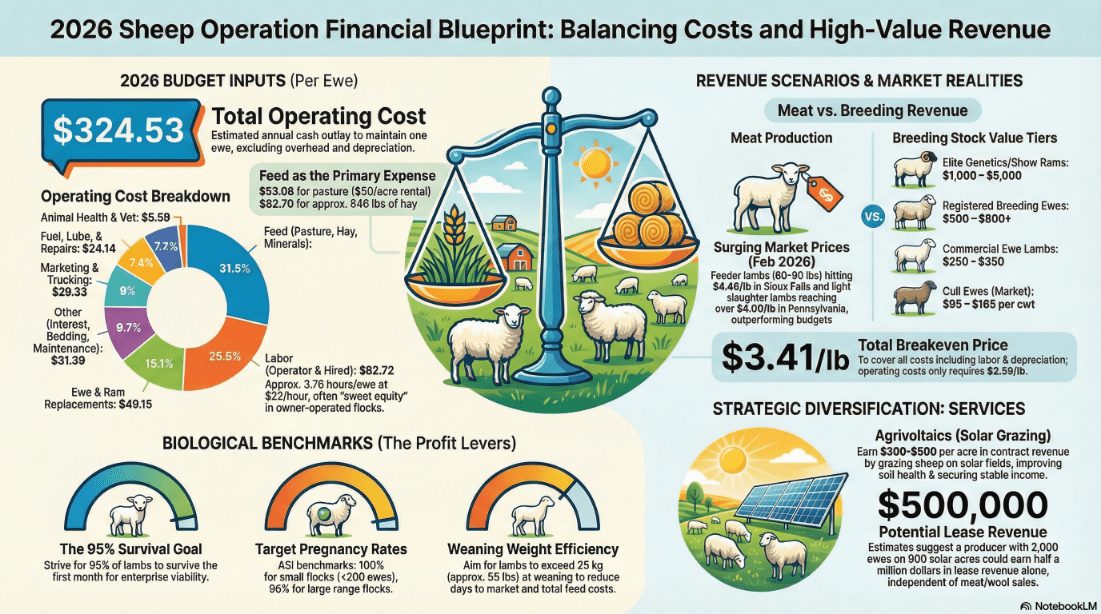
A rigorous understanding of the cost architecture is the first step toward enterprise liquidity. For a 50-ewe hair sheep flock utilizing a spring-lambing system, operating expenses are primarily driven by nutrition and labor. The following table identifies the specific cash and non-cash inputs required to maintain the flock, based on the Missouri 2026 Sheep Planning Budget.
Estimated Operating Costs Per Ewe (2026)
| Expense Category | Cost Per Ewe (Annual) |
| Feed (Pasture, Hay, Supplements, Minerals) | $102.21 |
| Labor (Operator and Hired at $22.00/hour) | $82.72 |
| Replacements & Breeding (Ewe replacements and Ram costs) | $49.15 |
| Machinery & Infrastructure (Fuel, Lube, Repair, Maintenance) | $28.04 |
| Livestock Services (Guard dog replacement/food, Marketing/Trucking) | $42.88 |
| Animal Health & Supplies (Vaccines, Deworming, Bedding) | $8.84 |
| Operating Interest (7.25%) | $10.70 |
| Total Operating Costs | $324.53 |
(Note: While owner-operators often treat the $82.72/ewe labor cost as “sweat equity,” underestimating these non-cash costs is a primary driver of the high failure rate seen in new sheep ventures during their first five years. To achieve true economic profitability, these costs must eventually be covered by revenue.)
3. Revenue Scenario 1: Meat Production and Market Surges
For commercial meat-based operations, profitability is determined by balancing biological output against market price volatility. Based on a 180% lambing rate, the baseline projected income over operating costs is $94.41 per ewe. However, current market conditions have significantly shifted the margin potential.
The Breakeven Reality:
- To cover cash operating costs: A market price of $2.59/lb is required.
- To cover total costs (including Labor, Overhead, and Depreciation): A market price of $3.41/lb is required.
Market Update: February 2026 Actuals Conservative budgets used a 3.11–3.48/lb baseline, but early February trades show a robust surge in value:
- Sioux Falls Feeder Lambs: 445.95 per cwt (**4.46/lb**).
- New Holland, PA Light Slaughter Lambs: 407.94 per cwt (**4.08/lb**). Notably, this represents a 47% year-over-year increase from the previous year’s $2.77/lb.
- Mt. Hope, Ohio Slaughter Lambs: 435.34 per cwt (**4.35/lb**).
4. Revenue Scenario 2: The Breeding Stock and Cull Market
Market intelligence indicates a looming shortage in breeding capacity. The national ram inventory saw a staggering 30% reduction to just 160,000 head in 2025. For producers focusing on elite genetics, this inventory gap justifies premium pricing for registered stock.
Breeding Stock Value Ranges:
- Commercial Ewe Lambs: $250 to $350 per head.
- NSIP-Recorded Katahdins & Registered St. Croix: $300 to $800.
- Elite Registered Genetics (Type 5 Dorpers): $1,000 to $1,500+.
Furthermore, the “Cull Revenue” stream is outperforming baseline estimates. While budgets might conservative-model cull revenue at ~27.13 per head, early 2026 market data shows cull ewes fetching between **95 and 165 per cwt**. Even slaughter rams (bucks) are showing strength, averaging between **106.99 and $129.38 per cwt**, providing a valuable cash-flow buffer during flock turnover.
5. Maximizing Profitability: KPIs and Efficiency Benchmarks
Financial resilience in the 2026 sheep market is inextricably tied to biological efficiency. To meet the $94.41/ewe margin, operations must hit specific Key Performance Indicators (KPIs).
ASI Benchmarks for Success:
- Pregnancy Rate: Target 100% for small flocks (<200 ewes) and 96% for large range operations.
- Lambing Percentage: Aim for 180% for non-prolific breeds (e.g., Rambouillet) and up to 240% for prolific breeds (e.g., Polypay/Finnish Landrace).
- Lamb Survival: A non-negotiable goal of 95% survival through the first month, where the majority of mortality typically occurs.
The most critical metric for any consultant to track is “Total Pounds of Lamb Weaned per Exposed Ewe.” This single figure accounts for reproductive success (twinning), maternal ability (milk production), and lamb vigor/mortality simultaneously, making it the most accurate predictor of gross margin.
6. Strategic Outlook: Agrivoltaics and Hair Sheep
Service-based revenue is the strongest hedge against commodity price drops in the 2026 landscape. Solar Grazing (Agrivoltaics) offers high-margin vegetation management contracts. While solar companies typically pay professional mowing businesses approximately 480 per acre**, sheep producers can competitively bid at **300 to $500 per acre. This allows the flock to generate significant lease revenue while still producing a marketable meat crop.
Complementing this service-based model is the continued shift toward Hair Sheep (Katahdin and Dorper). By eliminating shearing and wool handling costs—which often exceed the value of the clip for coarser grades—these breeds significantly reduce the labor burden, which is the defining challenge for 2026 operations.
7. Conclusion: The Path to Breakeven
Producers must view a sheep enterprise as a long-term capital play. Financial modeling shows a 62-month operational breakeven timeline, with full capital recovery often taking up to 10 years. New operations face a significant “EBITDA gap” in their first few cycles, where variable costs like supplemental feed (often 80% of revenue) and processing/packaging (up to 95% of revenue) can exceed initial income by 175%.
Expert Takeaway: Success in 2026 depends on balancing conservative cash-flow management with the agility to capture high-value niche opportunities.
- Watch the Cash Burn: Account for the “sweat equity” of owner-operator labor to avoid a five-year failure trap.
- Diversify Revenue: Look to solar grazing contracts and the registered breeding market to offset meat price volatility.
- Select for Performance: Use Type 5 or NSIP-recorded genetics to maximize pounds of lamb weaned per ewe.
As you plan your start-up capital for fencing, water systems, and shelter, remember that efficiency—not just inventory—is the key to surviving the early cash-burn phase and achieving long-term stability.