
This briefing document synthesizes data concerning the regulatory, environmental, and behavioral complexities of maintaining small-scale livestock—specifically ducks, chickens, and goats—within residential environments. It contrasts municipal zoning frameworks with private Homeowners Association (HOA) restrictions while detailing the technical requirements for waste management and biosecurity.
1. Regulatory Frameworks and Governance
The integration of livestock into residential zones is governed by a tiered system of authority, often involving conflicting regulations between municipal codes and private covenants.
Municipal Zoning: The Dallas Model
Under the City of Dallas Use Regulations (Division 51A-4.200), agricultural activities are strictly categorized. “Animal production” is defined as the commercial raising of animals, including poultry and fish. Key provisions include:
- Districts Permitted: Agricultural uses are allowed by right in A(A) districts and by Specific Use Permit (SUP) in non-residential districts.
- Setbacks: Animals must be maintained at least 20 feet from an adjacent property line. Alleys and public rights-of-way can be used to calculate this distance.
- Urban Gardens: In residential districts, urban gardens containing animals must provide a non-illuminated sign (maximum six square feet) featuring an emergency contact and the Dallas 311 city services information.
- Specific Use Permits (SUP): These permits may include requirements for site plans, operations plans, and even performance bonds to ensure site reclamation.
Private Governance (HOAs)
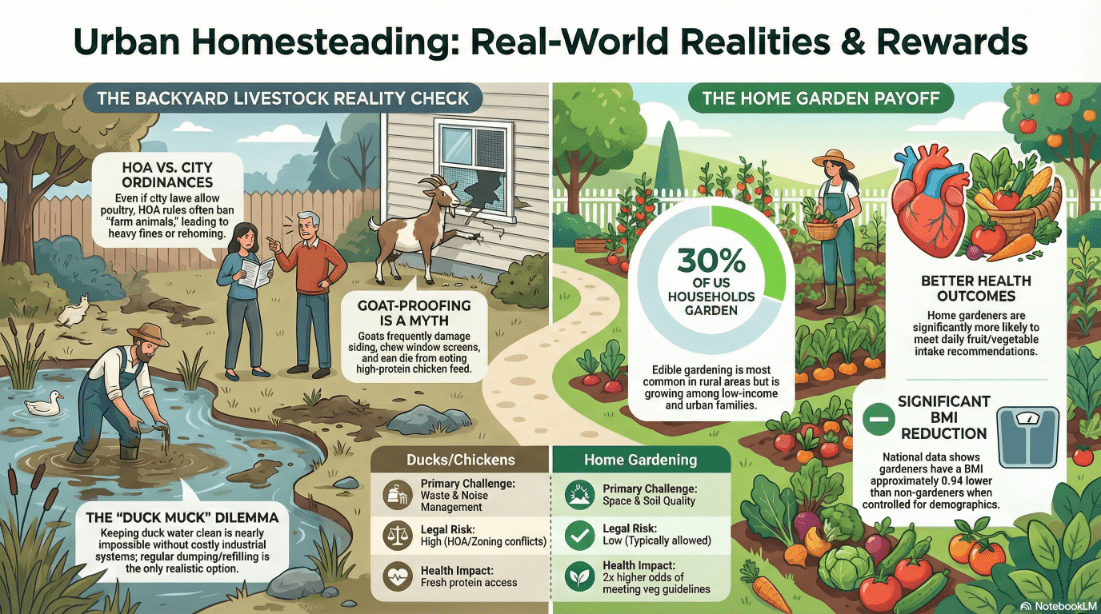
Homeowners Associations frequently impose more stringent restrictions than city ordinances. While a city may allow up to six chickens, an HOA “no farm animals” clause typically supersedes municipal permissions.
| Conflict Area | City/County Perspective | HOA Perspective |
| Categorization | May view chickens as permissible urban agriculture. | Typically classifies chickens as “livestock” or “fowl,” not “pets.” |
| Enforcement | Generally complaint-based or focused on setbacks. | Fines ( daily), warning letters, and potential foreclosure on property. |
| Legal Standing | Allows for “forgiveness” via minor amendments or SUPs. | Rarely offers “forgiveness”; usually requires culling or rehoming. |
Important Insight: Legal experts and former HOA attorneys warn that even if a current board is lenient, annual elections can install new members who enforce rules strictly, leading to “thousands of dollars” in fines.
2. Waste Management and Biosecurity in Water Systems
Maintaining biosecurity is most challenging with waterfowl due to their physiology and waste production. Ducks are noted for defecating immediately upon entering water, creating “duck muck” that is difficult to filter.
Filtration and Treatment Strategies
The source context identifies several technical approaches to managing duck pond water without the environmental cost of daily draining and refilling.
- The “Dump and Refill” Method: The most common approach. For 5–10 ducks, weekly cleaning is standard; for 30–50 ducks, refills are required every few days.
- Mechanical/Aquarium Filtration: Requires a pump with a Gallons Per Hour (GPH) rate 2–3 times the pond size. Multistage filters using coarse/fine sponges, bio-media, and UV sterilizer lights are necessary.
- Biological “Bog” Filters: Utilizing a pump to move water through gravel beds containing aquatic plants. This “maintenance-free” approach harnesses biology to clean water but requires a footprint 2–3 times larger than standard recommendations due to high nitrogen loads.
- “Duckquaponics”: A hybrid model using a radial flow settler to separate solids, which then flow into plant grow beds (e.g., lettuce, strawberries) before returning to the pond.
Maintenance Tools
| Tool | Function |
| Sump/Utility Pump | Facilitates rapid drainage and can be connected to sprinklers to use nutrient-rich waste water for lawn irrigation. |
| Fine Mesh Pool Net | Essential for daily removal of feathers and large debris to prevent pump clogging. |
| Pea Gravel/Sand | Placed at the bottom of ponds to trap sediment and prevent waste from being constantly stirred up by animal activity. |
3. Behavioral Dynamics and Property Impacts
Integrating goats and poultry into suburban yards introduces significant behavioral challenges that can lead to property damage and neighborhood friction.
Destructive Behavior and Fencing
Goats are characterized as “clever, destructive, and persistent.” Owners report the following impacts on residential property:
- Structural Damage: Goats often chew on wooden siding, window screens, and door frames. They may stand on windowsills or air conditioning units.
- Landscape Destruction: Adult goats can destroy mature trees and all ornamental plants within 48 hours unless protected by “goat-proof” fencing.
- Waste Distribution: Unlike horses, goats “don’t even think about pooping”; waste is deposited continuously across porches, patios, and outdoor furniture.
- Fencing Requirements: A 6-foot vinyl privacy fence may be insufficient for larger breeds like Nubians (reaching 200 lbs), who can flex or “blow out” panels by rubbing or headbutting. Electric strands are often the only “foolproof” solution.
Noise and Nuisance Mitigation
Noise is a primary driver of neighbor complaints and HOA enforcement.
- The “Egg Song”: Hens produce a “piercing” squawk after laying eggs.
- Distress Calls: Chickens scream at perceived threats, including airplanes, hawks, or boredom.
- Goat Vocalization: Goats will “scream” when they find their owners through windows or want attention.
- Breed Selection: While Silkies are noted as “quiet,” they still participate in egg songs. Large breeds like Brahmas are described as exceptionally loud, contrary to some online descriptions.
4. Interspecies Management and Biosecurity Risks
The coexistence of different species (e.g., goats and chickens) requires specific management of dietary and predatory risks.
- Toxic Feed Issues: Goats are highly attracted to chicken feed (“like crack addicts”). Consuming it can lead to fatal bloat within hours. Management requires “mind-bending” security or weight-activated doors to keep goats out of poultry areas.
- Predator Management: While 6-foot fences exist, they do not stop raccoons, hawks, owls, or eagles. Livestock Guardian Dogs (LGDs) like Great Pyrenees are effective, but “pet” dogs (e.g., Labs or Hounds) may inadvertently kill the poultry they are meant to protect.
- Parasite Transfer: Caution is advised regarding potential parasite transmission between goats and chickens sharing the same yard.
5. Socio-Economic and Health Outcomes
A national cross-sectional survey indicates that “home gardening” (inclusive of edible plants) is a significant predictor of positive public health outcomes.
Key Demographics and Statistical Findings
- Prevalence: Approximately 30% of U.S. households engage in home gardening.
- Profile of Gardeners: More likely to be White or Asian, employed, higher income, married, and living in rural or semi-urban areas.
- Health Correlations: Gardeners are significantly less likely to be obese and more likely to meet dietary recommendations for fruit and vegetable intake.
- Social Capital: The presence of a home garden is associated with higher neighborhood social capital and strengthened community connections.
Home Gardening as an Intervention
Research suggests that home gardens are an effective strategy for the “food justice movement” because they bypass barriers to community gardens (e.g., high property values, waiting lists, and transportation issues). For low-income households, these gardens reduce the need to purchase vegetables and allow for the continuation of cultural food practices.
——————————————————————————–
Quotes of Note:
- “The minute [ducks] get in, they will take a shit. The only way you’re going to keep a pool like that clean is to have new water coming in and old water going out.”
- “Chickens are not quiet and most certainly not tidy… all it takes is just one motivated neighbor to run for election and impose literal thousands of dollars on you.”
- “Goats are like crack addicts when it comes to chicken food and will do anything they can to get to it. If they eat too much they will die in a few hours from bloat.”