
1. Introduction: Why Grass Identification Matters for Your Land
Accurate grass identification is the baseline for a successful livestock operation. For Oklahoma landowners and ranchers, the ability to tell one species from another is about more than just botany; it is the key to maximizing pasture and hay production while ensuring livestock receive the highest forage quality. Without proper identification, you cannot perform an accurate forage quality analysis or protect your herd from the threat of poisonous species. This guide is designed to help you master the “vegetative landmarks” of your land, providing you with the expert tools needed to manage your resources effectively and build long-term productivity.
2. The Botanist’s Toolkit: Key Vocabulary for Identification
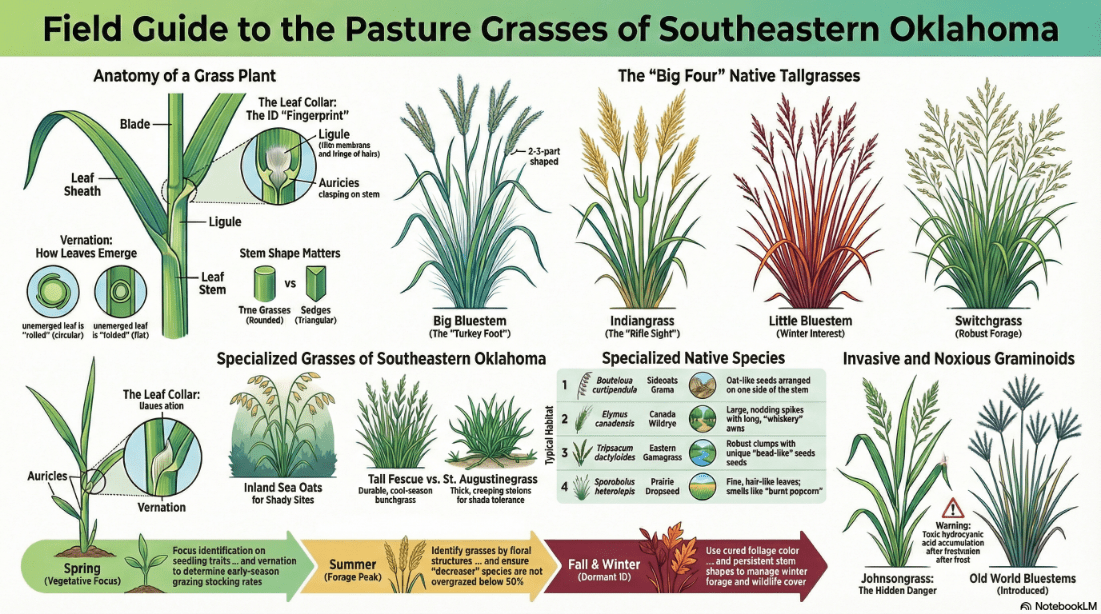
Identifying grasses requires a precise vocabulary. When you are in the field, look for these specific regions and structures to differentiate between species.
| Term | Definition |
| Poaceae | The botanical family encompassing all true grass plants (over 11,000 species). |
| Monocotyledonous | A group of flowering plants (monocots) characterized by having a single cotyledon. |
| Blade | The broad, flat upper portion of the leaf that extends away from the stem. |
| Sheath | The lower part of the leaf that wraps around and encloses the stem. |
| Collar | The transition zone where the leaf blade meets the leaf sheath. |
| Ligule | A small structure on the inside surface of the leaf at the junction of the blade and sheath. |
| Auricles | Small, claw-like projections in pairs where the leaf blade meets the sheath. |
| Node | The swollen “joint” of a grass stem where leaves and branches originate. |
| Glabrous | A surface that is smooth and completely lacking any hair. |
| Pubescent | A surface characterized by the presence of hair. |
Field Instruction: Focus your attention on the collar region; the combination of the ligule and auricles provides the most reliable “vegetative handshake” for identifying a grass before it ever produces a seed head.
3. The Foundation: Stems, Sheaths, and Nodes
Distinguishing True Grasses
The first step is ensuring you are looking at a member of the Poaceae family. True grasses typically have stems that are rounded or flat in cross-section and are usually hollow. In contrast, sedges (Cyperaceae), which frequently invade wet Oklahoma pastures, have distinctly triangular stems. Remember the old adage: “Sedges have edges.”
Stem and Node Anatomy
A grass stem acts as the structural axis of the plant. It is divided into nodes and internodes:
- Nodes: These are the swollen joints. They can be glabrous (smooth) or pubescent (hairy).
- Shapes: Stems are typically rounded, but some species like barnyardgrass or rescuegrass have noticeably flat stems.
- Textures: Surfaces range from entirely smooth to densely hairy, providing a tactile clue for identification.
The Leaf Sheath
The sheath supports the stem and protects developing leaves.
- Overlapping Non-Fused Sheaths: The margins of the leaf wrap around the stem and overlap but are not joined together.
- Fused (Closed) Sheaths: The margins are grown together into a continuous tube.
- Key Marks: Note the color (which often differs from the blade) and the presence or absence of a midrib.
4. The Identification “Handshake”: The Leaf Collar Region
The leaf collar is the transition zone where the blade meets the sheath. It provides flexibility for the leaf to move in the wind while maintaining structural integrity.
Ligule Types
The ligule acts as a seal, preventing water and debris from entering the space between the sheath and the stem. There are three main types:
- Membranous: A thin, clear, or white tissue. These may be rounded, pointed, or even look irregularly “torn” like a piece of paper.
- Hairy: A fringe or row of distinct hairs.
- Absent: Some species, notably barnyardgrass, lack a ligule entirely.
Auricle Characteristics
Auricles wrap around the stem to provide additional support to the leaf blade:
- Clasping: Large, “arm-like” projections that wrap around the stem, nearly meeting on the other side (typical of wheat).
- Small or Claw-like: Subtle bumps or small hooks at the base of the blade.
- Absent: Many grasses lack these structures entirely.
5. Species Spotlight: Key Oklahoma Forages
Indiangrass (Sorghastrum nutans)
A native perennial and a pillar of the Oklahoma tallgrass prairie, Indiangrass is a high-protein summer forage.
- Habit: Tall, native warm-season perennial.
- Foliage: Distinctive blue-green leaves.
- Ligule/Auricles: Features a ciliate membrane ligule and prominent “rabbit ears” or “gun sight” upright auricles.
- Stems: Characterized by noticeably hairy nodes.
- Management Note: Indiangrass is a “decreaser” species, meaning it is intolerant of repeated close grazing and will disappear from a pasture if overmanaged.
Switchgrass (Panicum virgatum)
This robust bunchgrass is famous for its massive root system and versatility.
- Habit: Perennial bunchgrass with scaly rhizomes and roots that can exceed 10 feet in depth.
- Ecotypes: Oklahoma growers should distinguish between Lowland ecotypes (taller, found in wet soils, less cold-hardy) and Upland ecotypes (shorter, more cold-tolerant, adapted to drier sites).
- Ligule: The primary ID mark is a densely hairy ligule of silky hairs.
- Usage: Used for forage, biofuel, and riparian buffers.
- Local History: The Caddo Indian tribe historically used switchgrass to construct houses and ceremonial structures that could last 50 years.
Quick-Reference Identification Table
| Species | Stem Shape | Ligule Type | Auricles | Key Identification Tip |
| Barnyardgrass | Flat | Absent | Absent | Look for the unique lack of any ligule. |
| Wheat | Rounded | Membranous | Clasping | Features “arm-like” auricles and a hairy collar. |
| Rye | Rounded | Small, serrated | Present | Look for a hairy (pubescent) sheath. |
| Oat | Rounded | Pointed, membranous | Absent | A very smooth collar region with a pointed ligule. |
| Rescuegrass | Flat | Long, pointed, split | Absent | The ligule is split, resembling a piece of torn paper. |
6. Practical Management & Land Stewardship
Forage Value and Timing
To maximize nutrition, you must time your management with the plant’s life cycle. Indiangrass is highly palatable in the summer, providing excellent protein and Vitamin A. However, it cures poorly and is only fair forage in winter. To improve digestibility, a spring burn is recommended between April 1 and April 15. You can identify the optimal time by looking for the emergence of the previous year’s large, hairy, coppery-colored seed heads.
Environmental Benefits
The deep root systems of switchgrass (reaching over 10 feet) make it a powerhouse for drought recovery and carbon sequestration, moving carbon deep below the plow line. Its stiff stems also make it an ideal buffer for trapping dust, odors, and ammonia around poultry or swine facilities.
Establishment and Weed Management
- Planting: For switchgrass, wait until soil temperatures are above 60°F. In colder northern Oklahoma counties, planting slightly earlier can provide natural stratification, helping to break seed dormancy.
- Depth: Plant seeds no deeper than 1/4 to 1/2 inch into a firm seedbed.
- Chemical Control: Weed management is vital during the establishment year. When using herbicides, always remember that the label is the law. Consult your Extension office for specific herbicide recommendations to ensure safety and efficacy.
7. Conclusion: Building a Resilient Pasture
Mastering the identification of species like Indiangrass and Switchgrass allows you to make precise decisions about grazing rotations and prescribed burns. Recognizing these plants in their vegetative state ensures you can protect “decreaser” species and maintain a healthy, diverse forage base.
For specific cultivar recommendations, soil testing services, or updated herbicide guidelines, contact your local County Extension office. Professional expertise combined with your own field identification is the best way to ensure your land remains a productive asset for generations to come.