
1. Introduction: The False Promise of Infinite Growth
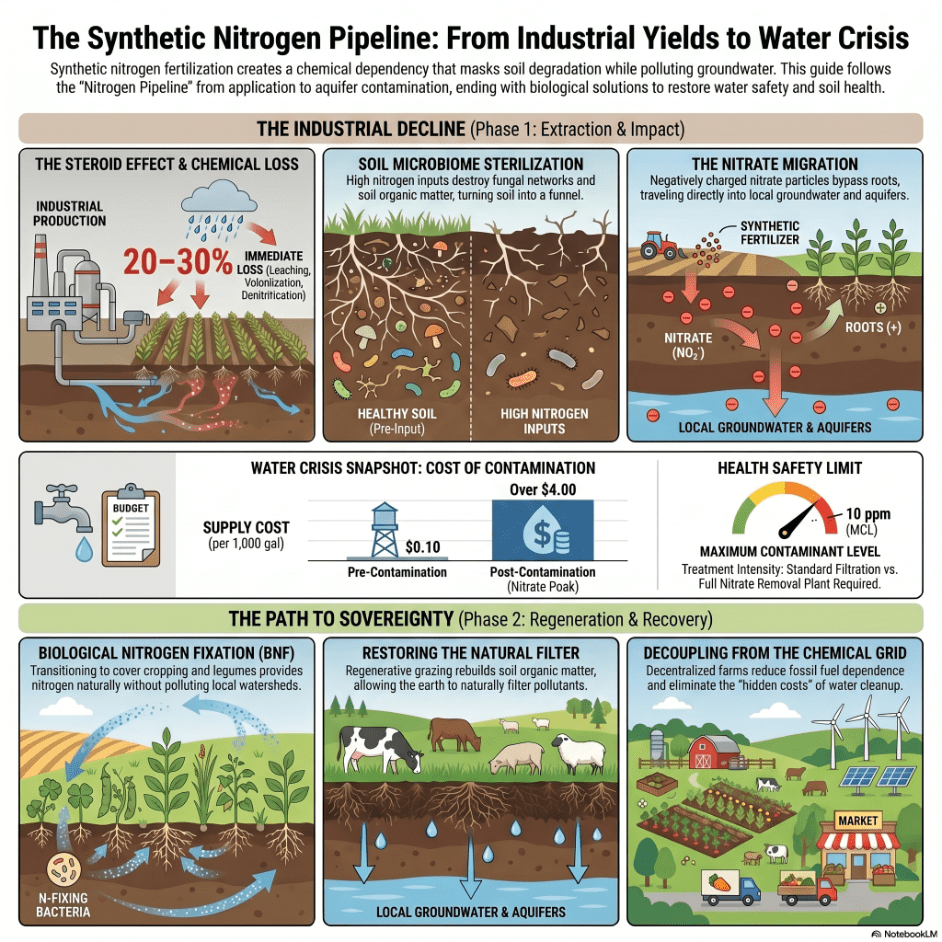
As we assess the agricultural landscape of 2026, the record-breaking crop yields of 2025—delivered by the heavy application of nitrogen synthesized via the Haber-Bosch process—have begun to show their true cost. While synthetic fertilizer enabled the Green Revolution and currently supports nearly half the world’s population, we are now facing the “paradox of nitrogen.” Like an ecological steroid, mineral nitrogen provides a temporary surge in productivity while simultaneously triggering soil acidification and stripping plants of their natural ability to recruit beneficial microbes.
A critical nuance of this paradox lies in modern crop breeding. High-yielding cultivars developed during and after the Green Revolution were bred in high-input environments where mineral nitrogen was always abundant. Consequently, these plants have inadvertently “lost” the genetic capacity to recruit and maintain the complex bacterial and fungal communities in the rhizosphere that their ancestors relied upon for nutrient cycling.
A Brief History of Nitrogen
- “White Gold” (19th Century): Before industrial synthesis, global agriculture relied on guano—nitrogen-rich fossilized seabird excrement. This “white gold” fueled a temporary surge in yields but was a finite resource that ultimately faced a supply crisis.
- The Haber-Bosch Revolution (1913): Chemists Fritz Haber and Carl Bosch developed a fossil-fuel-intensive process to synthesize ammonia by combining atmospheric nitrogen (N₂) and hydrogen (H₂) under high pressure. This breakthrough untethered agriculture from natural ecological limits but created a deep reliance on natural gas and industrial infrastructure.
——————————————————————————–
2. The Silent Migration: How Nitrates Enter Our Aquifers
The movement of nitrogen into our water systems follows a “Source, Pathway, Receptor” model. Understanding these dynamics is essential for watershed management.
- Source: Nitrogen enters the system via synthetic fertilizers (specifically Calcium Ammonium Nitrate (CAN) and urea), animal slurry, and livestock deposits.
- Pathway: Dissolved nitrogen moves through leaching—the downward movement of nutrients with percolating water. This is most prevalent in free-draining or sandy soils.
- Receptor: The destination is our groundwater, which feeds rural wells and eventually estuaries.
A significant challenge in managing this migration is the Time Lag. In free-draining areas, nitrate can move from soil to water in months. However, in moderately drained areas, this journey can take up to several decades. The contamination we measure in 2026 is often the legacy of nitrogen management decisions made twenty years ago.
Comparison of Nitrogen Mobility
| Form of Nitrogen | Charge | Mobility and Stability | Management Note |
| Nitrate (NO₃⁻) | Negative | Highly mobile and soluble; does not bind to the soil matrix. | CAN provides a large, immediate pool of nitrate at high risk of leaching. |
| Ammonium (NH₄⁺) | Positive | Stable; binds to negatively charged soil particles like a magnet. | Protected Urea converts to ammonium, acting as a “conveyor belt” for steady delivery. |
In 2026, rural well data shows nitrate concentrations frequently exceeding the 10 ppm health standard. This is a direct risk for anoxia (internal suffocation), or “blue baby syndrome,” in infants. Families must remember: do not boil water to remove nitrates. Evaporation during boiling actually increases the concentration of the contaminant.
——————————————————————————–
3. The Death of the Soil Microbiome: Turning Farmland into a Funnel
Excessive mineral nitrogen application disrupts the plant-microbe feedback loop. In natural systems, plants exude carbon to attract microbes; in high-N environments, this selective pressure vanishes, leading to sterile, simplified soil.
This degradation facilitates the “Funnel Effect.” As organic matter and microbial diversity decline, the soil loses its natural filtration capacity. Furthermore, nitrate leaching is a primary driver of subsoil acidity. This acidity restricts rooting depth, leaving fewer roots in the lower soil profile to intercept migrating nutrients. Consequently, water and pollutants are channeled directly into the water table via macropores and “bypass flow” with minimal soil contact.
The Ecological Debt Feedback Loop
- Biological Sterility: Modern cultivars fail to recruit microbes, leaving the soil unable to cycle nutrients.
- Increased Dependency: To maintain yields in “dead” soil, farmers must apply higher mineral inputs.
- Subsoil Acidity: Leached nitrogen acidifies the subsoil, restricting roots and worsening the Funnel Effect.
- Resource Loss: Excess nitrogen flushes into the watershed, representing a total loss of financial and environmental capital.
——————————————————————————–
4. The Economic Trap: Subsidized Yields vs. Long-Term Security
While the $700 million USDA Regenerative Agriculture Pilot Program of 2026 aims to transition the sector, the agricultural economy remains tethered to volatile, centralized systems. The “hidden costs” of a subsidized bushel are externalized across society:
- Environmental Cleanup: High municipal costs for water filtration and the restoration of aquatic “dead zones.”
- Healthcare: Economic burdens from nitrate-related illnesses and toxicological impacts.
- Volatility: The fragility of a system dependent on fossil fuels is exposed by 2026’s geopolitical instability, specifically the impact on fuel and fertilizer prices following the US and Israel’s attack on Iran.
Empirical data highlights the inefficiency of the industrial model. 15N isotope recovery studies (Snoeck, 1995; Lehmann et al., 1999) show that nearly half of urea nitrogen applied to crops can be lost to the environment, whereas nitrogen from biomass (green manure) shows up to a 99% recovery rate in the soil-plant system.
——————————————————————————–
5. The Path Toward Food Sovereignty: Restoring the Watershed
Restoring water quality requires a shift toward Food Sovereignty—moving beyond mere food security (volume) to local control over production and distribution. A primary solution is Biological Nitrogen Fixation (BNF) via “Green Manure.”
Success stories from Kenya’s Kisumu region and the Sahel demonstrate that green manure is “effectively free” and decoupled from global conflict-driven price spikes. These systems utilize specific nitrogen-fixing species that improve soil moisture and nutrient retention:
- Gliricidia sepium
- Piliostigma reticulatum
- Calliandra
- Canavalia ensiformis (Jack bean)
- Desmodium intortum and Leucaena leucocephala
By utilizing these species, decentralized farms in Burkina Faso and Mali have seen yields rise while protecting their local aquifers from the nitrate migrations typical of the chemical grid.
——————————————————————————–
6. Conclusion: A Call to Localized Action
The transition from the industrial “Green Revolution” to regenerative practices is a requirement for a just, more resilient world. By prioritizing soil health and planetary boundaries over industrial output, we can protect our watersheds and regain control of our local food systems.
——————————————————————————–
7. Technical References & Glossary
- Anoxia: A condition of internal suffocation caused by high nitrate intake, which impairs the blood’s ability to carry oxygen.
- Eutrophication: The over-enrichment of water bodies with nutrients, leading to harmful algal blooms and oxygen depletion.
- Haber-Bosch: The fossil-fuel-intensive industrial process of synthesizing ammonia from atmospheric nitrogen and hydrogen.
- Leaching: The downward movement of dissolved nutrients (like nitrate) through the soil profile with percolating water.
- NUE (Nitrogen Use Efficiency): The mass of nitrogen input relative to the resulting product, such as crop yield or biomass.