
1. Introduction: The Rise of the Secular Faith
In the hyper-rationalized corridors of the modern West, traditional religious adherence is in a state of terminal decline. As the pews of Judeo-Christian sanctuaries empty, they leave behind an expansive spiritual vacuum—a sociological void that human nature, with its inherent craving for ontological security and moral order, refuses to leave unfilled. This space has been colonised by a new ecotheology: modern environmentalism. No longer merely a matter of bureaucratic policy or scientific inquiry, the movement has matured into a “secular religion,” providing a comprehensive worldview and a rigorous moral code for a post-theistic age.
This transition from science to “secular faith” is not merely metaphorical. Environmentalism addresses the ultimate questions of human purpose, shifting the locus of the sacred from a transcendent Creator to a personified “Mother Nature” or Gaia. It offers a structured lens through which the “unaffiliated” can interpret their existence, find community, and perform penance in a world stripped of ancient mysteries.
Thesis Statement: Modern environmentalism functions as a secular religion by remapping Judeo-Christian theological structures onto ecological concerns. This religious framing explains the movement’s increasing dogmatism, the ritualization of consumer habits, and the economic “class war” waged by a techno-behavioralist elite against a working class that does not share their sacramental vision of consumption.
——————————————————————————–
2. The New Script: Eden, the Fall, and Carbon Calvinism
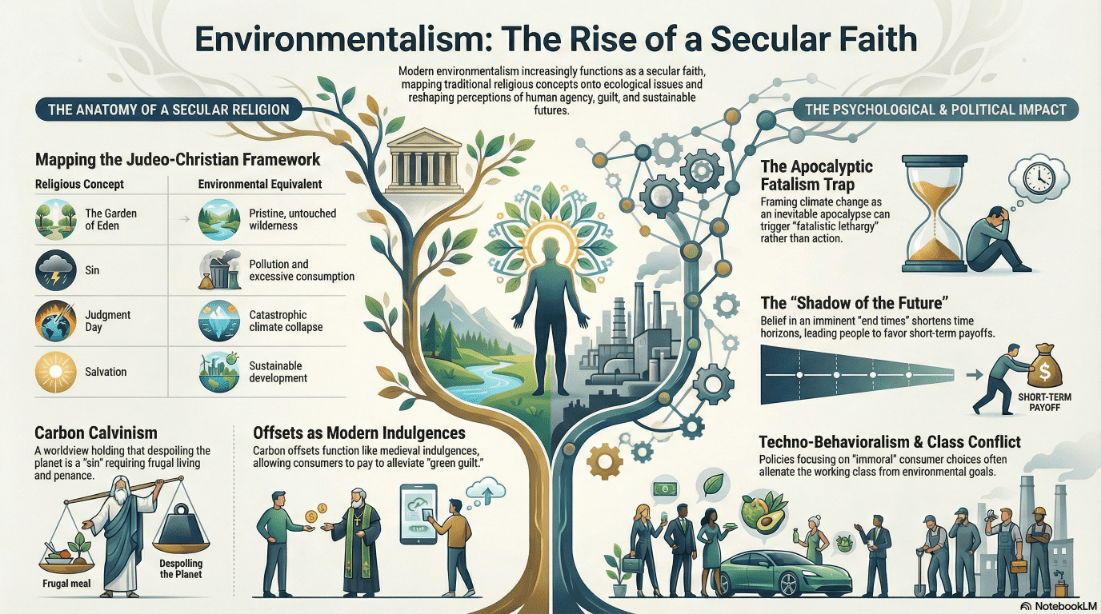
The narrative power of the climate movement derives from its mimicry of “Carbon Calvinism.” It adopts a familiar linear eschatology, providing a script for history that resonates with the deep-seated cultural memory of the West. This framework transforms ecological data into a dramatic story of sin and redemption.
The Theology of the Environment
| Traditional Religious Concept | Environmentalist Equivalent |
| Edenic State | The pre-industrial state of nature; a mythical era of grace and harmony with the biosphere. |
| The Fall | Industrialization; the original “sin” of pollution, greed, and the Promethean exploitation of resources. |
| Judgment Day | The coming climate apocalypse; a catastrophic, anthropogenic end of civilization. |
| Soteriology (Salvation) | The practice of “Sustainability”; the path of righteousness through carbon-frugal living. |
| Sacred Text | The IPCC reports; interpreted by a “priesthood” of technocrats and activists. |
——————————————————————————–
3. Dogma and the Demonization of the “Heretic”
As environmentalism hardens into a secular faith, it has become increasingly allergic to the “exploratory processes of science,” favoring instead a “carbon fundamentalism” that prioritizes ideological purity over empirical debate. In this environment, disagreement is no longer treated as a scientific dispute to be resolved with data, but as a moral failing to be purged.
The movement maintains its internal cohesion through several psychological and social mechanisms:
- Groupthink and Reality Testing: In the “ecotheological” bubble, reality testing is often replaced by a shared resignation to an inevitable fate. The community is reassured not by gaining material control, but by the social validation of their collective alarmism.
- Faith over Fact: The authority of science is frequently invoked as a “pious” foundation for authoritarian policy. When facts are used as “incantations” rather than tools of inquiry, any challenge to the consensus is viewed as an assault on the sacred.
- The Excommunication of Heretics: Prominent skeptics are treated as “infidels” or “deniers”—a term intentionally chosen to mirror the moral weight of Holocaust denial. For instance, when the physicist Freeman Dyson dared to challenge the orthodoxy, he was subjected to vitriolic “excommunications,” being labeled a “pompous twit,” a “blowhard,” a “cesspool of misinformation,” and an “old coot.” Such rhetoric serves to signal who is “on the side of salvation” and who is a “parasite” of the faith.
——————————————————————————–
4. Modern Indulgences and Green Rituals
To maintain its social structure and manage the pervasive “green guilt” of modern life, the movement has developed a series of green rituals. These behaviors function as outward signs of an inner “warm glow”—a psychological benefit derived from providing what economists call an “impure public good.”
The Psychology of the Warm Glow
Participation in environmental acts often serves as a form of “pollution penance.” Just as medieval Christians purchased indulgences to mitigate the consequences of sin, modern consumers utilize carbon offsets to “buy their way out of bad feelings.” This satirical reality is perfectly captured by sites like Cheatneutral.com, which offers to offset the “heartbreak and pain” of infidelity by paying someone else to stay faithful. Carbon offsets operate on a similar logic: the “energy sinner” continues their high-carbon lifestyle while funding a “faithfulness project” elsewhere, such as a tree-planting initiative.
Green Sacramentality
These rituals extend into the domestic sphere, where dietary laws—specifically the consumption of the “organic, pesticide-free wafer”—distinguish the “right people” from the unwashed masses. These acts of “moralistic consumption” often lead to a “rebound effect” or “moral licensing”: once an individual has “proven” their credentials through a specific ritual (like buying a hybrid car or a window decal), they may feel psychologically justified in acting in less environmentally friendly ways elsewhere.
——————————————————————————–
5. The Climate Class War: Elites vs. The Working Class
The economic reality of this secular faith reveals a profound “Climate Class War.” This conflict is driven by techno-behavioralism—a ruling ideology that ignores the structures of industrial production in favor of reforming the “immoral” practices of individual consumers.
The “Climate Class War” manifests in three pointed conflicts:
- Knowledge Workers vs. Industrial Workers: The movement is dominated by a middle-class “knowledge worker” elite—those who staff NGOs and state agencies. They impose “moralism” on the working class (e.g., fuel taxes or bans on gas stoves) while their own positions of power are insulated from the economic fallout.
- Moralism vs. Material Survival: Policies like the “Ultra Low Emission Zone” (Ulez) are perceived by the working class as an elite conspiracy to make ordinary life more costly. This results in populist revolts, such as the Gilets Jaunes (Yellow Vests) in France, who famously contrasted the elite’s concern for the “end of the world” with their own struggle to survive the “end of the month.”
- Consumption vs. Production: By focusing on “carbon footprints,” the movement erases the capitalist owners who control fossil-fuel production. It shifts the burden of responsibility from the “heart of the beast”—the industrial forces of production—to the individual habits of the masses.
——————————————————————————–
6. The Apocalypse Loop: Fatalism and Information Bubbles
The constant deployment of “alarmist repertoires”—narratives of “nuclear winter” or imminent planetary doom—creates a “shortening of the shadow of the future.” In game theory, when the perceived time horizon is short, individuals abandon long-term cooperation in favor of immediate, self-interested payoffs.
This leads to a “fatalistic lethargy.” If the world is fated to end, there is no social contract worth keeping. This fatalism ironically provides comfort, as it absolves the individual of agency or responsibility for the “inevitable.”
“I’m not making out Gaia to be a sentient entity… It’s really metaphoric. Our evolution of intelligence is something of immense value to the planet… [But] it’s sheer hubris to imagine we can save Gaia.” — James Lovelock, originator of the Gaia Hypothesis.
Lovelock’s late-career pivot highlights the schisms within the faith. While “Edenic” purists demand lifestyle modification, Lovelock—the movement’s “Old Testament prophet”—contemplated radical “techno-priest” solutions, such as spraying sulfuric acid into the stratosphere to reflect solar energy. This “planetary reengineering” stands in stark contrast to the “sustainability” salvation sought by the mainstream, revealing a movement caught between scientific pragmatism and apocalyptic zeal.
——————————————————————————–
7. Conclusion: Seeking a Reformation of Reason
When public policy is rooted in the “carbon fundamentalism” of a secular faith rather than pragmatic, democratic decision-making, the risk of catastrophic excess increases. A movement defined by religious zeal finds it impossible to adapt to changing facts or to embrace non-dogmatic solutions like nuclear energy.
For environmentalism to survive as a viable guide for humanity, it requires a “Reformation”—a return to empirical evidence and humanistic values. We must prioritize the quality of the human community over the preservation of a static, mythical nature. Only by lengthening the “shadow of the future” can we return to a mode of social cooperation that favors long-term progress over apocalyptic resignation.
——————————————————————————–
Key Takeaways: Why Environmentalism is a Secular Religion
- Theological Infrastructure: It rebrands the Judeo-Christian narrative of Eden, the Fall, and the Apocalypse into a story of “Carbon Calvinism” and “Sustainability.”
- Sacramental Consumption: Green rituals and carbon offsets function as modern-day “indulgences,” allowing an elite to purchase a clear conscience while moralizing the lives of the poor.
- Techno-Behavioralism: It prioritizes the “reform” of individual “immoral” habits over the democratic control of industrial production, fueling a widening class divide.