
Welcome to the modern grocery store aisle—or as I like to call it, the “Hall of Mirrors.” You stand there, squinting at a carton of eggs or a vacuum-sealed ribeye, surrounded by high-definition photos of rolling hills and cursive fonts whispering sweet nothings about “wellness” and “integrity.”
The marketing is working. According to the 2025 Organic Trade Association (OTA) report, the U.S. organic market has ballooned to a staggering $71.6 billion. That is a lot of money spent by people who want to believe the animal on the label had a better life than a Victorian chimney sweep. In fact, organic egg sales surged by 16.1% last year—though before you credit that to a sudden national passion for hen welfare, keep in mind that a massive outbreak of Avian Influenza (bird flu) decimated conventional supplies, sending prices sky-high and making the organic option look like a bargain.
In this “grocery store jungle,” just because a label sounds “nice” doesn’t mean the animal had a nice life. It often just means the legal department found a bigger loophole.
1. “Free Range” and the Great “Pop Hole” Magic Trick
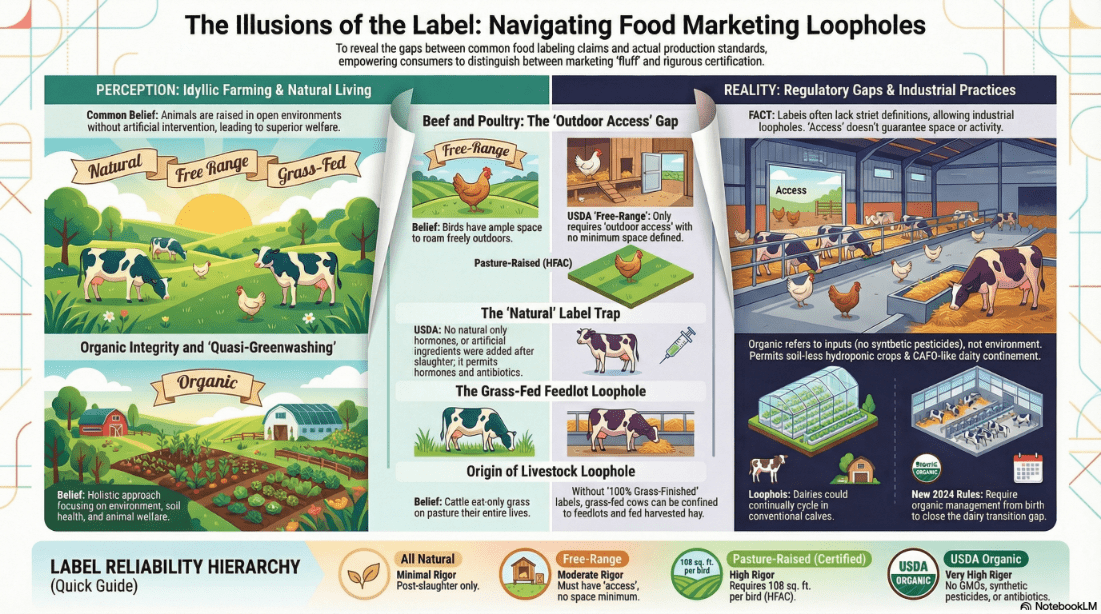
If you think “Free Range” means happy hens frolicking in a meadow, I have a bridge in Brooklyn to sell you. Under current industry and USDA standards, “Free Range” simply requires that birds have “outdoor access.”
How much access? The USDA doesn’t specify. What does the “outdoors” look like? They don’t really say that either. In the industry, this often manifests as a “pop hole”—a tiny door at the end of a massive warehouse holding thousands of birds. If the door is open for a few minutes, even if not a single bird ever makes it through the mosh pit to see the sky, it counts. In fact, Consumer Reports found that the USDA considers a mere five minutes of open-air access per day “adequate” for a label claim. It’s not a life; it’s a smoke break.
To find the truth, you have to look for independent certifications like Certified Humane (HFAC). They actually define these terms with numbers that don’t require a magnifying glass:
| Feature | Certified Humane “Free Range” | Certified Humane “Pasture Raised” |
| Space Requirement | 2 sq. ft. per bird | 108 sq. ft. per bird (1,000 birds per 2.5 acres) |
| Time Outdoors | Min. 6 hours/day (weather permitting) | Outdoors year-round (except inclement weather) |
| Living Conditions | Access to outdoors; barns with litter/perches | Rotated fields; mobile or fixed housing for night |
2. The Organic “Concrete Porch” and the Five-Year Hall Pass
For years, some of the biggest “organic” egg producers pulled off a brilliant piece of performance art: the concrete porch. They would build a screened-in, concrete-floored balcony onto a massive hen house and call it “outdoor access.” To a chicken, this is about as “natural” as a parking garage.
The USDA finally blinked. The new Organic Livestock and Poultry Standards (OLPS) rule officially prohibits these concrete porches and requires that outdoor areas be at least 75% soil and include actual vegetation. It also mandates that shelters have enough space for animals to express natural behaviors, like rooting for pigs and scratching for chickens.
The Catch: While the rule is technically “effective,” the industry successfully lobbied for what I call the “Five-Year Hall Pass.” While most welfare standards hit in 2025, the specific space and soil requirements for chickens don’t become mandatory until January 2, 2029. Until then, your “organic” egg might still come from a bird whose only experience with nature is staring through a screen at a strip of gravel.
3. The Dairy “Laundry” Loophole: Origin of Livestock
In the organic dairy world, there’s been a long-standing “laundry” service for cows. It’s called the Origin of Livestock (OOL) loophole, and it’s been a way for industrial dairies to “rinse” conventional practices out of their herd.
Here was the trick: a dairy would raise its calves “conventionally”—feeding them cheaper milk replacer (formula) and using antibiotics, both of which are strictly forbidden in organic production. Then, about a year before those cows were ready to be milked, the farm would “transition” them to organic. This continuous cycle allowed big operations to grow their herds at a fraction of the cost of a farmer who raised their calves organically from day one.
The fix is finally in: the new OOL rule requires a one-time-only transition for a whole herd. Once certified, any new cow added to the team must be organic from the last third of gestation.
The Investigative Catch: Even if a cow is transitioned to organic for milk, here is the “meat” of the problem: those transitioned animals are considered organic for milk production only, never meat. Because the animal wasn’t raised organically from birth, that “organic” dairy cow legally becomes a “conventional” burger the moment it hits the slaughterhouse.
4. Beef: The “Grass-Fed” vs. “Grass-Finished” Grudge Match
“Grass-fed” is the ultimate buzzword, but since 2016, it is no longer a government-audited designation. If a label says “grass-fed” without a third-party seal (like the American Grassfed Association), you’re operating on the honor system.
However, there is a major terminology trap you need to watch for: “Grass-Fed” vs. “Grass-Finished.” Under USDA guidance, the claim “Grass Finished” is not the same as “Grass Fed.” An animal can be “Grain Fed, Grass Finished,” meaning it spent its life in a feedlot eating corn and was only switched to grass at the very end.
Is the 100% grass-fed hunt worth it? Nutritionally, the science says yes:
- The Saturated Fat Surprise: Grass-fed beef is higher in Stearic Acid, a unique saturated fat that has a neutral impact on human cholesterol.
- The B-Vitamin Boost: It contains Niacin (Vitamin B3) at levels up to nine times higher than grain-fed beef.
- The Gut Health Hero: Research shows grass-fed beef is nearly twice as high in Hippurate, a compound linked to improved gut microbial diversity and lower metabolic syndrome risk in humans.
- The CLA & Omega-3 Factor: It boasts 2-4 times the Conjugated Linoleic Acid (CLA) and significantly higher Omega-3s (EPA and DHA).
- The Taste Reality: Grain-finishing promotes “intramuscular fat” (marbling). 100% grass-fed beef is leaner, “athletic,” and may taste “grassy” or “green” because of the chlorophyll-derived diterpenoids.
5. The “All Natural” Hall of Shame
If you see a label that doesn’t have a government seal or a third-party stamp, you are likely looking at “marketing fairy dust.”
- “All Natural”: The Reality: No formal definition. The FDA is currently “seeking comments” on it, which is government-speak for “we’ll get to it in the next decade.” It usually just means no added synthetic colors.
- “Non-GMO”: The Reality: Only 10 crops (including corn, soybeans, and sugar beets) have been approved for genetic modification in the U.S. If you see a “Non-GMO” stamp on a product where a GMO version doesn’t even exist (like tomatoes or some fruits), it’s pure marketing fluff.
- “Wholesome” / “Doctor-Recommended” / “Local”: The Reality: These are manufacturer-driven claims with zero legal standing. “Local” could mean the next county over or 400 miles away depending on who’s asking.
- “Gluten-Free”: The Fact: This is the gold standard of regulation. It must be strictly <20 ppm. It serves as a depressing reminder that the government can regulate effectively when it wants to.
Conclusion: How to Shop Without Being a Sucker
To avoid being the “sucker” that funds a $71 billion illusion, follow this three-step action plan:
- Look for the “Detective Tip”: In the meat aisle, look for fat color. True grass-fed beef often has yellowish fat. That yellow is a sign of high beta-carotene and carotenoids from a forage-heavy diet. If the fat is bright, bleached white, that cow likely spent a lot of time eating grain.
- Trust Third-Party Seals: “Certified Humane,” “Non-GMO Project,” or “American Grassfed” mean someone other than a brand manager is checking the barn. The USDA Organic seal remains the only way to guarantee no GMOs, no synthetic pesticides, and no antibiotics—even if the animal welfare side is “buffering” until 2029.
- Establish a Handshake Relationship: The best choice is always a local producer. Find a farmer who can shake your hand and explain their practices. If they can’t tell you what their cows ate last Tuesday, keep walking.
Making a simple omelet shouldn’t require an investigative report, but until the 2029 loopholes close, keep your eyes on the fat and your hand on your wallet.