
1. The Human Face of Iowa’s Cancer Surge
For Reg Morton, a resident of rural Franklin County, his five-acre property was once a slice of paradise—a place where he raised three daughters and crafted art from scrap metal. That dream was shattered two years ago when he was diagnosed with a rare form of lymphoma. As he endured the grueling cycles of chemotherapy, he began to look at the cornfields surrounding his home, and the “generous amount” of Roundup he had used on his own garden, with a haunting new perspective.
Morton is merely one face in a rising tide of Iowans suffering in the shadows of the Heartland’s industrial fields. Nick Schutt, a lifelong Iowan who grew up on a farm, can count 17 members of his immediate family who have been diagnosed with cancer. For Schutt, the correlation between the state’s landscape and its health crisis is a visible, daily assault.
“I can’t believe Iowa’s not number one, with the gallons and gallons of chemicals and herbicides that I see going up and down the road every day.” — Nick Schutt
The central tension of life in Iowa has become impossible to ignore: while families live in a perceived paradise of fertile soil, they are increasingly reaping a “harvest of sickness.”
2. A State in Crisis: By the Numbers
The statistics expose a public health emergency that has been engineered over decades. While industry proponents often deflect by citing “lifestyle factors,” Iowa’s data stands out as a national anomaly that cannot be explained away by tobacco or exercise.
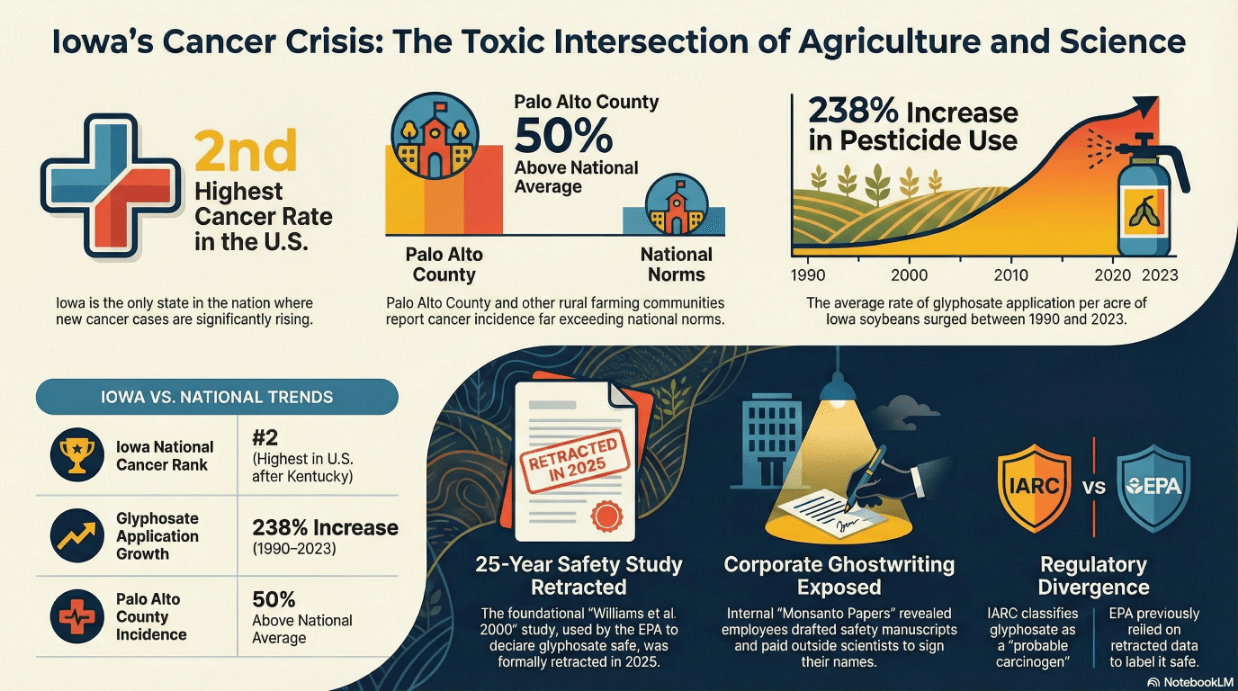
- Second in the Nation: Iowa holds the grim distinction of having the second-highest cancer incidence rate in the United States.
- The National Leader in Growth: Iowa is the state with the fastest-growing rate of new cancers in the country.
- The 238% Surge: From 1990 to 2023, the average rate of glyphosate application per acre of Iowa soybeans skyrocketed by 238%.
When comparing Iowa to Kentucky—the only state with a higher incidence rate—the disparity of cause becomes clear. Kentucky’s crisis is heavily tied to high smoking rates. Iowa lacks such a singular lifestyle explanation; instead, the 238% jump in glyphosate use and heavy nitrate contamination point toward an environmental “chemical cocktail” as the primary suspect.
3. The Chemical Cocktail: Pesticides and Nitrates
The toxicity found in Iowa’s soil and water is not accidental. Independent researchers have warned that commercial formulations like Roundup can be 50 times more toxic to human DNA than glyphosate alone. Simultaneously, fertilizer runoff has saturated drinking water with nitrates, creating a multi-front assault on public health.
Primary Agricultural Contaminants
| Contaminant | Associated Health Risks/Concerns |
| Glyphosate-based herbicides | Non-Hodgkin Lymphoma, Parkinson’s, Alzheimer’s, and Haemolymphoreticular tissues (leukemia/lymphoid malignancies). |
| Nitrate in drinking water | Fertilizer runoff linked to colorectal cancer and thyroid issues, even at levels currently deemed “safe” by the EPA. |
Regulatory bodies have been inexcusably slow to act. David Cwiertny of the Center for Health Effects of Environmental Contamination (CEHEC) has blasted the EPA’s continued delay in conducting essential health assessments for nitrates, even as the agency acknowledges the need to weigh mounting evidence of risk at low concentrations.
4. Decades of Deceit: The Monsanto Ghostwriting Scandal
The “scientific consensus” on pesticide safety was not discovered; it was manufactured. In 2025, the journal Regulatory Toxicology and Pharmacology took the extraordinary step of retracting the seminal safety review by Williams et al. (2000). For 25 years, this paper was the keystone of global regulation, yet the “Monsanto Papers” exposed it as a corporate fiction.
Internal emails from Monsanto executives like William Heydens and David Saltmiras revealed a calculated strategy to “keep the cost down” by drafting research internally and enlisting outside scientists to “just edit & sign their names.” As Monsanto chief of global scientific affairs Eric Sachs stated in a 2012 email, the goal was “keeping Monsanto in the background so as not to harm the credibility of the information.”
This “Decades of Deceit” involved three systemic tactics of corruption:
- Ghostwriting Research Papers: Drafting safety reviews (such as Greim et al. 2015 and Kier & Kirkland 2013) while paying academic “experts” like David Kirkland—whose services Saltmiras noted came at a “premium” of £1,400/day—to serve as independent faces.
- Influencing Regulators: Providing the EPA with specific “talking points” and enlisting officials to block critical reviews from the Agency for Toxic Substances and Disease Registry (ATSDR) to prevent a “domestic IARC” (International Agency for Research on Cancer) classification.
- Front Groups and PR: Funding nonprofits and “science media” centers to discredit journalists and independent scientists who raised safety alarms.
5. Regulatory Capture: Why the EPA Failed to Protect
The EPA did not just fall victim to corporate influence; it acted as a willing vessel for a corporate-funded mirage. The ghostwritten Williams et al. (2000) paper was cited as a cornerstone in the 2016 EPA Glyphosate Issue Paper and the 2020 Interim Registration Review, directly steering federal policy for decades.
This corruption has long been contested from within. Internal documents reveal that as far back as 1991, several members of an EPA committee refused to sign a review classifying glyphosate as non-carcinogenic, openly dissenting against the agency’s surrender to industry pressure.
The consequences of this capture are lethal. While the EPA maintained that glyphosate was safe, the 2025 Global Glyphosate Study (Panzacchi et al.) found significant tumor increases in subjects exposed to levels at the European Union’s Acceptable Daily Intake (ADI)—proving that “legal” limits are failing the public.
The depth of this capture was further exposed by the MAHA Strategy Report flip-flop. In early 2025, a version of the report raised alarms about pesticide-driven chronic disease; however, by September 9, 2025, after intense industry lobbying, the language was scrubbed and replaced with an endorsement of the existing, broken regulatory process.
6. Defeating the “Cancer Gag Act”
In a final, desperate move to avoid accountability for this public health catastrophe, the pesticide industry—represented by the Bayer-funded “Modern Ag Alliance”—pushed the “Cancer Gag Act.” This Pesticide Immunity Bill sought to shield corporations from legal liability, effectively telling Iowans they must bear the physical and financial brunt of cancer alone to protect Bayer’s bottom line.
However, a historic coalition of farmers, labor unions, and health advocates rose to meet the threat. At the State Capitol, advocate John Crabtree provided a heartbreaking rebuttal to corporate greed. He displayed a family photo from the 1970s; of the eleven people pictured, five had already died of cancer.
“To say the people of Iowa need to bear the brunt of cancer on their own so that Bayer can have a bottom line — that, frankly, is offensive.” — John Crabtree
The coalition’s victory in stopping the bill was a monumental win for “people over pesticides,” but the threat remains national. Iowa was just one of 12 states where the industry introduced similar immunity bills, signaling a coordinated, nationwide attempt to subvert the judicial system.
7. Conclusion: Seeking Justice in the Heartland
The defeat of the Cancer Gag Act in Iowa proves that corporate power is not absolute, but the war for the Heartland’s health is far from over. With a 2026 EPA registration review deadline looming, the agency must decide whether to continue hiding behind retracted, ghostwritten studies or to finally prioritize independent science.
The path to healing Iowa requires a total rejection of regulatory capture. We must demand transparency, fund independent research, and ensure that the lives of families like the Mortons and the Schutts are never again sacrificed for the sake of chemical profits. The future of Iowa depends on a simple, urgent mandate: people over pesticides.
——————————————————————————–
Key Takeaways
- Systemic Corruption: Iowa’s record-high cancer rates are the byproduct of heavy agricultural chemical use and a regulatory system that has been subverted by industry ghostwriting.
- Institutional Failure: The EPA relied on retracted studies (Williams et al. 2000) to maintain safety designations, ignoring internal dissent that dates back to 1991.
- The Power of Activism: The defeat of the “Cancer Gag Act” demonstrates that diverse local coalitions are the only effective barrier against the industry’s attempt to secure total legal immunity for corporate-induced illness.
——————————————————————————–