
Introduction: The $15,000-per-Mile Problem
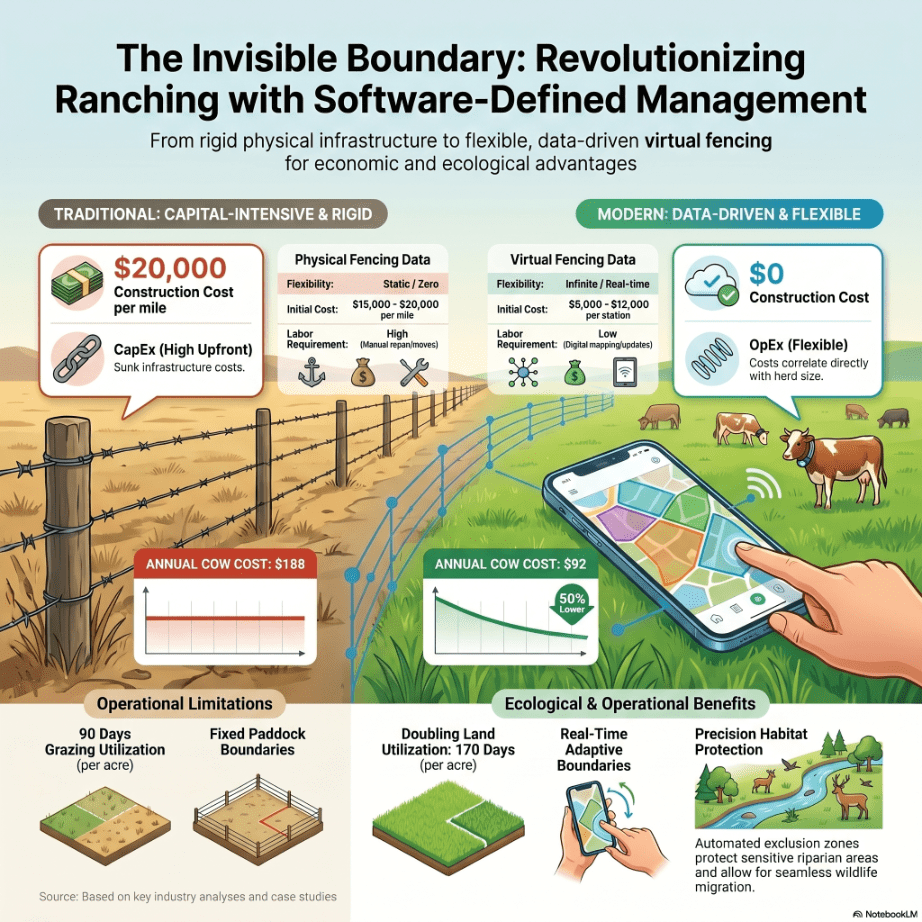
Traditional ranching is hitting a massive infrastructure wall. Building a standard 4-wire metal fence now costs upwards of $15,000 per mile—a baseline figure that can spike even higher in rocky or mountainous terrain where labor costs soar. For a large-scale operation managing thousands of acres, the capital required for fence replacement is no longer just a line item; it is a million-dollar barrier to entry.
Virtual Fencing (VF) is emerging as the cornerstone of “Ranching 4.0.” It is not just a high-tech gadget but a necessary economic evolution that transforms the fence into a data-driven platform. By integrating GPS collars with real-time monitoring, we are moving beyond simple containment toward a sophisticated system of precision livestock management that maximizes both forage productivity and animal welfare.
1. The “One-Way” Logic—Why It’s Smarter Than Barbed Wire
One of the most strategic advantages of virtual fencing is its ability to act as a one-way barrier. When an animal manages to cross a physical barbed-wire fence—often triggered by a stressor like a predator or thunder—it becomes trapped on the “wrong” side. This separation causes immense stress and leaves the animal vulnerable.
Virtual fencing solves this by utilizing “re-entry logic.” When the system recognizes an animal is outside the designated area, it suppresses the audio cues and electric shocks as the animal moves back toward the herd. This leverages natural social facilitation to maintain containment without the punishment found in static physical barriers.
“VF acts as a one-way fence and allows animals to re-enter without consequence… it will want to return to the herd based on herd mentality.”
2. The Math of the Invisible—Slashing Costs by Over 75%
The economic synthesis for virtual fencing becomes increasingly favorable as ranch size and fence length grow. According to a New Mexico State University study of a representative large-scale ranch, virtual fencing can reduce the annual cost of containment by more than half when compared to traditional fencing depreciated over its useful life.
Annual Cost Comparison (Per Cow):
- Physical Fencing: $188.00
- Virtual Fencing: $92.71
While the “Year 1” hurdle is significant—with initial adoption costs ranging from $175 to $400 per cow for hardware and setup—the long-term ROI is driven by infrastructure efficiency. A single solar-powered LoRaWAN tower provides a communication range of 10–12 miles, and the robust cattle collars feature a battery life of 6–12 months, drastically reducing the labor required for maintenance and gathering.
3. The “Boundary Testers”—Why Some Cows Lead the Way
Animal behavior in a virtual system is “socially facilitated,” meaning the herd often follows the lead of a few. Data indicates that a small subset of the herd—often just 2 to 3 “boundary testers”—accounts for 30% to 50% of the total audio zone interactions.
Strategically, these adventurous animals may actually be your most productive; research suggests a positive relationship between boundary testing and weight gain. However, an expert manager must use the system’s real-time analytics to monitor for “slow learners” or lower-ranking animals. These individuals may receive excessive shocks if they are being bullied or pushed into the fenceline by dominant herdmates, requiring them to be moved to an alternative management system.
“Often two to three animals receive 30–50% of the audio cues in any given day, continually exploring the fenceline and grazing into the ‘audio zone.’ … research [suggests] a positive relationship between boundary testing and weight gain.”
4. Precision Conservation—Fencing for Wildfires and Water
Virtual fencing enables “precision grazing” in rugged terrain where building physical wire is impossible. This technology allows ranchers to create instantaneous “fuel breaks” by grazing cattle intensely in specific strips to reduce nonnative grasses, effectively slowing the spread of wildfires.
Beyond fire resilience, the system provides unparalleled protection for freshwater quality. Producers can remotely exclude cattle from riparian zones or sensitive streams during high-rainfall periods to prevent poaching and water contamination. This level of environmental stewardship was previously cost-prohibitive but is now achievable with a few clicks on a smartphone.
5. The “Dynamic” Challenge—When the Fence Starts Moving
There is a critical distinction between static virtual boundaries and “dynamic fencing,” where the fence moves to guide animals to a new pasture or a milking parlor. While cattle typically learn a static boundary in 4 to 7 days, dynamic movement has a steeper learning curve of 2 to 4 weeks and requires higher levels of predictability to avoid animal confusion.
Critical Considerations: Ground Truthing and Controllability To ensure animal well-being, the “controllability” of the environment is paramount. Managers must practice “Ground Truthing”—physically walking a new virtual boundary with a smartphone—to ensure GPS drift hasn’t accidentally blocked access to water or shade. Without this verification, a “moving fence” coming from behind could trap an animal against a natural hazard, leading to repeated shocks and significant distress.
Conclusion: A New Frontier for the Early Adopter
The transition to virtual fencing is supported by an expanding ecosystem of government cost-sharing programs. The USDA NRCS and programs like EQIP (Environmental Quality Incentives Program) are increasingly funding these systems, recognizing their role in both regenerative agriculture and rural economic resilience.
As we replace miles of rusted wire with digital boundaries, we aren’t just adopting a new tool; we are restoring the “aesthetic of the open range.” This technology offers a rare win-win: the efficiency of high-tech “Ranching 4.0” paired with the restoration of a landscape no longer scarred by the 19th-century fence line. Is your operation ready to lead the way into the invisible?