
1. The Great Milk Monopoly and the Fragility Crisis
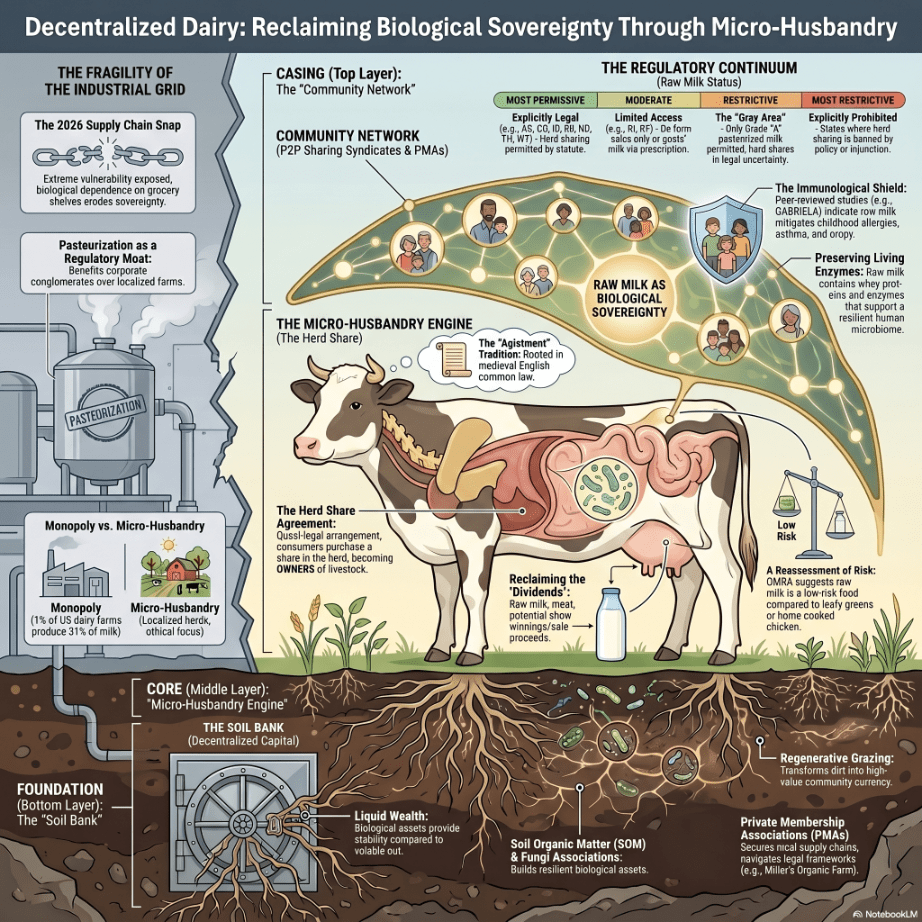
The architected dismantling of local food resilience was not an accident of history, but a calculated consolidation of biological infrastructure. The modern industrial dairy system is a brittle, “Soviet-style” monopoly, prone to systemic collapse and engineered to eliminate the individual producer. This “fragility crisis” was cemented by the 1924 Pasteurized Milk Ordinance (PMO), a regulatory moat that transformed the dairy landscape from a network of accountable neighbors into a corporate conglomerate of Concentrated Animal Feeding Operations (CAFOs) housing 2,000 to 30,000 cows.
While pioneers like Dr. Henry Coit advocated for a certification model based on hygiene and small-herd accountability, the mandatory pasteurization movement of the 1920s won the political day. The supreme irony, as documented in the historical record, is that many original proponents viewed pasteurization as a temporary stopgap—an emergency measure until milk could be made inherently safe. Instead, the emergency became permanent, enabling an industrial model that sacrifices safety for scale.
The consequences of this centralization are catastrophic when the system fails. The 1985 Midwest Salmonella typhimurium outbreak—the largest of its type ever reported in the U.S.—infected between 168,791 and 197,581 individuals through contaminated pasteurized milk. In 2007, a Massachusetts Listeria outbreak caused three fatalities. In the industrial paradigm, a single point of failure is a national health crisis.
True biological sovereignty requires the absolute decoupling of human health from the centralized grid. Dependence on industrial grocery store shelves is a surrender of the human microbiome to a system that prioritizes corporate stability over individual immunological resilience.
2. The Micro-Husbandry Revolution: A Biological Hedge
Micro-husbandry is more than a return to the land; it is a tactical biological hedge against the inflation and instability of 2026. By utilizing the Jersey cow as the primary unit of measure, we transition from industrial extraction to regenerative cycles that connect the soil directly to the gut.
A single Jersey cow produces approximately six gallons of raw milk per day, creating a decentralized supply chain capable of supporting a 35-member “neighborhood share” (one gallon per week). This model outperforms the CAFO in every metric:
- Regenerative Stewardship: Grass-fed husbandry on pasture regenerates the topsoil, sequestering carbon and producing nutrient-dense fats that CAFO-confined cows simply cannot replicate.
- Technological Traceability: Because 98.2% of shareholders visit the production site, the system creates a “defined consumer pool.” This allows for “rapid traceback”—a localized technological advantage that industrial systems, with their co-mingled vats, completely lack.
- Accountability Loops: The direct relationship between producer and shareholder ensures a transparent feedback loop, where animal welfare and hygiene are verified by sight, not by a distant regulatory stamp.
3. Raw Milk: The Science of Biological Sovereignty
Raw dairy is a complex, living fluid that functions as an immunological software update. Industrial heat treatment degrades the very enzymes and proteins essential for human resilience. Peer-reviewed research, specifically the GABRIELA study involving nearly 8,000 children, confirms that raw milk consumption is inversely associated with asthma, atopy, and hay fever. This protective effect is specifically linked to the integrity of whey proteins, such as bovine serum albumin and alpha-lactalbumin, which are neutralized during pasteurization.
We must dismantle the “pathogen myth” with data. Quantitative Microbial Risk Assessments (QMRA), the international gold standard, categorize safely produced raw milk as a “low-risk food.” When testing for Listeria monocytogenes, Campylobacter, Staphylococcus aureus, and Escherichia coli 0157, the inherent risks of raw milk are statistically lower than many common industrial foods like leafy greens or deli meats.
Safety Frameworks: Narrative vs. Reality
| Aspect | Industrial Narrative | Sovereignty Reality |
| Safety Origin | Pasteurization as the only shield. | Hygiene, testing, and soil health. |
| Microbiome | Sterile fluids are safer. | Diverse microbial life builds immunity. |
| Pathogen Risk | Large-scale, fatal outbreaks. | QMRA “low-risk”; localized & traceable. |
| Protein Status | Denatured/neutralized whey. | Intact serum albumin & alpha-lactalbumin. |
4. Dairy as Decentralized Capital: The Liquid Wealth Model
The family cow is not merely a cow; it is a productive, inflation-resistant asset class. This “Soil Bank” model finds its roots in the 14th-century legal technology of Agistment—the common law practice of boarding and caring for another’s livestock for a fee. This ancient precedent is far more resilient than modern fiat-based corporate structures.
By investing in a herd share, the individual secures four primary dividends of “Liquid Wealth”:
- Weekly Distributions: Reliable, high-nutrient raw milk that bypasses inflationary grocery chains.
- Biological Interest: A proportional share of proceeds from the sale of calves or new herd members, growing the “capital” of the herd.
- Caloric Security: A proportional share of meat upon animal slaughter, providing a deep reserve of protein.
- Reputational Capital: Community prestige and the preservation of elite genetic lines that act as a stable currency during de-globalization.
5. Building the Community-Backed Dairy Network: Tactical Strategies
Navigating the legal landscape of 2026 requires precise intelligence. The 50 states exist on a continuum of regulation:
- Permitted (7): AK, CO, ID, MI, ND, TN, WY (Expressly legal herd shares).
- Prohibited (6): FL, LA, MD, NC, UT, WV (Active hostility).
- Sales Permitted (25): Including CA, PA, WA, ME (Various retail/on-farm allowances).
- Only PMO Language (9): Gray-area states like AL, DE, IA, NJ, OH, and VA.
The Triple Oaks Farm case in Virginia (Shelton, Commissioner of VDH vs. Triple Oaks, LLC) serves as a critical tactical warning. In July 2024, Attorney General Jason Miyares petitioned for an injunction, claiming their Private Membership Association (PMA) was a “charade for retail sales.” The state alleged violations of 2VACS-531-50 and 2VACS-490-75. If the state proves the PMA operates in public commerce, the model fails.
Tactical Commands for Resilient Agreements:
- De-link Boarding Fees from Volume: Payments must be flat rates for agistment services. Utilize electronic or mail-in payments to further separate the transaction from the physical exchange of milk, reinforcing the bailment relationship.
- Explicit Risk-of-Loss Clauses: The agreement must state that the shareholder assumes the risk of loss for the animal. This establishes the shareholder as a legal owner, not a retail customer.
- Define Multi-Asset Dividends: Explicitly include rights to meat and sale proceeds to solidify the “ownership” status beyond just milk distribution.
6. Conclusion: Decoupling from the Grid
The movement toward decentralized dairy is the ultimate act of secession from a failing industrial order. By reclaiming the human microbiome, we reclaim the foundation of human independence. The transition from a passive consumer to a shareholder—and ultimately a sovereign producer—is the only way to secure a future immune to the fragility of the state. Rebuild the Soil Bank. Reclaim the liquid wealth. Reclaim your sovereignty.