
If you take a road trip across the American Heartland, you’ll be met with an endless, shimmering sea of green. Looking at those millions of acres of farmland, it’s easy to buy into the patriotic narrative that the United States is the “food basket of the world.” We produce a staggering amount of agricultural output, yet there is a biting irony at play: despite this massive capacity, finding local, fresh, nutrient-dense produce in many of these regions is surprisingly difficult.
The reality, as any investigative look at the data reveals, is that the U.S. food system has been systematically re-engineered into something else entirely. It is no longer a food basket; it is a “feed and fuel system.” We aren’t actually farming for dinner plates—we’re farming for gas tanks and global industrial supply chains.
——————————————————————————–
1. The 31% Reality: Most “Food” Isn’t for Humans
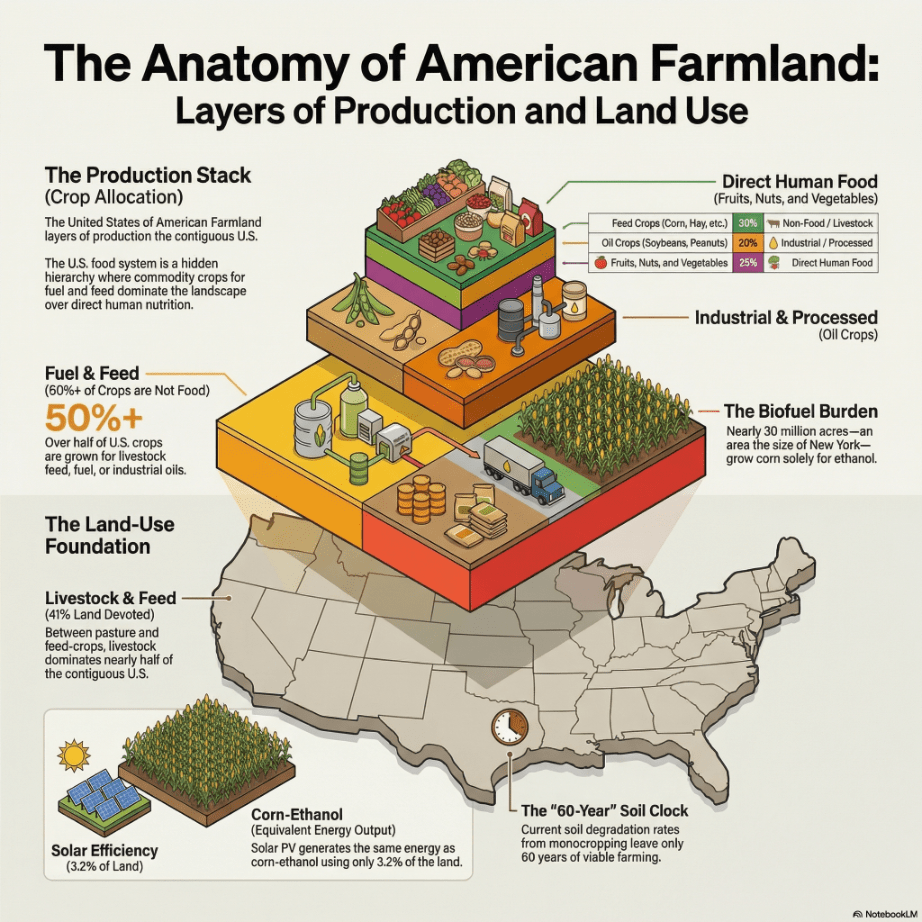
When we talk about American “food production,” the word “food” is doing a lot of heavy lifting. According to USDA projections for 2025, the vast majority of what we grow is never intended for a human mouth.
The breakdown of projected crop sales reveals that “actual food” is a shrinking minority:
- Feed Crops (30%): Corn, barley, oats, and hay destined for livestock.
- Oil Crops (20%): Mostly soybeans and peanuts used for industrial processing.
- Other (19%): Non-edible or “barely food” crops like cotton, tobacco, and nursery plants.
- Fruits, Vegetables, and Food Grains (31%): The actual minority of our harvest.
This means nearly 70% of our cropland doesn’t produce a single calorie for direct human consumption. The tragedy here is one of allocation, not capacity. Research from the World Resources Institute (WRI) notes a projected global shortfall of 994 trillion kcal per year by 2030—roughly 30% less than what is needed to feed the world. The irony is that we already grow enough calories to feed the planet; we simply choose to divert them into engines and industrial livestock vats.
2. The New York-Sized Energy Inefficiency
Currently, 29.7 million acres of U.S. farmland—an area the size of New York State—are dedicated to growing corn for ethanol fuel. While critics often express “social opposition” to placing solar panels on “prime agricultural land,” the investigative reality shows that our current use of that land is a catastrophic waste of space.
A study from Cornell University found that corn grown for ethanol is 31 times less land-efficient than solar power. If we shifted our perspective, the potential for recovery is staggering:
“Using just 3.2% of the land currently used for corn ethanol could increase the share of utility-scale solar energy in the U.S. from 3.9% to 13%.”
Even more profound: if we converted 46% of that ethanol land to solar, the U.S. could fully decarbonize its entire electricity system by 2050. Furthermore, these “ecovoltaic” arrays—solar panels coupled with perennial vegetation—could reduce nitrogen and phosphorus runoff into the Mississippi River by as much as 85%, acting as a massive, state-sized filter for our waterways.
3. The 60-Year Expiration Date on Our Soil
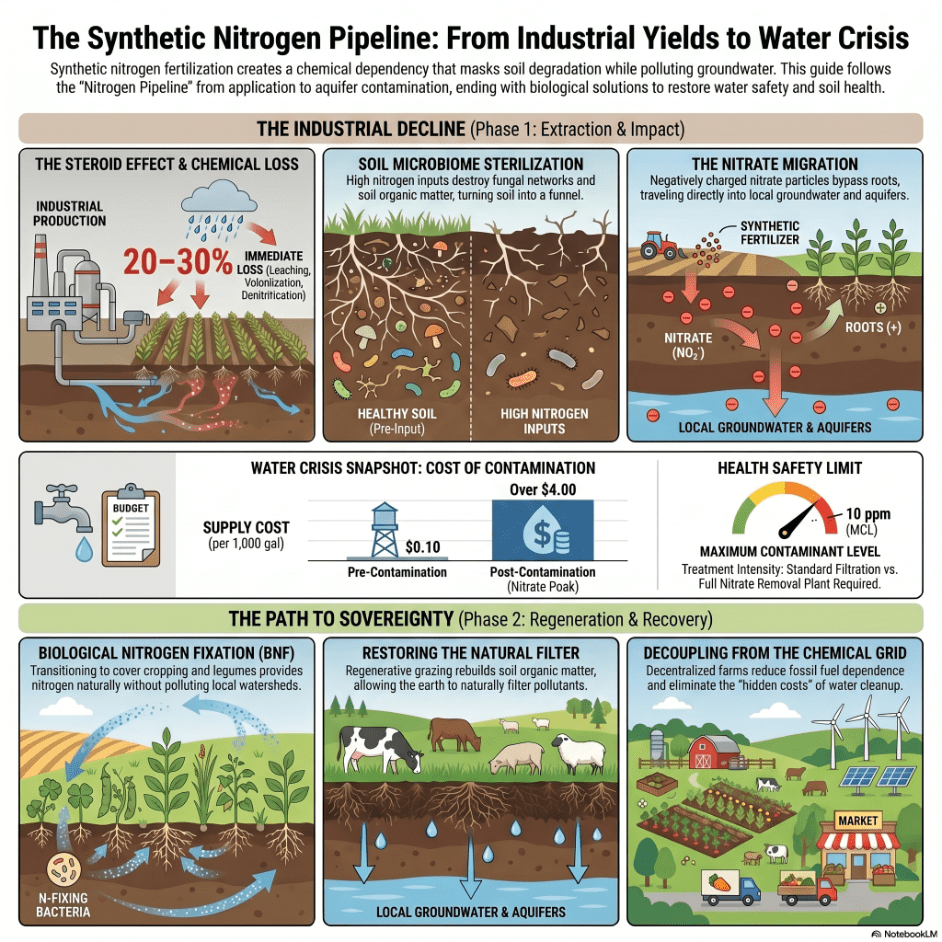
We are currently “mining” our soil rather than farming it. Decades of monocropping—planting nothing but corn and soy—combined with aggressive tilling has decimated the natural microbial life that makes soil “living.” Today, we use synthetic fertilizers and pesticides not as supplements, but as life support systems for dirt that can no longer produce on its own.
We are facing a terrifying collision of data points: the UN/FAO warns that global food production must increase by 70% by 2050 to meet population growth, yet our primary resource is vanishing.
Scientific American has noted that “if soil degradation continues at the current rate, there will be only 60 years of farming left.”
We are operating on a biological countdown that is almost entirely ignored in mainstream policy. We treat topsoil as a disposable industrial input, and the clock is ticking.
4. The Policy Trap: Why Farmers Can’t Just “Switch”
It is tempting to blame farmers for this lack of diversity, but they are the primary victims of a “Policy Trap.” Billions of dollars in annual federal subsidies and crop insurance specifically incentivize low-value commodity crops like corn and soy.
Farmers aren’t choosing to grow these crops because they want to feed a processed food factory; they are responding to economic incentives created by outdated legislation. Corporations then take these subsidized commodities and create “Frankenstein versions” of them—specifically High Fructose Corn Syrup (HFCS) and ultra-processed oils—which are the primary drivers of our modern health crises.
The consequences of this policy-driven monoculture are clear:
- Degraded Soil: The death of natural nutrient cycles.
- Polluted Water: Massive nutrient runoff into the Mississippi.
- The Obesity Epidemic: A system that makes cheap, metabolic-disrupting sweeteners more affordable than fresh carrots.
5. The Indiana-Sized Footprint of Our Actual Diet
One of the most mind-bending facts in agricultural science is how little land we actually need to feed the American people. The total land area required to grow all the food Americans actually eat is roughly the size of Indiana, Illinois, and half of Iowa.
Compare that to the fact that 41% of the contiguous U.S. is currently devoted to livestock—consisting of 29% in pasture land and the remainder in cropland specifically grown for feed.
This leads to the “Export Paradox.” While our domestic soil health is sacrificed for grain, much of that grain is shipped overseas to fuel the meat-heavy diets of the global middle class. To visualize where American topsoil is going, look at the 26-story pig farm in Hubei Province, China—a massive industrial operation fueled by American-grown soy and corn. We are effectively exporting our ecological future so a foreign middle class can eat more pork.
——————————————————————————–
Conclusion: A Course Correction for 10 Billion People
By 2050, we will have 10 billion people to feed on a planet with finite land and dying soil. To survive this, we must transition from a “commodity-first” policy to a “nutrition-first” policy. This means ending the mandates that turn food into fuel and shifting subsidies toward crop diversity and soil restoration.
If we stopped farming for cars and foreign livestock, we could feed the entire nation on a fraction of the land we currently use—leaving the rest for nature, clean energy, and the desperate restoration of our topsoil.
The data is clear: we have the land, and we have the technology. The only thing standing in our way is the narrative. If we can feed the nation on a few states’ worth of land, why are we still choosing the myth?