
1. Introduction: The Uncomfortable Truth of Modern Animal Health
As an ecological veterinarian, I see the “regenerative dream” not as a pastoral aesthetic, but as a clinical necessity. We envision vibrant grasslands where livestock serve as the engines of soil health, yet the reality of modern veterinary intervention is often a form of biological sabotage. Conventional medical norms, while intended to manage individual animal symptoms, have effectively deployed a chemical arsenal that sterilizes the very systems required for planetary health.
When we administer synthetic parasiticides and antibiotics, the clinical impact does not stop at the animal’s skin. These compounds spill over into the soil, disrupting the intricate microbial and insect networks responsible for nutrient cycling and carbon sequestration. We are currently trapped in a reactionary model, trading the long-term integrity of the grassland ecosystem for a temporary, drug-induced status quo.
Regenerative Agriculture: A paradigm shift in food production that moves beyond mere “sustainability” (maintaining a degraded state) to actively healing and rewilding depleted soil, enhancing biodiversity, and restoring the living systems upon which all agriculture depends.
——————————————————————————–
2. The Invisible Toxicity: How Endectocides Smother the Pasture
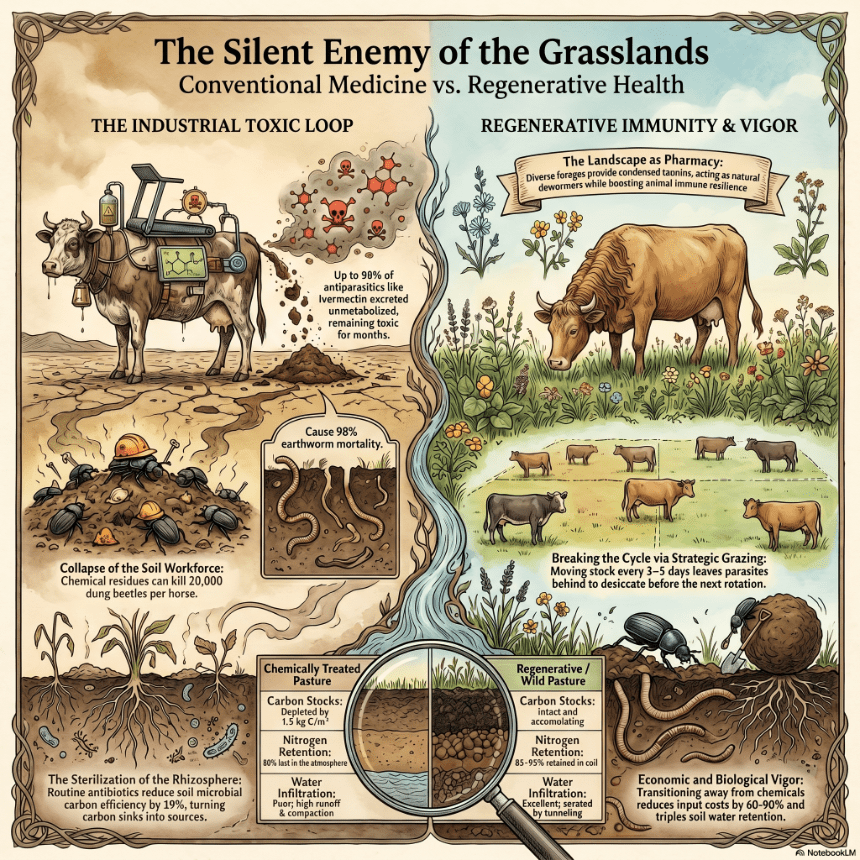
The widespread use of macrocyclic lactones—specifically endectocides like Ivermectin (IVM)—has created an invisible toxicological crisis. Ivermectin is not completely metabolized by the animal; research confirms the parent molecule remains intact and is excreted in feces, where it persists for months.
This persistence is lethal to our most critical “soil managers”: the dung beetles. The following data from a study on Colombian Caribbean assemblages quantifies how escalating Ivermectin concentrations lead to a collapse in beetle richness and biomass.
The Impact of Ivermectin on Soil Managers
| Management Style | Beetle Richness (Species) | Beetle Abundance (Individuals) | Beetle Biomass (Grams) |
| No-IVM (Control) | 25 | 11,334 | 374.5 |
| 1% IVM (Low Dose) | 14 | 10,222 | 262.9 |
| 3.15% IVM (High Dose) | 17 | 3,885 | 159.9 |
The destruction of paracoprid (tunneler) beetles creates a catastrophic system failure. These insects are essential for soil aeration (macroporosity) and water infiltration. When endectocides impair their locomotor and reproductive capacities, the result is a “smothering” effect: manure accumulates on the surface, grass growth is physically obstructed, and sunlight cannot reach the soil.
The ultimate paradox: By killing the beetles with Ivermectin, ranchers accidentally preserve the very gastrointestinal nematodes (parasites) they intended to eliminate. Without tunnelers to bury and break the parasite life cycle in the dung, the pasture remains a hotbed for re-infection, forcing the rancher back onto the chemical treadmill.
——————————————————————————–
3. Microbial Sterilization: Antibiotics and the Carbon Crisis
The crisis deepens at the microscopic level through the spillover of veterinary antibiotics, such as tetracycline. These are stable compounds that do not decompose easily, lingering in the soil for decades. This creates a state of “microbial sterilization” that directly undermines global climate goals.
A key indicator of this failure is Carbon Use Efficiency (CUE). This metric determines whether soil microbes store carbon or respire it into the atmosphere. Data from Global Change Biology indicates that areas grazed by livestock treated with antibiotics show a 19% lower CUE compared to areas grazed by wild herbivores.
- Microbial Respiration: Lower CUE means microbes are less efficient, respiring more carbon dioxide back into the atmosphere rather than sequestering it.
- Carbon Loss: Soils under livestock-grazed areas contain 1.5 kilograms less carbon per cubic meter than those managed by wild herbivores.
- The Rewilding Solution: Restoring soil health requires “rewilding” the microbiome—moving away from stable antibiotic residues that create subterranean deserts and returning to biological nutrient cycling.
——————————————————————————–
4. The Paradox of the Industrial Health Loop
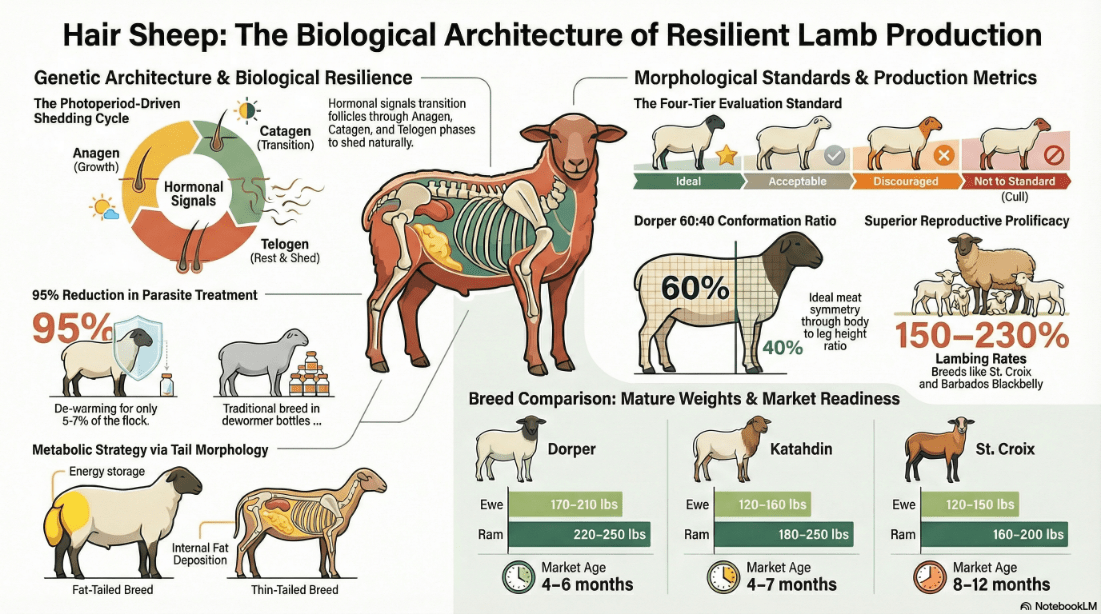
Conventional ranching is currently stuck in an “Input Treadmill” where drugs are used as a crutch for poor management and mismatched genetics. Many operations rely on large-framed cattle breeds that require high-energy intake and struggle on grass-only diets. These animals require constant chemical intervention to survive high-density, high-stress conditions.
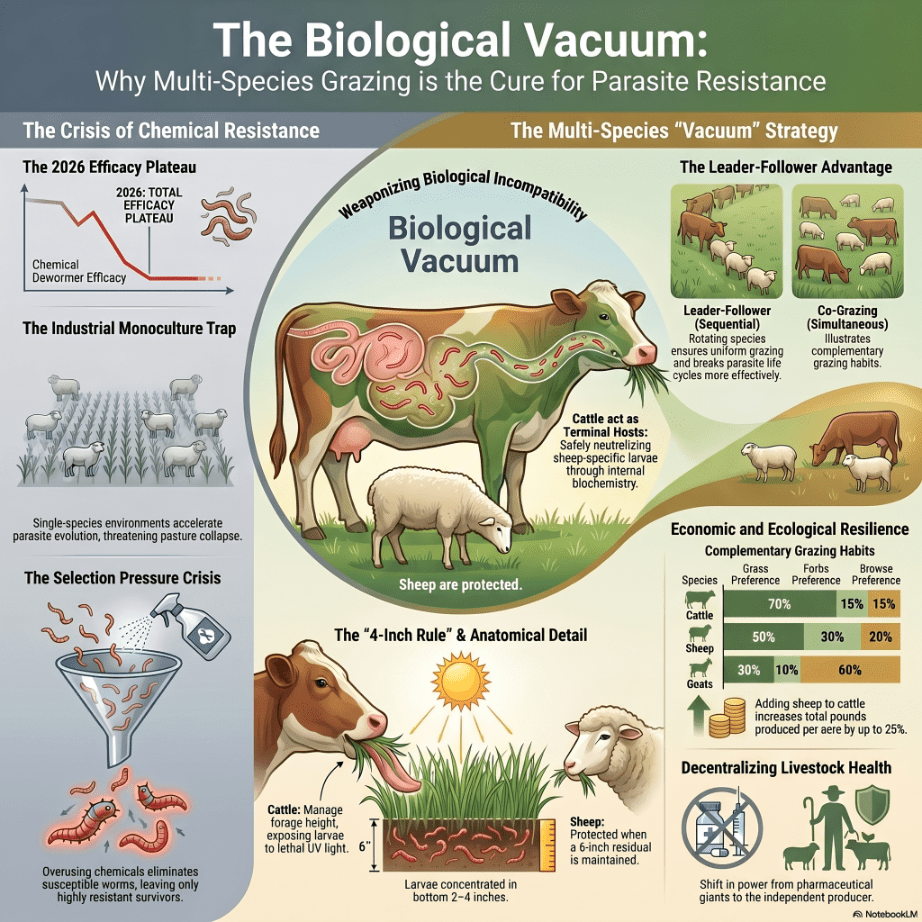
This has led to a surge in Anthelmintic Resistance. Parasites like the barber pole worm (Haemonchus contortus) have evolved immunity to traditional dewormers. Producers are left using “cures” that no longer kill the target worms but continue to decimate beneficial soil life.
Furthermore, there is a looming Commodity Risk. As global markets shift toward a “One Health” paradigm, reliance on routine antibiotics and parasiticides will leave ranchers structurally excluded from premium, health-conscious supply chains.
——————————————————————————–
5. Regenerative Immunity: The Landscape as a Pharmacy
The transition to Managed Grazing allows the landscape to function as a pharmacy, breaking parasite cycles through strategic mimicry of wild herds.
Strategic Grazing Mimicry:
- The 3-Inch Rule (With Weather Nuance): While 90% of parasite larvae reside in the bottom 3 inches of grass, a strategist must account for the “rain splat” effect. Rainfall can launch larvae up to 8 inches high, requiring taller residual grazing during wet weather to avoid infection.
- Intense Rotation: Moving animals every 1–3 days prevents them from grazing near their own fresh manure, breaking the 4-to-6-day hatching cycle of most parasites.
- Multi-Species Integration: Integrating cattle with chickens or small ruminants creates biological control. Chickens, for instance, spread manure and consume larvae that would otherwise infect the herd.
- Drought Resilience: By eliminating chemicals and building soil organic matter, the land’s water-holding capacity increases by 20,000 gallons per acre for every 1% increase in organic matter.
——————————————————————————–
6. Economic Rewilding: Prosperity Through Biological Integrity
Eliminating conventional veterinary norms is a superior economic strategy. Transitioning to regenerative practices can yield a 60–90% reduction in input costs while supporting smaller, more efficient cattle breeds that allow for 200–300% higher carrying capacity on the same acreage.
The Three-Phase Transition Strategy:
- Phase 1: Foundation & Channel Security. Eliminate synthetic endectocides and antibiotics. Begin basic rotation. Most importantly, establish a Marketing Partnership (e.g., Texas Grass Fed Farms) to secure premium sales channels before scaling.
- Phase 2: Scaling Biological Complexity. Expand paddock systems for intense rotation. Introduce multi-species grazing and invest in portable infrastructure (fencing/water).
- Phase 3: Optimization. Maximize soil carbon sequestration. Leverage the “One Health” status of your product to lead the market, capturing maximum value per animal through direct-to-consumer and premium retail channels.
——————————————————————————–
7. Conclusion: A Shift in Global Health Management
The future of ranching demands a shift from “reactionary medicine” to “ecological health management.” We must treat the entire grassland pyramid—from the soil microbiome to the dung beetle to the grazing herbivore—as a single, interconnected organism.
By 2026, the data indicates that operations remaining tethered to the “Industrial Loop” will face structural exclusion from high-value markets as global demand pivots toward planetary restoration. Resilient, biodiverse ecosystems are the only sustainable path to animal vigor and financial prosperity.