
1.0 Introduction: Re-evaluating Land Use for Food and Fuel
The global community faces the immense challenge of meeting growing demands for food and energy sustainably. As pressure on our finite agricultural land intensifies, a critical re-evaluation of our dominant land-use models is required. This analysis will argue for a paradigm shift from a linear, resource-depleting agricultural model focused on a single fuel output—corn for ethanol—to a cyclical, regenerative model that produces multiple synergistic outputs: high-quality food, restored soil capital, and a resilient carbon sink. This document systematically evaluates the strategic advantages of transitioning agricultural land from extractive corn monocultures to integrated perennial grasslands for ruminant grazing, demonstrating a superior pathway toward a resilient, efficient, and regenerative agricultural future.
2.0 Enhancing Food System Efficiency and Resilience
Ensuring global food security requires optimizing the efficiency of our agricultural land base. True efficiency, however, is not merely a measure of crop yield per acre; it is a holistic assessment of how effectively total biomass is converted into human nutrition. In this context, the integrated system of ruminant agriculture on perennial grasslands represents a uniquely effective model of food production.
2.1 The “Upcycling” Role of Ruminants
Ruminant animals, such as cattle, possess a unique biological capability that allows them to function as powerful “upcyclers” within the food system. Their specialized rumen hosts a complex microbial ecosystem that enables the digestion of high-fiber, human-inedible feedstuffs—including grasses, forages, and agricultural byproducts—and converts them into high-quality, nutrient-dense protein for human consumption.
Crucially, this capability allows cattle to utilize forages grown on lands unsuitable for cultivated crops, thereby expanding the total land base available for food production. By transforming landscapes that cannot produce human-edible crops into sources of valuable nutrition, they enhance the resilience of the entire food system. Furthermore, by consuming byproduct feeds from the food, fiber, and biofuel industries—such as distillers grains, cottonseed, and beet pulp—cattle convert potential waste streams into a valuable food source, improving the sustainability of other economic sectors.
2.2 A Net Contribution to the Human-Edible Protein Supply
An analysis of U.S. beef production systems reveals a remarkable level of protein conversion efficiency, directly challenging the narrative that livestock production competes with human food needs. This cyclical upcycling system is, in many cases, a net contributor to the human food supply.
- Dominantly Inedible Feed Intake: Over 90% of the lifetime feed intake of a typical grain-finished beef animal in the United States is composed of forages and other materials that are not in competition with the human food supply.
- Net Protein Generation: Certain U.S. beef production systems are so efficient that they generate more human-edible protein in the form of beef than the cattle consume in human-edible feeds over their lifetimes.
This multi-benefit system stands in stark contrast to the single-output, extractive use of prime arable land for producing corn destined for fuel, a practice that diverts a human-edible grain from the food system and places food and fuel interests in direct competition. The same biological processes that make this food production model so efficient are also the engine for its profound environmental benefits.
3.0 Strengthening Environmental Health: Carbon Sequestration and Soil Restoration
The management of agricultural land plays a critical role in the global effort to mitigate climate change. The choice of cropping system has a direct and substantial impact on whether soil functions as a carbon source, releasing greenhouse gases, or as a powerful carbon sink that rebuilds natural capital.
3.1 Perennial Grasslands as Powerful Carbon Sinks
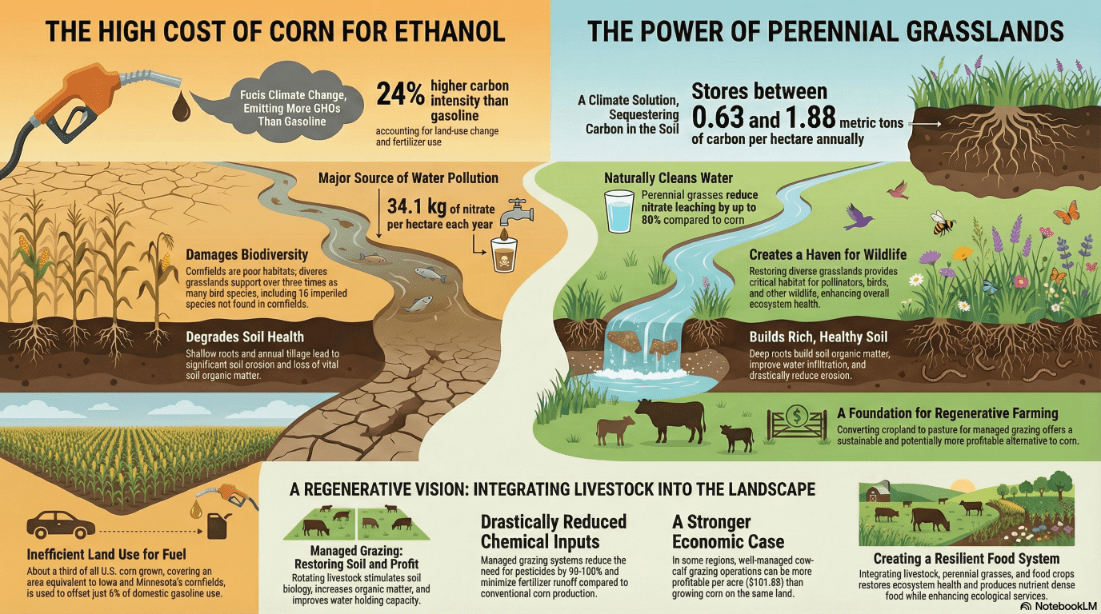
Unlike annually tilled corn monocultures, the deep and extensive root systems of perennial grasses remain undisturbed, continuously adding organic matter to the soil. Scientific synthesis of experimental data confirms their exceptional carbon sequestration potential. This is a powerful effect, with annual net soil organic carbon storage under herbaceous perennials ranging from 1.14 to 1.88 Mg C ha⁻¹ year⁻¹—a rate that dramatically exceeds the minimum threshold of 0.25 Mg C ha⁻¹ year⁻¹ required for a crop system to be considered a net mitigator of greenhouse gases. By converting land from an extractive annual system to a regenerative perennial one, we can actively draw down atmospheric carbon and store it securely in the soil.
3.2 Regenerative Agriculture and Climate Impact
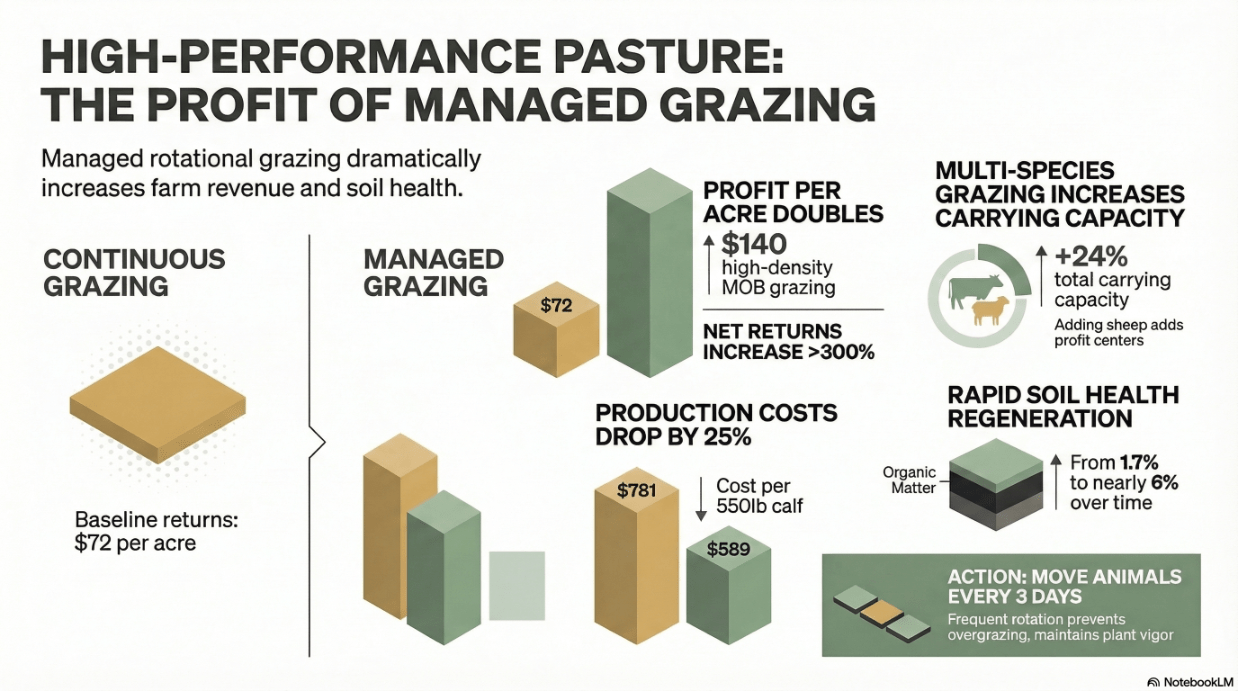
Managed grazing on perennial pastures is a cornerstone practice of regenerative agriculture, a holistic system of farming principles that seeks to restore and enhance ecosystem function. These practices collectively rank as the number one solution for sequestering greenhouse gases, challenging the conventional view of agriculture as a primary emissions source. This regenerative approach not only builds soil health but also fosters the biodiversity that leads to phytochemical richness in the forage base. This stands in sharp contrast to the soil degradation and loss of biodiversity often associated with conventional annual row-cropping systems that depend on intensive tillage and inorganic fertilizers.
While building soil carbon is a primary asset of this system, a holistic environmental accounting must also address its liabilities, particularly greenhouse gas emissions.
4.0 A Systems-Level View of Greenhouse Gas Emissions
Concerns surrounding enteric methane emissions from cattle are valid. However, a credible sustainability assessment requires moving beyond a single-metric analysis to a full “balance sheet” approach. This holistic system accounting evaluates both the liabilities (emissions) and the primary assets (carbon sequestration) to provide a comprehensive view of the net climate impact.
4.1 Methane as the Calculated Trade-Off for Upcycling
In the United States, enteric methane from beef cattle represents 1.8% of total greenhouse gas emissions. This emission must be framed as a calculated trade-off for the invaluable ecological service that ruminants provide: the upcycling of inedible biomass into high-quality food. It is the inherent cost associated with unlocking vast nutritional resources from land that cannot otherwise feed humanity, a core function of this regenerative agricultural model.
4.2 Sequestration and Dietary Factors as Strategic Mitigation Levers
An integrated grass-based system offers two powerful, built-in strategic levers for mitigating its own GHG footprint, creating a more balanced and potentially climate-positive outcome.
- Carbon Sequestration: The significant carbon sequestration potential of managed perennial grasslands, as previously detailed, is a primary asset on the system’s carbon balance sheet. In well-managed systems, the amount of carbon stored in the soil can offset a substantial portion of, and in some cases exceed, the GHG emissions produced by the grazing livestock.
- Dietary Mitigation through Phytochemical Richness: Diets based on diverse forages—which include a variety of forbs, shrubs, and trees—naturally reduce ruminant methane emissions. This is a direct result of the phytochemical richness of these biodiverse pastures. These plants contain compounds such as tannins and saponins, which have been scientifically shown to inhibit the methane-producing microbes in the rumen.
This holistic accounting reveals a system with advantages that extend beyond climate mitigation to crucial co-benefits for animal and human well-being.
5.0 Co-Benefits of Perennial Grass-Based Livestock Systems
The strategic shift from corn-for-ethanol to perennial grasslands offers a cascade of synergistic advantages that encompass crucial ethical and health-related considerations, creating a more humane and potentially more nutritious food system.
5.1 Advancing Animal Welfare Standards
The conditions common in large-scale feedlots can violate the internationally recognized “five freedoms” of animal welfare. In contrast, a well-managed, pasture-based system allows animals to express their natural behaviors. They are free to roam, graze, and self-select from a diverse diet, granting them access to the landscape’s phytochemical richness to maintain their own health and vigor. This approach aligns with higher ethical standards for animal husbandry. The welfare benefits of this system are not merely an ethical consideration; they are directly linked to the biochemical profile of the final food product.
5.2 Influence of Forage Diversity on the Nutritional Profile of Meat
The stress, confinement, and phytochemically impoverished diets of feedlot systems result in a different biochemical profile in meat compared to that from animals raised on diverse pastures. When livestock forage on phytochemically rich landscapes, their meat may in turn contain beneficial compounds that protect against protein oxidation and lipid peroxidation. The consumption of such meat may lead to lower post-meal inflammatory responses in humans, a factor implicated in several chronic diseases. This crucial distinction is often overlooked, as many epidemiological studies critical of red meat consumption fail to differentiate between meat from grain-fed feedlot livestock and meat from animals finished on diverse, phytochemical-rich pastures.
These significant co-benefits further reinforce the strategic value of this proposed land-use transition.
6.0 Conclusion: A Strategic Path Toward Sustainable Land Management
The evidence makes a compelling case for a strategic shift from the linear, extractive model of corn-for-ethanol to the cyclical, regenerative model of perennial grasslands for ruminants. This transition enhances food system efficiency by upcycling human-inedible biomass into a net-positive supply of high-quality protein. It delivers superior environmental outcomes by transforming agricultural lands into powerful carbon sinks that rebuild natural capital and climate resilience. A holistic GHG balance sheet reveals that sequestration and dietary factors within this integrated system create a more favorable climate profile. Finally, this transition offers significant co-benefits for animal welfare that are directly linked to a more advantageous nutritional profile for human health. This proposed land-use shift is not merely an alternative practice; it is a strategic imperative for de-risking our food system, rebuilding environmental health, and creating long-term value for future generations.