
1. Introduction: The Commodity Trap vs. The Regenerative Goldmine
For decades, the traditional agricultural model has been defined by the “Commodity Trap”—a grueling cycle where producers work harder to increase volume while remaining at the mercy of fluctuating global prices. Whether you are running a cow-calf operation or high-input row crops, the thin margins of continuous systems often vanish the moment input costs spike or market prices dip.
However, as a strategist, I am seeing a profound shift. Forward-thinking producers are moving away from the mindset of maximizing raw volume and toward a model of “biological intensification.” By shifting from a continuous grazing mindset to managed systems driven by data and soil health, it is possible to decouple from the commodity market and multiply returns. The secret to this regenerative goldmine isn’t buying more land; it is increasing the carrying capacity and efficiency of the acres you already own.
2. The Overgrazing Myth: Why 100 Cows Are Better for Your Soil Than One
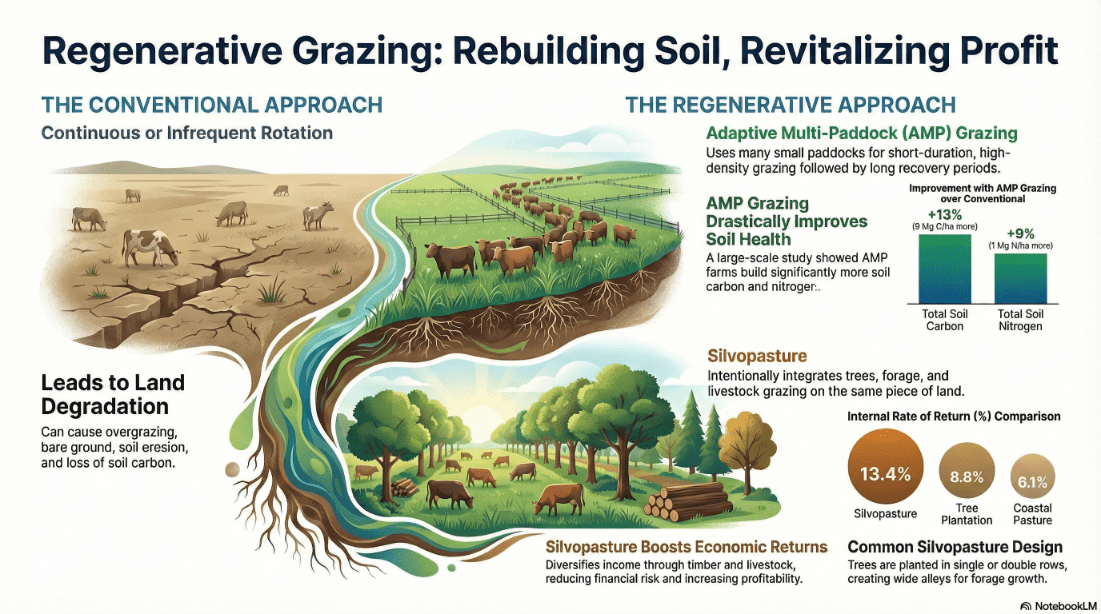
A common misconception in ranching is that “overgrazing” is a result of having too many animals. In reality, overgrazing is a function of time, not animal numbers. Traditional “Continuous Grazing” allows livestock unlimited access to a single pasture, where they repeatedly graze the most palatable plants before they can recover, eventually exhausting the root systems.
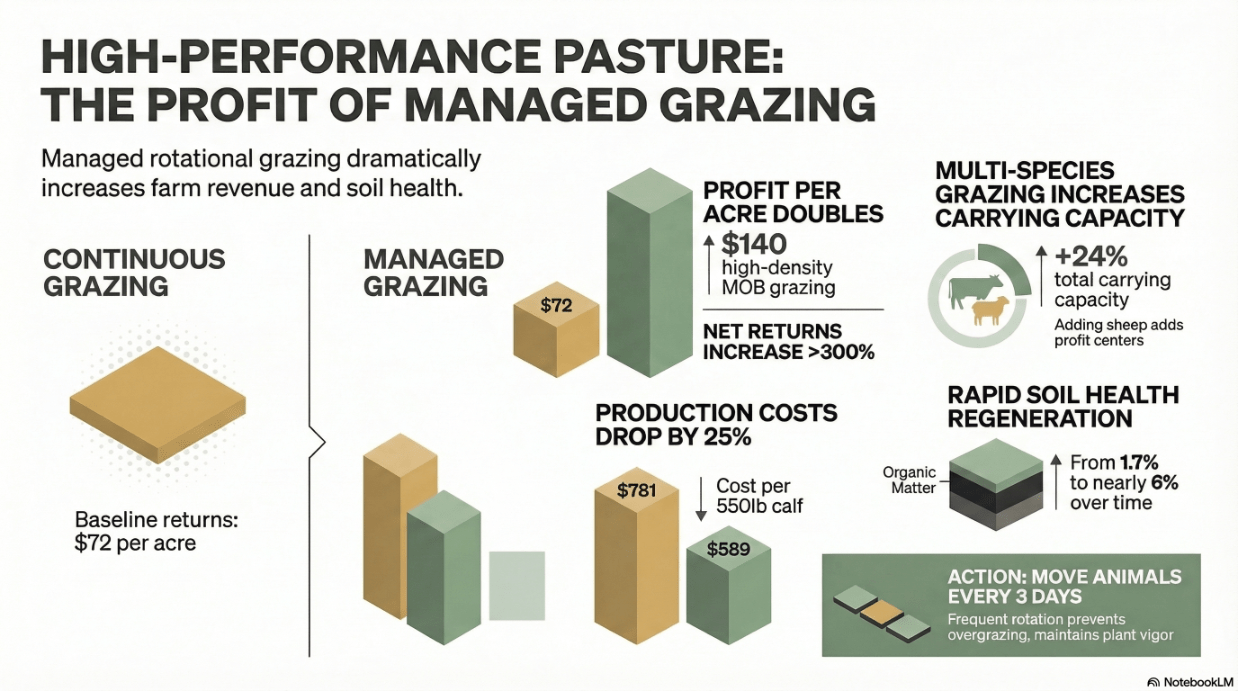
To maximize profitability, we must transition to Managed Rotational Grazing (MRG), specifically Management Intensive Grazing (MIG) or “Mob Grazing” (MOB). By moving animals every one to three days—or even multiple times per day—we capitalize on high stocking density followed by long recovery periods. This approach is more efficient; while continuous grazing typically has a low utilization rate of only 30%, a high-density MOB system can reach 75% utilization.
The research of Richard Teague and Steven Apfelbaum highlights a startling comparison: one cow grazing on 10 acres all season can kill thousands of plants through repetitive stress. Conversely, 100 cows grazing that same acre for a single day will not kill a single plant, provided the area is allowed adequate rest to maintain plant vigor and root depth.
“I’m convinced most ranchers give their cattle highest priority, followed by grass; little thought is given to soil. I suggest that is backwards. We should think soil first, as all life springs from the soil.” — Burke Teichert, Beef Magazine
3. Livestock as Biological Herbicide: The Multi-Species Advantage
In a business context, multi-species grazing is the definition of intensification—increasing revenue without increasing your land footprint. By integrating cattle, sheep, and hair sheep together, you can increase your total carrying capacity by 24% compared to cattle alone. This works because of the lack of “dietary overlap”:
- Cattle (Roughage Feeders): Focus primarily on grasses.
- Sheep (Intermediate Feeders): Prefer forbs (weeds).
- Goats (Concentrate Feeders): Target browse (brush and woody plants).
Using small ruminants transforms “weeds” into a second or third marketable product. Instead of spending $17.00 to $18.82 per acre on chemical sprays like 2,4-D or Grazon, livestock act as a “biological herbicide,” creating significant cost-saving opportunities.
Biological Weed Control Benefits:
- Targeted Suppression: Naturally controls Blackberry, Pigweed, and the notoriously difficult Sericea Lespedeza.
- Lowered Input Costs: Reduces or eliminates the need for expensive chemical weed spray.
- Parasite Management: Multi-species grazing breaks parasite life cycles, reducing veterinary expenses and disease transmission.
- Diversified Cash Flow: Marketing different products (lamb, goat, beef) at different times of the year spreads market risk.
4. Why Your Pasture is More Profitable Than a Corn Field
While row crops are often viewed as the “highest and best use” of fertile land, the financial data suggests managed grazing is the superior agribusiness move. According to the Land Stewardship Project, total farm returns on a 300-acre operation jump from 14,408 under continuous grazing to an exact **46,321** under high-density managed grazing.
The efficiency is found in the unit cost of production. In a continuous system, the cost per pound of calf produced is approximately 1.58. In a high-density MOB system, that cost drops to **1.19 per pound**. This lower unit cost is achieved despite higher costs for intensively-managed pasture, proving that management precision offsets operational expense.
From a capital expenditure standpoint, the hurdle is the 192.50 per acre cost for permanent electric fencing and watering systems. However, as a strategist, I view this as a **20-year depreciable asset**. When annualized, this is a mere **9.62 per acre per year**. Contrast this with the recurring annual costs of seed, fertilizer, fuel, and machinery depreciation required for corn or soybeans, which must be paid every single season. Furthermore, savvy managers can utilize USDA EQIP cost-share funds to further subsidize this infrastructure investment, significantly lowering the initial barrier to entry.
5. Resiliency is the New ROI: Lessons from the “Flash Drought”
Profitability is not just about the best years; it is about surviving the worst ones. Mike and Jennifer Rupprecht, who have practiced managed rotational grazing for 30 years, demonstrated this during a recent five-week “flash drought.” While neighbors’ fields failed, the Rupprechts’ pastures—built on decades of soil health—kept growing.
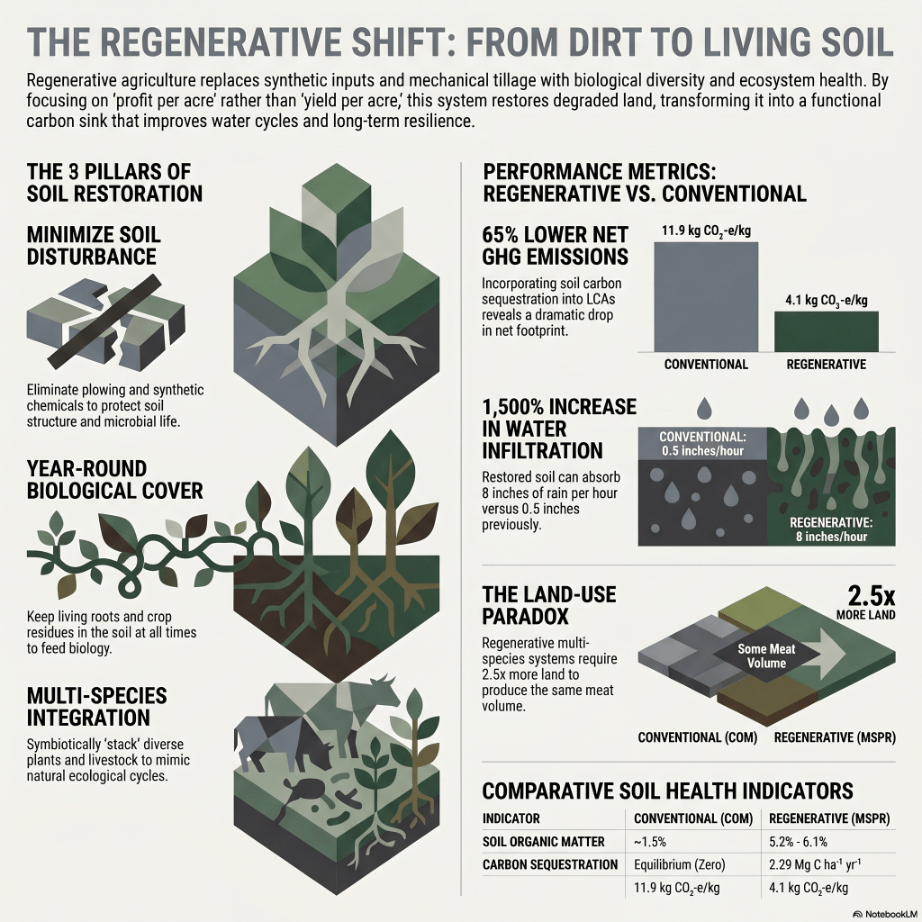
This resiliency is fueled by Soil Organic Matter (SOM). By stocking cattle in high numbers on pastures and diverse cover crop mixes, North Dakota farmer Gabe Brown famously raised his organic matter on depleted fields from 1.7% to nearly 6%. This SOM acts as a biological sponge, soaking up heavy rainfalls and retaining moisture during dry spells, providing a buffer against climate volatility.
“With a well-managed grazing system, I am producing income on land that should never be tilled.” — Mike Rupprecht
6. The “Business of Farming”: Why KPIs Are Your Best Management Tool
Transitioning to high-margin agribusiness requires a shift toward data-driven decision-making. Utilizing Key Performance Indicators (KPIs) allows you to identify exactly where your operation is leaking capital.
Based on Navfarm insights, the top three KPIs for a grazing operation are:
- Feed Conversion Ratio (FCR): This is the gold standard of grazing efficiency, measuring exactly how much forage is required to produce a unit of weight gain. It tracks your forage-to-meat efficiency.
- Revenue Per Acre: This assesses the economic viability of your grazing intensity versus alternative land uses like row crops.
- Soil Health Index: Monitoring nutrient levels and SOM provides a baseline for long-term land appreciation and natural fertility.
Beyond the field, the most profitable producers are those entering the “trenches” of direct-to-consumer sales. Navigating the logistics of permits, inventory management, and certifications like “grass-fed” allows you to capture the retail margin usually lost to middlemen.
7. Conclusion: A Forward-Looking Harvest
The evidence is clear: modern farming profitability is found in the synergy between livestock diversity, soil health, and intensive management. By moving away from a “mining” mindset—where the soil is a resource to be exhausted—and toward an “investment” mindset, you build an operation that is both financially superior and environmentally resilient.
If your soil is your most valuable asset, are you treating it like a resource to be mined, or an investment to be grown?