
1. Introduction: The Death of the Jeffersonian Ideal
The historical baseline of the American Heartland was built upon the “Jeffersonian ideal”—the vision of the independent yeoman farmer whose autonomy and land ownership served as the primary defense against the concentration of political and economic power. Today, this ideal is effectively dead, replaced by a systemic transition toward “Corporate Feudalism.”
As an agribusiness socio-economist, I define Corporate Feudalism as a paradigm where the “Jeffersonian” autonomy of the family farmer is supplanted by a rigid, vertically integrated hierarchy. In this new order, multinational agribusinesses act as “integrators” (the new lords), wielding monopsony power to control market access and proprietary biological assets. Meanwhile, the independent producer is subjected to a process of proletarianization, relegated to a debt-leveraged vassal whose labor is extracted while they bear the overwhelming weight of asymmetric risk.
2. From Farmers to Vassals: The Mechanics of Contract Serfdom
The modern agricultural landscape functions through a theoretical framework where legal and economic obligations mirror the manorialism of the Middle Ages.
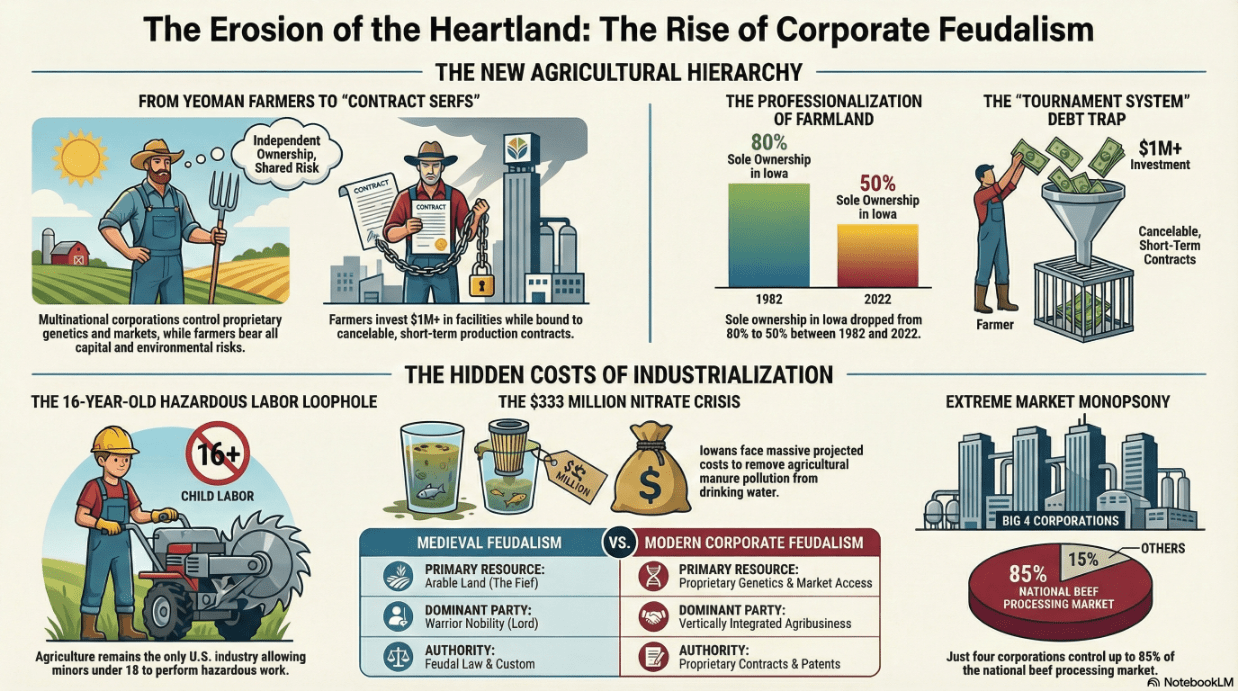
Comparison of Feudal Structures
| Feature | Medieval Feudalism | Modern Corporate Feudalism |
| Primary Resource | Arable Land (The Fief) | Proprietary Genetics and Market Access |
| Dominant Party | Warrior Nobility (Lord) | Vertically Integrated Agribusiness (Integrator) |
| Dependent Party | Vassal or Serf | Contract Producer or Grower |
| Obligation | Service and Labor for Protection | Debt Servicing and Production for Fees |
| Risk Allocation | Lord bears political/military risk | Farmer bears capital, environmental, and mortality risk |
| Authority | Feudal Law and Custom | Proprietary Production Contracts and Patents |
Under this system, the “fief” consists of proprietary genetics and seed patents. To gain market access, a farmer must invest upwards of $1 million in specialized CAFO (Concentrated Animal Feeding Operation) infrastructure, typically financed through long-term mortgages. This creates a state of debt-bondage. The farmer does not own the pigs or the feed; they are essentially a “glorified janitor” providing hospitality and waste management for corporate assets.
The economic cruelty of this system is codified in the Tournament System. Compensation is determined by a net return formula that exposes the producer’s vulnerability:
R_{producer} = \left( \frac{F_{fixed} + B_{incentive} – C_{operating}}{D_{service}} \right)
In this equation, B_{incentive} (the performance bonus) is a volatile variable controlled by the integrator, who provides the chicks, pigs, and feed. If the corporation provides a substandard batch of biological inputs, the producer is penalized for the resulting poor performance, yet their D_{service} (debt obligation) remains fixed. The integrator captures record profits while the producer is squeezed toward insolvency.
3. The Financialization of the Soil: Shifting Land Ownership (1982–2022)
Using Iowa as a proxy for the broader Heartland, we see the “Great Erosion” manifesting as a historically unprecedented rate of land turnover. The soil is being treated as a financial asset class—a stable hedge against inflation—rather than a community resource.
Shifting Ownership Patterns in Iowa Farmland
- The Decline of Autonomy: “Sole Owner” and “Joint Tenancy” holdings—the hallmark of the family farm—plunged from 80% in 1982 to 50% in 2022.
- The Rise of Institutional Control: Trusts now hold 23% of Iowa’s farmland, while LLCs have surged to 9%.
- The Demographic Auction Block: 66% of Iowa farmland is owned by those over 65. Most critically, a record 37% of the land is held by those aged 75 and older.
- Absentee Stewardship: 55% of the land is owned by non-farmers. This absenteeism creates a profound disconnect from ecological stewardship, as profits move toward urban or global centers rather than back into the soil.
Importantly, while foreign ownership is often a political lightning rod, it remains limited to approximately 2% of agricultural land, primarily tied to wind energy leases. The true threat to the Heartland is not a foreign invasion, but the domestic and global corporate financialization that places the Heartland on a permanent auction block for institutional investors.
4. The Human Toll: Persistence of Child Labor and Worker Exploitation
The industrial agricultural model is sustained by a systemic reliance on vulnerable workforces. By “subcontracting the liability,” corporations like Tyson and Perdue create a shield of plausible deniability regarding the exploitation of migrant and child labor.
Why Child Labor Persists in Agriculture
- FLSA Loopholes: The Fair Labor Standards Act allows 16-year-olds to perform hazardous agricultural work, while other sectors require a minimum age of 18.
- Subcontracted Liability: Corporations use third-party cleaning services to “insulate” themselves from legal repercussions. A prime example is Packer Sanitation, which was fined $1.5 million for illegally employing over 100 children in hazardous roles across various plants.
- Racialized Neglect: As Reid Maki of the Child Labor Coalition notes, “these loopholes are allowed to exist because Congress just doesn’t care enough about Brown kids.” The workforce is largely comprised of the 400,000 unaccompanied minors who have crossed the southern border since 2021.
Harrowing DOL investigations have found children as young as 12 cleaning dangerous “kill floor” equipment at 2:00 a.m. Recent tragedies include the death of a 16-year-old at a Mar-Jac plant and the shredding of a 14-year-old’s arm at a Perdue facility. Despite this, Iowa recently passed SF 542, a bill weakening child labor protections to allow 14-year-olds to work night shifts in meatpacking plants, prioritizing industrial labor supply over the safety of youth.
5. The $333 Million Crisis: Externalizing Environmental Debt
The CAFO model relies on the externalization of costs—socializing the environmental damage while privatizing the profits.
Iowa’s livestock population produces manure equivalent to the waste of 168 million people—more than 50 times the human population of the state.
This waste crisis has transformed Heartland waterways into conduits for pollution. Currently, 92% of the nitrogen in Iowa’s waters comes from nonpoint agricultural sources. The result is a projected $333 million cost for nitrate removal from drinking water over the next five years. This is not merely a financial debt; it is a public health crisis, with long-term nitrate exposure linked to increased rates of thyroid cancer, bladder cancer, and birth defects.
6. The Hollowing of Main Street: Social Decay and School Consolidation
The “Get Big or Get Out” agenda has triggered a catastrophic “leakage” of wealth. Because industrial operations bypass local vendors in favor of corporate headquarters in Arkansas or China, the economic “multiplier effect” that once sustained rural towns has vanished.
Rural Communities: Then vs. Now
- Hog Producers: Iowa once boasted 50,000 independent hog farms; today, that number has declined by 90% even as the total hog population has reached record highs.
- Retail Dominance: Independent grocers have been displaced by Dollar General, which now serves 80% of towns with fewer than 20,000 people. Research shows that the entry of a dollar store makes a local grocer 5% more likely to close, acting as an accelerant of rural poverty.
- Social Capital: The closure of a school is the ultimate trauma for a rural community. When schools consolidate, the town loses its “social glue” and identity, making it impossible to retain the next generation.
7. Resistance and the Path to Resilience: Regenerative Alternatives
Restoring the Heartland requires a shift toward “Responsible Agriculture” that centers farmer autonomy and ecological worth.
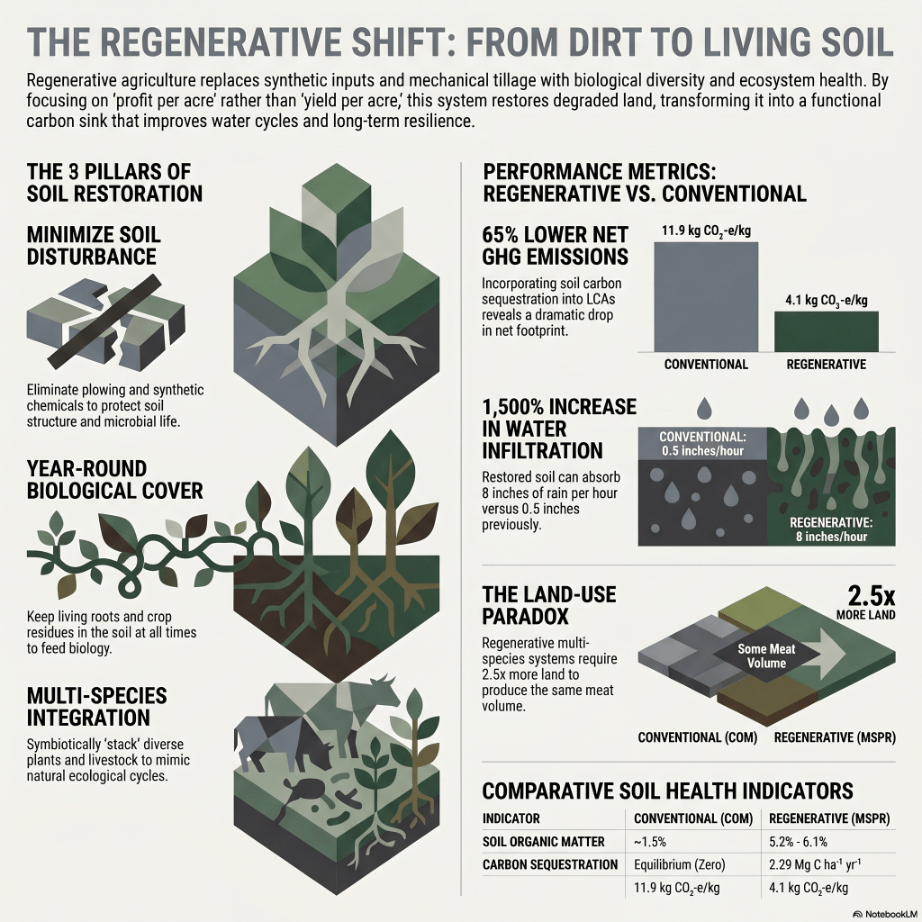
- Regenerative Practices: Moving beyond monocultures toward cover cropping and rotational grazing to sequester carbon and restore soil health.
- Producer Cooperatives: Using models like the Perennial Promise Growers Cooperative to pool resources and market sustainable crops like Kernza (a perennial grain), allowing farmers to bypass corporate integrators.
- Local Market Diversification: Organizations like Practical Farmers of Iowa (PFI) are leading the transition toward organic and perennial production, recapturing the value that is currently “leaking” out of the state.
8. Conclusion: The Breaking Point
The Heartland is standing at a precipice. The economic outlook for 2025-2030 is grim: Iowa’s net farm income is projected to drop to $10.60 billion in 2025, a staggering 30% decline from its 2022 peak. This cost-price squeeze is the logical conclusion of the Corporate Feudal model.
The question for the next decade is whether the Heartland will remain a corporate-owned factory of extraction or return to a diversified, regenerative agrarian economy. To save the Heartland, we must reject the “vassalage” of contract farming, support local producer cooperatives, and advocate for policies that hold agribusinesses accountable for their environmental and human debts.