
It is the great paradox of modern agriculture: the bovine—an animal that evolved over millennia to turn cellulose into protein—often can no longer survive on a diet of grass. The industrial machine of the late 20th century didn’t just ignore survival traits; it systematically purged them. By tethering livestock to a “synthetic matrix” of grain rations, sub-therapeutic antibiotics, and chemical crutches, the industry created a fragile animal optimized for the feedlot but helpless in the field.
Today, a new biological frontier is emerging. Regenerative agriculture is reclaiming the cow, treating it not as a passive product but as a sophisticated biological tool for soil restoration. This movement is fueled by a radical shift in genetics, moving away from high-maintenance “passengers” and toward resilient “doers” that thrive where the industrial model fails.
The Failure of the “Synthetic Matrix”
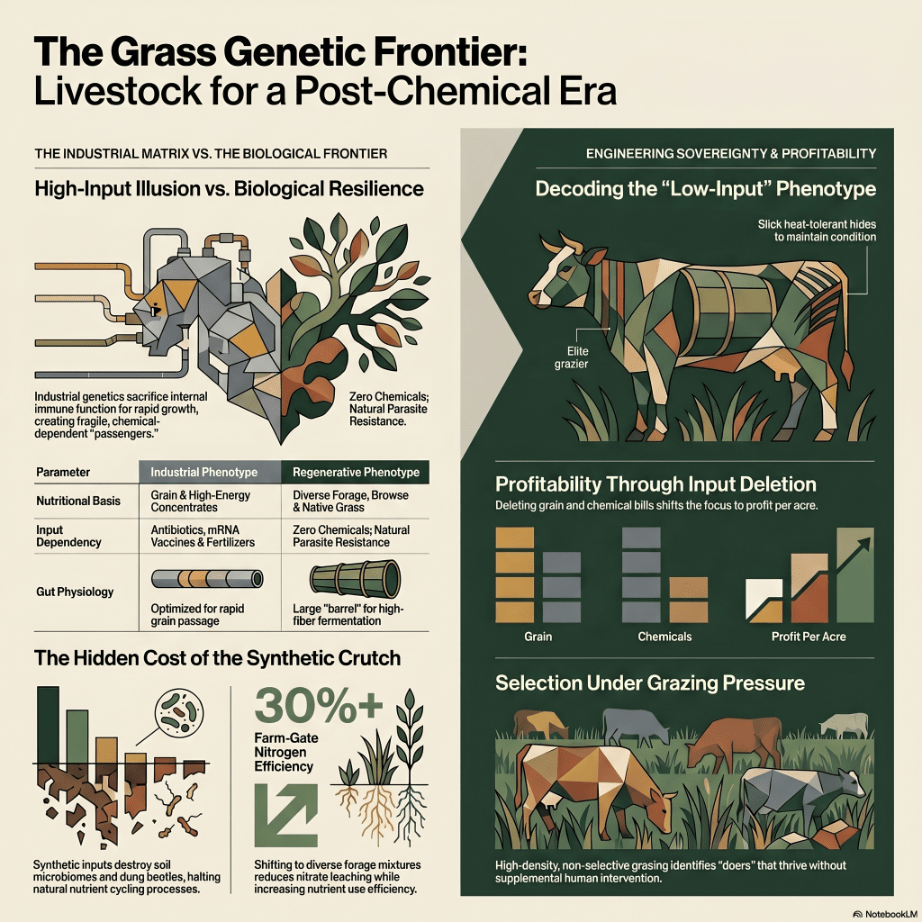
Industrial ranching has effectively deleted the ancestral hardiness of cattle. In a grain-dependent system, livestock are maintained on a life-support system of mRNA vaccines and synthetic wormers. These phenotypes have a high metabolic overhead and low gut capacity; when they are removed from the industrial machine and placed on rugged, chemical-free pastures, their performance collapses. They simply lack the physical machinery to ferment the fiber found in standing forage.
| Parameter | Industrial Phenotype | Regenerative Phenotype |
| Nutritional Basis | Grain, concentrates, high-quality hay | Diverse forage, browse, standing grass |
| Input Dependency | Antibiotics, mRNA vaccines, anthelmintics | Zero chemicals, natural resistance |
| Environmental Adaptation | Low (requires climate control/shelter) | High (heat tolerant, parasite resistant) |
| Selection Tool | Genetic markers for growth | Selection “under fire” (grazing pressure) |
| Gut Physiology | Optimized for rapid passage/grain | Large “barrel” for fiber fermentation |
——————————————————————————–
Takeaway #1: The Rise of the “Southern Mama Cow”
To beat the heat of the American Southeast, ranchers are turning to the South Poll. Developed in the 1990s by Teddy Gentry, this breed is a strategic four-way cross of Red Angus, Barzona, Hereford, and Senepol. It was engineered to solve a specific industrial failure: the “cooking” cow.
In humid climates, traditional European breeds often stop grazing and seek shade to avoid overheating. As Greg Judy observes, “in the sun they’d cook.” The South Poll, however, possesses “slick hair” and a moderate frame that allows it to maintain fertility and continue grazing during peak summer heat. This is the “10 pounds of sugar in a 5-pound sack” philosophy—a compact, high-output animal that produces more beef per acre because, as Judy puts it, “the money comes from animals that can excel on a grass diet.”
Takeaway #2: Ancient Genes are the New Chemical-Free Frontier
While the South Poll is a modern triumph, the frontier also looks backward to the Mashona of Zimbabwe and the heritage Pineywoods. These animals represent a “wild foraged” resilience, consuming not just grass but a biodiverse buffet of kudzu, brambles, and woody browse.
The Pineywoods, descending from 16th-century Spanish stock, recently delivered a blow to industrial logic. A butcher with 30 years of experience was stunned to find exceptional rib-eye marbling and tenderness in Pineywoods beef that had never tasted a grain of corn—a feat previously thought impossible without feedlot rations. This genetic hardiness allows operations like the Ayavalla Land Company to eliminate the “chemical crutch” entirely:
“Our cattle are chemical free. They receive no hormones, vaccinations or parasite medication. This means their manure is organic fertilizer and that is how we manage the land with no synthetic fertilizers.” — Ayavalla Land Company
Takeaway #3: The “Barrel” is the Most Important Biological Tool
In the regenerative model, an animal’s value is determined by its gut. The “barrel”—the massive stomach capacity required to ferment fiber—is the primary engine of forage conversion efficiency. Industrial cattle, bred for rapid passage of grain, have a lower gut capacity and a higher metabolic overhead, making them “passengers” that require handouts.
Identifying the “doers” requires a process of relentless culling under pressure. Through high-density, non-selective grazing, cattle are forced to consume a high percentage of available forage rather than just the “best bites.” This acts as a biological filter. Greg Judy’s mantra for selection is absolute: “You’ll never have a herd any better than what you are willing to cull for.” If an animal can’t maintain condition and breed back on forage alone, it is removed—even, as Judy notes, if they “look at you funny.”
Takeaway #4: Diverse Pastures are a Nutritional “Gold Mine”
The biological frontier replaces “simple” ryegrass with multispecies swards (MSS). Data shows that incorporating diverse species can reduce the need for imported feed by up to 46% and increase milk solids production by 3%. These pastures are a “nutritional gold mine” that use secondary plant metabolites to solve environmental problems:
- Chicory: Rich in minerals with sesquiterpene lactones that act as natural anthelmintics (dewormers).
- White Clover: A biological nitrogen factory, fixing atmospheric N into the soil.
- Plantain: A technical powerhouse for nitrogen management. It reduces nitrate leaching through a “dilution effect” (increasing water intake and urine volume) and biological nitrification inhibition via compounds like aucubin, which keep nitrogen in the soil longer.
Takeaway #5: Shifting the Goal from “Weight” to “Profit per Acre”
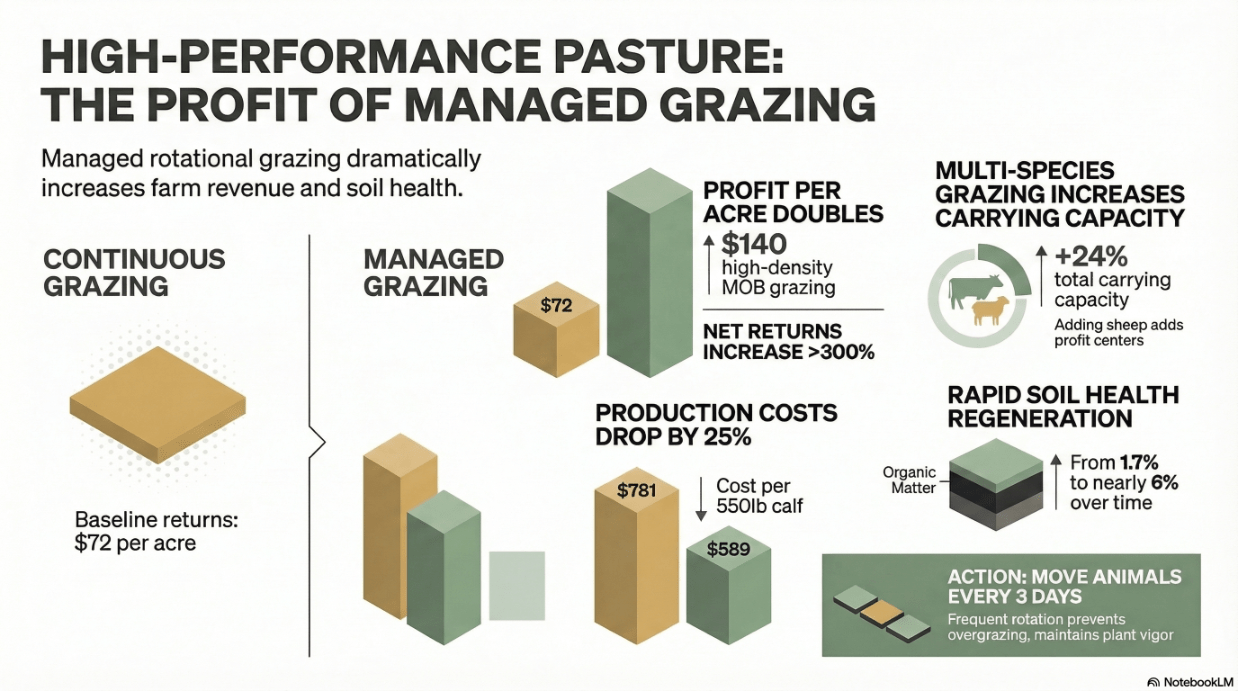
The ultimate shift in the “grass genetic” frontier is the socio-economic dismantling of agribusiness. Traditional models measure success by individual animal weight, ignoring the astronomical cost of the “synthetic crutch.” Regenerative ranching pivots to “profit per acre” and soil health.
By “deleting” the grain bill, vaccine overhead, and synthetic fertilizer costs, the balance sheet is transformed. Success is no longer about how big the cow is, but how efficiently it uses the land. In this system, the animal is a tool for soil regeneration, creating a self-sustaining cycle where fertility is built for “free” through the herd effect and nutrient cycling.
——————————————————————————–
Conclusion: The Livestock of 2026 and Beyond
The future of food is being written at the intersection of the soil and the gut. We are moving toward site-specific genetics like the “Ayavalla Hybrid”—a sophisticated composite of Mashona, Red Angus, Red Devon, South Poll, and Beefmaster—engineered to turn local environmental pressures into high-quality protein.
As the efficacy of the industrial “chemical matrix” continues to wane, we face a fundamental choice. Does the future of our food system lie in the high-tech, high-input laboratories of the past, or in the resilient, forage-driven genetics of the biological frontier?
The next time you choose your beef, ask yourself: are you supporting a failing machine, or an ecosystem in rebirth?