
1. Introduction: The Rebel Narrative and the 2026 Crisis
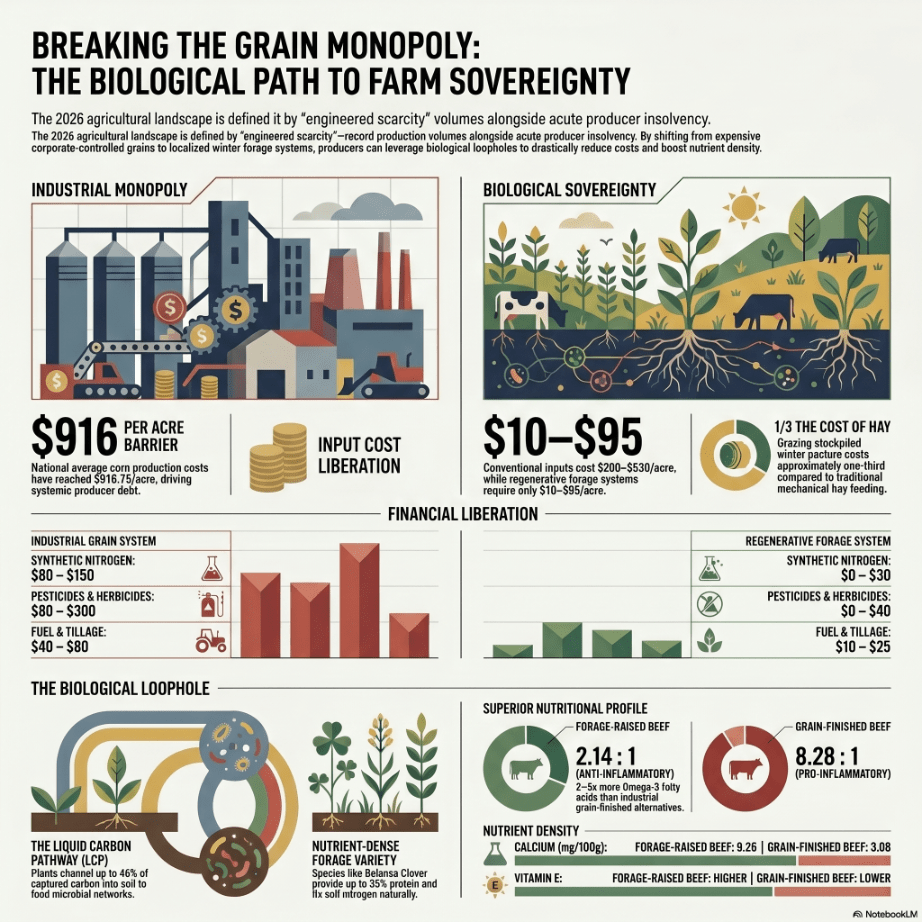
The year 2026 marks the definitive collapse of the industrial grain-heavy matrix. We are currently navigating a “profit compression” event where the national average cost to produce an acre of corn has surged to a staggering $916.75, while global commodity prices continue to soften. This is not a market fluctuation; it is an engineered scarcity. The system is designed to keep the producer in a perpetual state of debt, tethered to high-cost synthetic inputs and global supply chain volatility.
However, a biological loophole has emerged for those willing to commit an act of producer sovereignty. By shifting from grain-heavy dependencies to high-protein winter forage cycles, we are bypassing the industrial bottleneck. This is the biology of resistance: a system that leverages cold-hardy forages and soil microbial health to thrive outside the commodity trap.
2. The Matrix of Engineered Scarcity: 2026 Global Realities
The 2026 macroeconomic landscape is a warning to every producer still following the old playbook. While net farm income is projected at $142.5 billion, the “Sticky Cost Plateau” remains—input costs for seed and technology are up 3.2%, even as the U.S. share of global exports has plummeted from 47% in 2000 to just 22% today.
The driver of this collapse is clear: Brazil has doubled its harvested acres to 177 million, capturing the market share once held by the American producer. Simultaneously, China—the primary destination for U.S. grain—is facing a shrinking population and a GDP growth rate that has slowed to less than 5%. Relying on an export-driven grain model is no longer a business strategy; it is a liquidation plan.
The Commodity Trap (2026 Data)
| Metric | Industrial Grain Matrix (Corn/Soy) | Sovereign Biological Systems (Forage) |
| Input Cost (Per Acre) | $750.00 – $916.75 | $10.00 – $95.00 |
| Export Exposure | High (Facing 22% Global Share) | Low (Localized/Regional Focus) |
| Market Dependency | China/Brazil Price-Fixed | Community/Soil Controlled |
| Primary Financial Goal | Solvency Preservation (Debt Management) | Profit Resilience (Equity Building) |
3. The Biology of Resistance: High-Protein Winter Forage Systems
To break the monopoly, we must master the “Biology of Cold-Hardy Protein.” Unlike the dead-soil model of fallow grain fields, winter forage systems utilize “liquid carbon pathways.” By keeping living roots in the ground through the dormant season, plants continuously pump photosynthates to soil microbes. This microbial activity maintains soil temperature and structure, ensuring rapid spring recovery and superior nutrient density compared to processed concentrates.
Key Winter Forage Varieties for 2026:
- Cereal Rye: The ultimate cold-weather weapon; extremely hardy and the first to provide spring growth.
- Triticale: A wheat-rye hybrid offering elite cold tolerance and high-quality forage.
- Ryegrass: Highly palatable with aggressive regrowth, provided moisture is managed.
- Brassicas (Turnips, Radishes): These energy-dense “biological drills” stay green in freezing temperatures and improve soil aeration.
The Strategic Sward:
- Cool-Season Annuals: Small grains that provide high-yield protein during traditional “dead” months.
- Legumes (Clovers, Vetch): Essential nitrogen-fixers that eliminate the need for synthetic N-fertilizer, naturally charging the soil for the next cycle.
4. The Mechanics of Liberation: Integrating High-Intensity Winter Grazing
Liberation from the matrix is a mechanical shift. Moving cattle from indoor confinement to active winter landscape management through “Bale Grazing” and “Swath Grazing” turns the herd into a biological workforce. Instead of hauling waste, you are depositing fertility.
As demonstrated in global trials ranging from the heavy clay floodplains of the UK to the rangelands of Alberta, the cost disparity is undeniable:
| Corral Feeding (The Old Matrix) | Extensive Wintering (The Sovereign System) |
| Fuel: >$3,500/season for daily tractor feeding | Fuel: <$50/season for initial site setup |
| Housing: £2.40 [~$3.10] per head/day | Outwintering: £1.00 [~$1.30] per head/day |
| Labor: $4,830 in seasonal hauling/feeding costs | Labor: <2,800 (Swath grazing saves >2,000) |
| Impact: Manure is a waste liability | Impact: Manure/Trampled hay builds topsoil |
In the sovereign system, cattle harvest their own protein while naturally fertilizing dormant topsoil. This is a holistic benefit where carbon and nutrients are returned to the land rather than being hauled to a lagoon.
5. Financial Sovereignty and Localized Nutrient Density
The economic rebellion is fueled by the elimination of the middleman. Regenerative systems save producers between $105 and 435 per acre by removing the need for synthetic fertilizers (50–120/acre savings) and chemical pesticides (25–$175/acre savings).
The Drivers of Farm Solvency:
- Input Elimination: Shifting to nitrogen-fixing legumes can save up to $150 per acre in fertilizer costs alone.
- Market Decoupling: By bypassing retail grocery monopolies and selling in bulk—such as “half-cow” shares—producers provide consumers with 20–30% savings while increasing their own margins.
- Logistics Efficiency: Localized processing and shorter supply chains save consumers roughly $0.30 per pound by eliminating the 25% of retail costs typically lost to processing and long-haul transportation.
6. The Roadmap to Food Sovereignty: Reclaiming the Future
To scale these systems, we must adopt Technological Sovereignty. We are no longer guessing; we are using precision data to reclaim our land’s potential.
- Manage the “Profit Engine”: Data from Teagasc indicates that “Grass Eaten” (pasture utilization) explains 40% of the difference in farm profitability.
- Satellite Precision: Utilize tools like Pasture.io to track the “feed wedge” via satellite measurement. Managing grazing at the 2.5-to-3 leaf stage is the difference between profit and waste.
- Climate Whiplash Playbooks:
- The “Too Wet” Playbook: Protect soils from “pugging” by using standoff pads and sacrifice paddocks to preserve future regrowth.
- The “Too Dry” Playbook: Protect residuals and slow the rotation early to maintain the “biological pump” and prevent plant exhaustion.
- Decentralized Market Access: Use geolocation platforms to connect directly with regional consumers, cutting 70–80 per animal in trucking and handling fees.
7. Summary Table: The Economic Shift
| Metric | Industrial Grain Dependency | Regenerative Winter Forage |
| Soil Impact | Nutrient depletion and erosion risk | Improved organic matter and liquid carbon storage |
| Producer Debt/Profit | High debt/low margin; $916.75/acre cost | High solvency; 105–435/acre input savings |
| Nutrient Control | Dependent on global processed concentrates | Self-harvested, nutrient-dense biologicals |
| Climate Resilience | Fragile; dependent on “sticky” inputs | Robust; flexible rotations and feed buffers |
The grain monopoly is an obsolete relic of a high-input, low-margin past. By reclaiming control of your biological assets and soil health, you are no longer a victim of the 2026 commodity squeeze—you are the architect of a resilient, sovereign food system.