
1. Introduction: Setting the Scene
The image of a wind turbine’s blade striking a bird is a powerful and common concern in discussions about renewable energy. While the direct impact of this green technology on avian populations is a valid and important issue, a critical question remains: how does this modern threat compare numerically to other human-caused dangers, particularly the long-standing legacy of chemical pesticides?
This article provides a data-driven analysis of these two specific sources of bird mortality. By examining figures from scientific studies and national reports, we can place the scale of each problem into a clearer, more objective perspective, moving beyond anecdotal evidence to understand the comparative risks.
2. The Impact of Wind Turbines: A Modern Energy Challenge
Scientific assessments have sought to quantify the direct impact of wind turbines on bird populations. According to a 2005 study by Erickson et al., cited in a National Research Council report, wind turbines in the United States were estimated to kill between 20,000 and 37,000 birds annually in 2003. While this national average provides a baseline, localized studies can reveal far higher mortality rates depending on geography and species composition, as a recent comprehensive study from India’s Thar Desert demonstrates.
The findings from this study highlight the significant variables that can influence mortality rates.
- Bias-Adjusted Mortality Rate: The study estimated a mortality rate of 1.24 birds per turbine per month, which equates to approximately 14.9 birds per turbine per year.
- Landscape-Level Impact: This yielded an annual mortality estimate of approximately 4,464 birds per 1,000 km² in an area containing roughly 300 turbines.
- Comparison to Global Rates: The study’s authors note that this mortality rate in the Indian Thar desert is “near the upper limit of global estimates of its kind.”
It is important to note that the researchers define this mortality as the compounded effect of the turbines and their associated power lines within the 150m search radius.
While pigeons and doves (Columbidae) accounted for a high number of total deaths due to their sheer abundance, the study identified raptor families as the most vulnerable. After accounting for their relative numbers and flight patterns, families such as Falconidae (falcons) and Accipitridae (hawks and eagles) were found to be most at risk. This finding corroborates a general conservation concern for raptors, which are often victims of energy infrastructure worldwide.
3. Placing Wind Energy in the Broader Context of Man-Made Threats
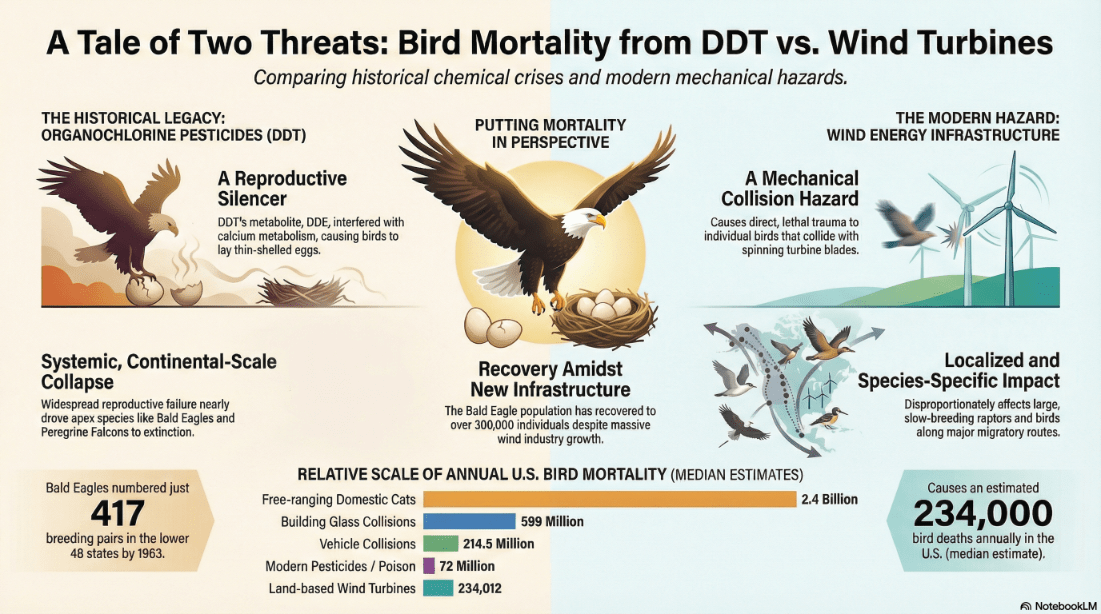
To accurately scale the problem, it is essential to compare wind turbine-related fatalities with other anthropogenic, or human-caused, sources of bird mortality. The National Research Council report concludes that “bird deaths caused by wind turbines are a minute fraction of the total anthropogenic bird deaths—less than 0.003% in 2003.”
The table below, using estimates provided by Erickson et al. (2005) and the U.S. Fish and Wildlife Service, illustrates this disparity.
Annual Anthropogenic Bird Mortality in the U.S.
| Source of Mortality | Estimated Annual Bird Deaths |
| Wind Turbines | 20,000 to 37,000 |
| Communications Towers | 4 million to 50 million |
| Cars | 80 million |
| Toxic Chemicals (incl. pesticides) | More than 72 million |
| Buildings | 97 million to 976 million |
| Domestic Cats | Hundreds of millions |
| High-Tension Lines | 130 million to over 1 billion |
This comparison does not dismiss the impact of wind turbines. Instead, it serves to contextualize the issue, showing that other, more pervasive threats are responsible for a vastly larger number of avian deaths each year.
4. The Chemical Legacy: A Persistent and Pervasive Threat
When comparing wind turbines directly to chemical agents, the difference in scale is stark. The National Research Council report provides a clear and sobering statistic:
“Toxic chemicals, including pesticides, kill more than 72 million birds each year…”
This figure stands in sharp contrast to the estimated 20,000 to 37,000 annual deaths from wind turbines during the same period. The lowest estimate for mortality from toxic chemicals is thousands of times greater than the highest estimate for wind turbines, highlighting a threat of a completely different magnitude.
5. Conclusion: Beyond the Numbers – A Path Forward for Green Energy
The data is clear: on an absolute numerical basis, pesticide-related deaths represent a far larger threat to bird populations than wind turbines. However, this does not render turbine mortality insignificant. It remains a serious conservation issue, particularly for vulnerable raptor populations that are disproportionately affected.
To address this, scientific research points toward practical solutions that can reconcile the growth of wind energy with the need for biodiversity conservation. The Thar Desert study offers key management implications for a responsible path forward:
- Strategic Siting: Future wind farm development should prioritize the avoidance of “critical habitats for raptors, bustards, and other threatened species.”
- Mitigation Measures: There is an urgent need for the large-scale testing and implementation of mitigation strategies. One promising method suggested by researchers is “painting half of one blade black” to increase visibility and reduce motion smear for approaching birds, thereby minimizing collisions.
Ultimately, the expansion of wind energy must be paired with rigorous ecological assessments and proactive mitigation. By doing so, we can ensure that the “environment-friendly ethos” of green energy is fully realized, bridging the gap between developing sustainable power and conserving the natural world.