
1. Introduction: The Evolution of Pasture Defense
For over a century, the ranching industry has been locked in an “Old-World” paradigm of pasture defense—a reactive, linear approach characterized by lead, steel, and poison. This mechanical mindset viewed predators as a variable to be deleted rather than a biological force to be managed. However, the data is unequivocal: lethal control is a fleeting tactical fix for a structural ecological problem. Research within the Northern Rockies has demonstrated that when a wolf pack is lethally removed, the resulting “territorial vacuum” is almost invariably filled by a new pack within two years.
This cycle of violence is not only ecologically destabilizing but financially ruinous. In 2010 alone, the costs associated with depredation investigations, lethal control, and state-sanctioned compensation exceeded $1.5 million in the Northern Rockies region. We are now witnessing the birth of a “New-World” paradigm: Ecological Security. This approach utilizes “biological hacking”—leveraging a predator’s own ancestral hardwiring—to create a landscape of fear that protects livestock without compromising the ranch’s biological integrity. As public opposition to lethal management scales, the shift toward decentralized, high-tech biological intelligence is no longer optional; it is the prerequisite for the modern land steward.
2. The Economic Case for Non-Lethal Intelligence
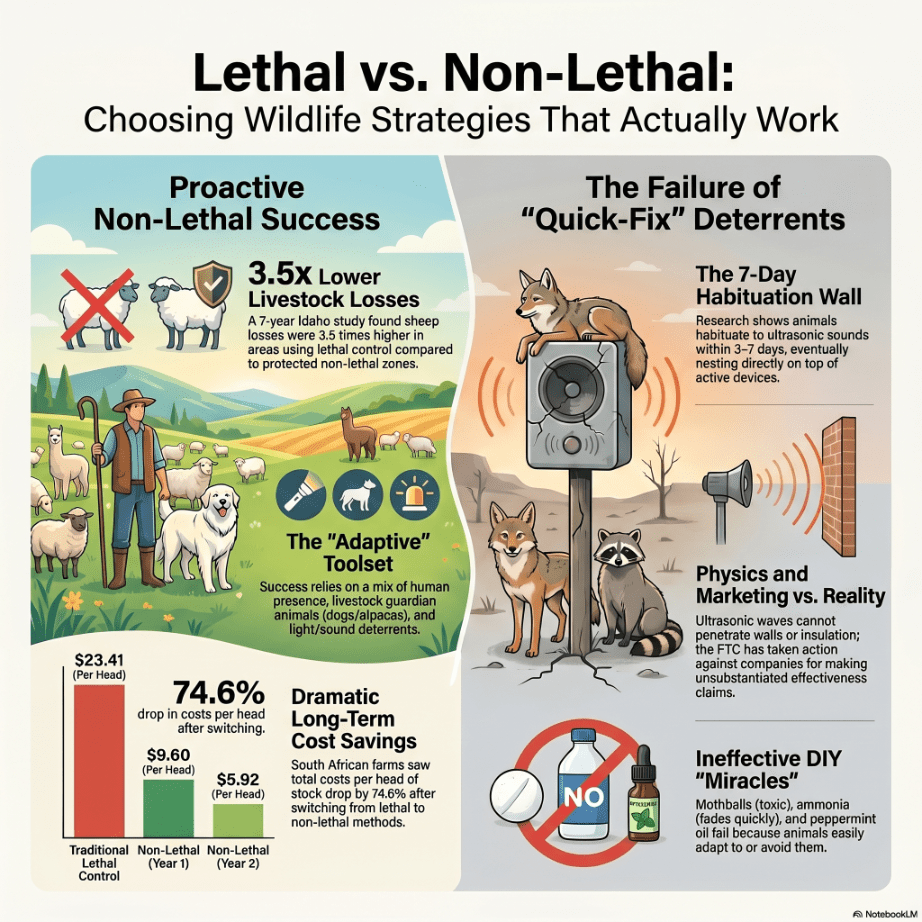
The transition from lethal to non-lethal management is often slowed by the myth of high overhead. However, when we apply rigorous life-cycle accounting, the non-lethal model proves far more lucrative. A multi-year study on South African livestock farms (McManus et al.) tracked the economic shift as producers abandoned traditional traps and hunting in favor of guardian animals and protective collars.
| Management Phase | Cost per Head of Stock (USD) | Depredation Cost per Head (USD) | Total Economic Impact |
| Year 1: Lethal Control | $3.30 | $20.11 | $23.41 |
| Year 2: Non-Lethal (Setup) | $3.08 | $6.52 | $9.60 |
| Year 3: Non-Lethal (Running) | $0.43 | $5.49 | $5.92 |
These findings are corroborated by the Wood River Wolf Project in Idaho. In one of the state’s most rugged sheep-grazing sectors, the cost of implementing a suite of non-lethal deterrents averaged just $1.00 per sheep. This strategic investment resulted in a loss rate of only 0.02%—the lowest depredation rate in any wolf-occupied range in the state.
3. The Olfactory Perimeter: Scent as a Barrier
Ecological Security begins at the molecular level. By deploying synthetic pyrazine analogs—the chemical markers of apex predator musk—we can manifest an “invisible fortress.” This triggers a primal avoidance response in both prey species and competing mesopredators, effectively establishing a landscape of fear without the need for physical barriers or toxic pollutants.
From a regenerative perspective, the link between soil health and predator risk is direct. High-resolution sensors (such as those from BioSensor Solutions) monitor the soil microbial “engine.” High microbial activity zones produce nutrient-dense forage, which acts as a biological beacon for wild ungulates like elk and deer. Because predators follow prey, these high-health pasture zones are also high-risk depredation zones. Managing the olfactory perimeter allows the steward to protect these critical nutrient cycles.
Best Protocols for Olfactory Walls:
- Strategic Risk Mapping: Apply scent deterrents specifically in zones where high soil microbial activity indicates a high density of wild prey attraction.
- Corridor Precision: Application must be concentrated along established wildlife movement zones and pasture boundaries to reinforce the “landscape of fear.”
- Apex Validation: To prevent habituation, the local ecosystem must retain a baseline presence of actual apex predators to validate the chemical threat signal.
- Microbial Neutrality: Use synthetic analogs that trigger behavioral shifts without introducing foreign organic waste that could disrupt the delicate soil microbiome.
4. Sonic Warfare: Beyond the Ultrasonic Myth
The market is saturated with generic “ultrasonic” devices that promise a miracle cure for wildlife conflict. The reality, as documented by the University of Arizona and field specialists at Attic Fanatics, is that these devices are largely failures.
- The Habituation Window: Most predators habituate to static, high-frequency tones within 3 to 7 days. If the sound does not signal an immediate physical threat, it is quickly categorized as “background noise.”
- Barrier Failure: Ultrasonic waves are directional and easily absorbed by insulation, dense vegetation, or physical walls, creating massive “dead zones” in the defense.
- The Attraction Risk: University of Arizona research highlights a cautionary tale: some generic devices designed to repel mosquitoes actually increased the bite-rate by 50%, demonstrating that unverified tech can inadvertently attract the very pests it seeks to deter.
Conversely, Biosonic technology utilizes biologically relevant sounds—predator distress calls, intraspecific alarm calls, and mating sounds—that carry high-stakes meaning for the target species. These high-fidelity, solar-powered arrays are designed for autonomous, off-grid ranching operations, providing a persistent but adaptive acoustic barrier that is far more resistant to habituation.
5. Layered Defense Protocols: Adaptive Implementation
The Wood River Wolf Project provides the blueprint for a “Holistic Strategy.” Success is not found in a single tool, but in the adaptive rotation of the following toolset:
- Turbo-fladry: Electrified poly-wire with hanging flags, combining visual and physical stimuli to break the predator’s approach.
- Foxlights: LED arrays that flash in irregular patterns, feigning a human presence that predators cannot predict.
- Radioactivated Guards (RAGs): High-intensity sirens and lights triggered by the proximity of a radio signal. Consultant Warning: These are only effective if local packs are currently radio-collared by state or federal wildlife agencies.
- Livestock Guardian Dogs (LGDs): Deployment of 3+ dogs per band to provide a constant biological deterrent.
- Proactive Human Presence: Increased vigilance by herders during the high-risk night hours.
Strategic Timing and Intelligence: The “Adaptive Use” protocol requires ramping up deterrent density during the April–June denning and rendezvous season. This is the critical window when wolf packs are most defensive of pups and prone to conflict. By layering this timing with Biological Intelligence tools—GIS overlays, real-time microbial sensor data, and satellite moisture indices—ranchers can shift their defense from reactive panic to predictive security.
6. Strategic Outlook: Scaling Ecological Intelligence
The shift to dual-sensory systems (scent and sound) is the defining characteristic of a resilient, modern ranch. These non-lethal protocols have been proven to reduce livestock losses by up to 90% and are 3.5 times more effective at preventing depredation than unprotected areas.
The era of managing land through conflict is ending. For the modern land steward, the choice is to continue the expensive, temporary cycle of “old-world violence” or to embrace a future built on high-tech biological intelligence. By trading the trap for the sensor, you secure your livestock, your profit margins, and the evolutionary health of the landscape. This is the new standard for ethical, decentralized food systems.