
For centuries, the “wealth on a sheep’s back” was the gold standard of agricultural prosperity. But today, that romanticized image is colliding with a brutal economic reality: in many parts of the world, including Europe, wool is being “thrown in the trash” as a waste product. For the modern producer, the golden fleece has become a lead weight.
Savvy farmers are no longer waiting for a market rebound that may never come. Instead, they are deploying a disruptive innovation: hair-coated sheep like the Katahdin and St. Croix. This isn’t just a trend; it is a strategic pivot. By synthesizing the latest genomic research and scientific stress studies, we can distill five truths that prove why the future of the industry belongs to the sheep that can take care of themselves.
1. The “Value Gap”: Wool as a Parasitic Cost Center
We must audit the flock’s finances with a strategist’s eye. For meat-focused operations, wool has transitioned from an asset to a parasitic cost center. This is the “Value Gap” in its simplest form: the cost to harvest the product now exceeds the value of the fiber itself.
Data from producer reports shows a staggering disparity. Professional shearing costs currently range from $5 to 16 per head**. Meanwhile, wool from common meat breeds may only fetch between **1.15 and $2.15 per kg. If an average sheep shears roughly 7 lbs of fleece wool, the total wool income sits at approximately 15.25. When contrasted against a modern annual production cost of **165 to $250 per head**, the math is devastating.
“Even when wool prices are good, wool is little more than a break-even proposition for most producers.” — Maryland Small Ruminant Page
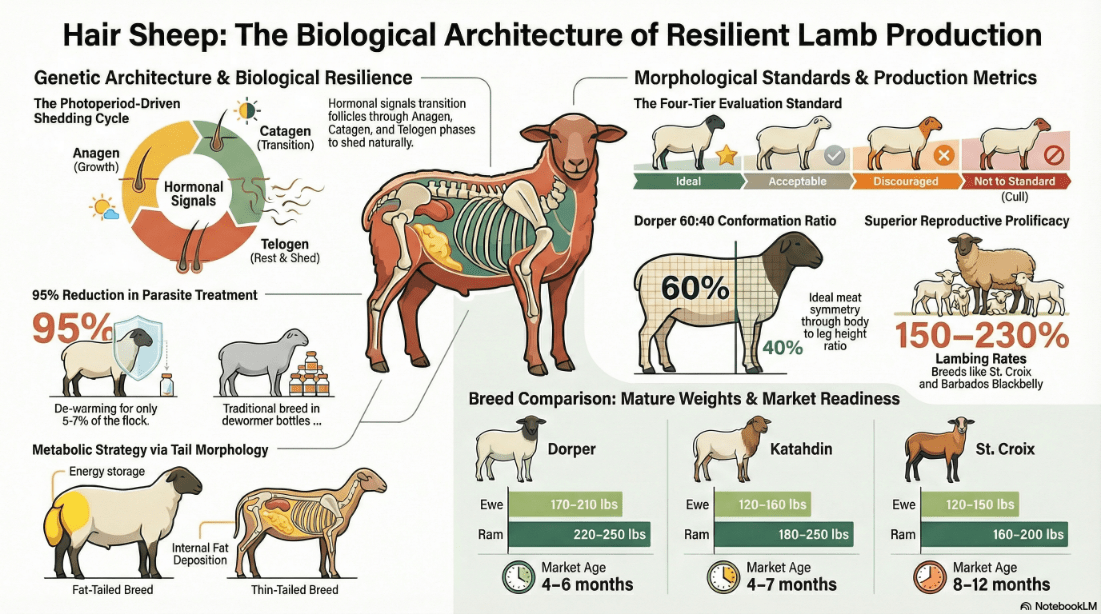
By transitioning to hair sheep, which naturally shed their coats in the spring, producers eliminate the labor and expense of shearing, crutching, and tail docking. In this model, we stop chasing a break-even byproduct and focus entirely on the profit driver: the lamb.
2. The “Resilience King”: St. Croix and Metabolic Stability
As climate change creates more volatile production environments, we must select for “Metabolic Assets.” A landmark PMC multivariate study analyzed Dorper, Katahdin, and St. Croix breeds under extreme stress—high heat, limited feed, and water restriction. While all hair sheep showed hardiness, the St. Croix emerged as a statistical outlier in resilience.
The St. Croix’s superiority is proven by specific biological markers that indicate a higher degree of “Metabolic Stability”:
- Nutritional Efficiency: St. Croix sheep maintained a higher blood urea nitrogen level under heat stress, indicating they can maintain a higher dry matter intake relative to their body weight compared to other breeds.
- Energy Regulation: During severe feed restriction, the St. Croix showed a significantly lower magnitude of decline in triglycerides. This suggests they can better regulate energy metabolism and reduce their maintenance requirements when resources are scarce.
- Respiratory Depth: Higher blood oxygen concentrations in St. Croix sheep suggest a deeper, more efficient breathing pattern, allowing them to better saturate the blood while managing core temperatures.
For a strategist, these findings mean the St. Croix is the primary genetic tool for livestock survival in a climate-stressed world.
3. The Genetic Tug-of-War: The Growth Trap
A critical strategic warning for any breeder is the reality of “Genetic Antagonism.” A PMC Mexico study on Pelibuey and Blackbelly breeds confirmed a counter-intuitive truth: selecting strictly for faster growth (direct heritability) can inadvertently sabotage the ewe’s maternal capacity.
Data shows a negative correlation between selecting for the “heaviest lambs” and the future ewe’s milk production. If you focus solely on size, you lose the “room and capacity” (as defined by the CKSA) required for a ewe to carry and feed her lambs effectively. Bigger is not always better; a massive ram may produce fast-growing offspring, but if his daughters lack the maternal genetics to support a twin lamb crop, your long-term flock profitability will crater. Sustainable farming requires a balanced selection that protects maternal traits from the “Growth Trap.”
4. Data-Driven Management: The Hidden Immune System
Parasite resistance is the secret superpower of hair sheep, but it must be managed as a data-driven strategy. While wool sheep typically develop immunity to the “barber pole worm” (Haemonchus contortus) at 5–7 months, hair sheep—particularly Katahdins—develop this innate resistance as early as 3–4 months.
This allows producers to weaponize the “80/20 Rule” of pasture management:
“Roughly 20% of the sheep in a flock are responsible for depositing 80% of the parasite eggs on a pasture.” — ACSRPC
In a low-input system, identifying and culling that susceptible 20% is not just a chore; it is a management strategy that reduces the need for chemical dewormers. By keeping the resistant 80%, you create a self-sustaining, low-contamination environment ideal for organic or forage-based production.
5. Avoiding the “Scooter” Bottleneck: Line Breeding vs. Hybrid Vigor
The term “Line Breeding” is often used as a professional euphemism for inbreeding. Strategists must understand the difference. Breeders often flock to a “Champion” like the famous “Scooter” (a hypothetical national winner). When everyone buys Scooter’s genetics, it creates a genetic bottleneck that allows recessive ailments—like dwarfism, scrapie, or jaw deformities—to rear their heads.
The antidote is Hybrid Vigor: the synergistic effect of bringing together geographically segregated lines (such as importing Australian Poll Dorset genetics). This “recreates” health and growth potential by broadening the genetic pool.
The Strategic Buyer’s Checklist:
Before investing in breeding stock, demand answers to these technical requirements:
- Coat Grading: To be eligible for CKSA registration, a Katahdin ram must be born from an A or AA coat-graded dam to ensure shedding reliability.
- Mouth/Jaw Alignment: Ensure a true, even bite. “Parrot mouth” (overshot jaw) is a major fault that destroys an animal’s ability to graze effectively.
- Genetic Audit: Has the breeder tested for recessive traits like scrapie or dwarfism?
- Manes and Horns: For Katahdins, a seasonal mane is an essential breed characteristic for rams; however, horns are a disqualification.
Conclusion: The Low-Maintenance Revolution
We are witnessing a fundamental shift in the definition of a sheep’s value—moving from the wool it grows to the labor it doesn’t require. In this new era, wool is merely “the icing on the cake,” but lamb quality and animal resilience are what pay the bills.
The Katahdin has already proven it can meet North American carcass standards without the maintenance of a wool coat. As input costs for labor and feed continue to climb, we must ask: Is your flock an asset that works for you, or a liability that you work for? The low-maintenance revolution has arrived; it’s time to shed the fleece.