
1. Introduction: The Greenland Paradox
In 985 AD, a Norse explorer named Erik the Red led a fleet toward a massive island in the North Atlantic. He bestowed upon it a name that modern observers often dismiss as a clever marketing ploy: “Greenland.” However, the archaeological record suggests that for the medieval Norseman, the name was a literal description. Far from the desolate, icy wasteland we recognize today, the southern coast of Greenland was actually forested when the first settlers arrived.
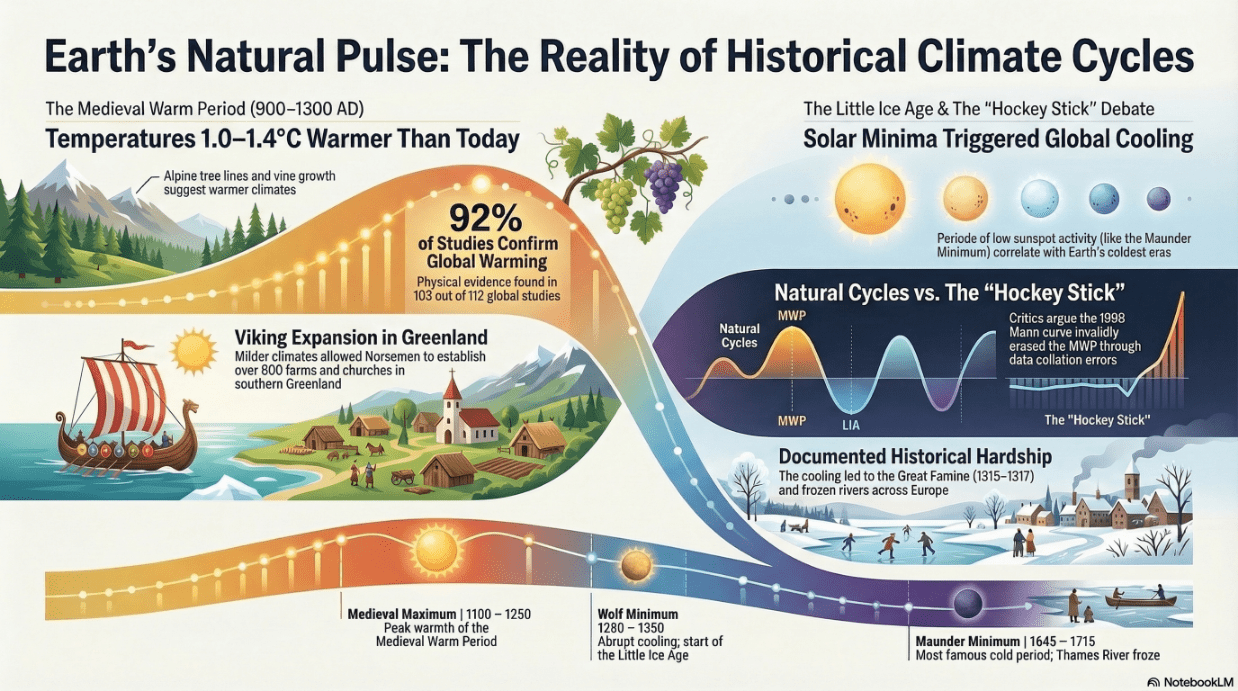
To a modern scientist, the findings are an “archaeological shock.” Beneath layers of what is now solid permafrost, excavations have revealed approximately 620 farms, including longhouses that once sheltered 10 to 20 people each. These settlers did not live on seal blubber alone; they brought grain seeds—barley, oats, and rye—and maintained stalls for horses, cattle, sheep, and goats. Estimates suggest a thriving population of 6,000 to 9,000 residents living in a territory where such agriculture is currently impossible. This “Greenland Paradox” serves as our first clue that the Medieval Warm Period (MWP) was a physical reality that challenges the “normalcy” of our modern climate.
2. When English Vineyards Outpaced the French
The prosperity of the Greenland colonies was not an isolated event; it was the product of a global climatic shift between 900 AD and 1300 AD. During this window, the movement of “growing zones” provided tangible, biological evidence of a world significantly warmer than the present.
In England, wine grapes were cultivated as far as 500 kilometers (300 miles) north of the modern limits for French and German vineyards. In continental Europe, the shift was even more measurable. German vineyards reached elevations of 780 meters (2,500 ft), whereas today they are only feasible up to 560 meters (1,800 ft). Even further north, in Trondheim, Norway, the successful harvest of wheat and oats suggests regional temperatures roughly 1°C (2°F) warmer than today.
“Grapes are presently grown in Germany up to elevations of about 560 m, but from about 1100 A.D. to 1300 A.D., vineyards extended up to 780 m, implying temperatures warmer by about 1.0–1.4 °C.”
3. The Global Consensus: It Wasn’t Just Europe
Critics of the Medieval Warm Period have long attempted to categorize it as a regional European anomaly. However, the data suggest a global consensus. In 2003, researchers Soon and Baliunas published a massive meta-analysis of 112 studies, utilizing oxygen isotope data and other physical proxies from across the globe. Their findings were overwhelming: 92% of the studies showed physical evidence of the MWP. Most strikingly, out of 112 papers, only two failed to find evidence of this warm epoch.
The evidence of this “warm oscillation” is written into the physical proxies of every continent:
- The Sargasso Sea: Marine organism isotopes indicate sea surface temperatures were approximately 1°C warmer than today.
- The Tibetan Plateau: Tree-ring data from the central-eastern Tibetan Plateau confirm a prominent warm period matching the European record.
- Antarctica: Ice cores from the eastern Antarctic Peninsula record a distinct warming trend.
- Equatorial East Africa: Sedimentary data shows a significantly drier climate between 1000 AD and 1270 AD, consistent with higher temperatures.
- Japan: Lake and marine sediments record a period of notably higher temperatures.
- American Southwest: Tree rings and lake levels reveal prolonged, intense droughts that defined the era.
4. The “Hockey Stick” and the Erasure of History
Despite “several thousand papers” establishing the MWP and the subsequent Little Ice Age (LIA) as global events, the scientific narrative was radically overhauled in 1998. Michael Mann and his colleagues published a tree-ring study that featured the “Hockey Stick” graph—a model that essentially smoothed out the previous millennium, erasing both the MWP and the LIA from the record.
This reconstruction allowed the Intergovernmental Panel on Climate Change (IPCC) to assert in 2001 that modern warming was unprecedented. The impact was profound, leading to the famous claim by Al Gore (2007) that: “Our civilization has never experienced any environmental shift remotely similar to this. Today’s climate pattern has existed throughout the entire history of human civilization.”
Investigative scrutiny by researchers like McIntyre and McKitrick (2003, 2005) later revealed the “Hockey Stick” was plagued by collation errors, unjustifiable truncation of source data, and incorrect calculations. The “Climategate” email leaks further peeled back the curtain, revealing a desperate effort by certain researchers to “hide the decline” in temperature data that contradicted their models, all to protect the dogmatic view that modern warming has no historical precedent.
5. The Modern “Adjustment” of the Past
The erasure of climate history is not confined to the Middle Ages. Investigative journalist Joseph D’Aleo has highlighted what many call “data doctoring” in 20th-century records. Analysis of NASA GISS and NOAA GHCN databases reveals that temperatures from the 1930s and 1940s—historically the warmest decades of the last century—have been systematically adjusted downward.
These adjustments serve a specific narrative: by cooling the past, modern warming looks more dramatic and “unprecedented.” A key “smoking gun” was discovered by Steve McIntyre, who identified a “Millennium Bug” in the USHCN data. Just as significantly, records from 1987 show that GISS temperatures were modified downward in the middle of the century specifically in time for Dr. James Hansen’s testimony before Congress.
“1998 and 1934 ping-pong regularly between first and second warmest year as the fiddling with old data continues.”
NASA officials have privately admitted that their climate findings might be “inferior” to other data sets. John Goetz further revealed that 20% of the historical record was modified 16 times in just a 30-month period ending in 2007, raising serious questions about the integrity of our baseline data.
6. The Sun’s Silent Command: Solar Minima and Famine
As a science historian, one must look past computer models to the primary driver of climate: the sun. The transition from the MWP to the Little Ice Age was an abrupt, devastating shift linked to Total Solar Irradiance (TSI) and Low Sunspot Numbers (SSNs). At the end of the MWP (c. 1300 AD), the global climate plummeted into the “Wolf Minimum.”
The results were catastrophic. The “Great Famine” (1315–1317, extending to 1322) was triggered by torrential rains and bitter cold that rotted crops in the fields. The winter of 1309–1310 saw the Thames River freeze over in London. By 1350, the Greenland settlements were being abandoned as advancing pack ice blocked sea routes and permafrost claimed the once-forested coast.
| Solar Minimum | Approx. Dates | Impacts |
| Wolf Minimum | 1280 – 1350 AD | End of MWP; Great Famine (1315-1317); Thames freezes (1309); Greenland abandoned. |
| Maunder Minimum | 1645 – 1715 AD | Deepest LIA cold; Alpine glaciers bury villages; 50-year period of virtually no sunspots. |
| Dalton Minimum | 1790 – 1820 AD | Intense cooling and hardship; crop failures; Napoleon’s defeat in the Russian winter. |
7. Conclusion: A Ponderable Future
The conflict of our age lies between “physical proxies”—the foundations of Norse churches, the isotope ratios in ice, and the historical records of wine harvests—and “computerized models” like the Hockey Stick. One tells a story of natural cyclicality, driven by the sun and the oceans; the other attempts to eliminate history to make the present appear unique.
The revelations of “Climategate” and the systemic adjustment of historical records remind us that data integrity is the only defense against dogma. We must consider the core tenet of geology: “The Past is the Key to the Future.” If we allow the Medieval Warm Period to be erased from our collective memory, we lose the only baseline we have for understanding the natural cycles of our planet. Do we truly understand the Earth’s climate, or has our focus on a single variable blinded us to the lessons of the Middle Ages?