
1. The Mirage of Modern Food Security
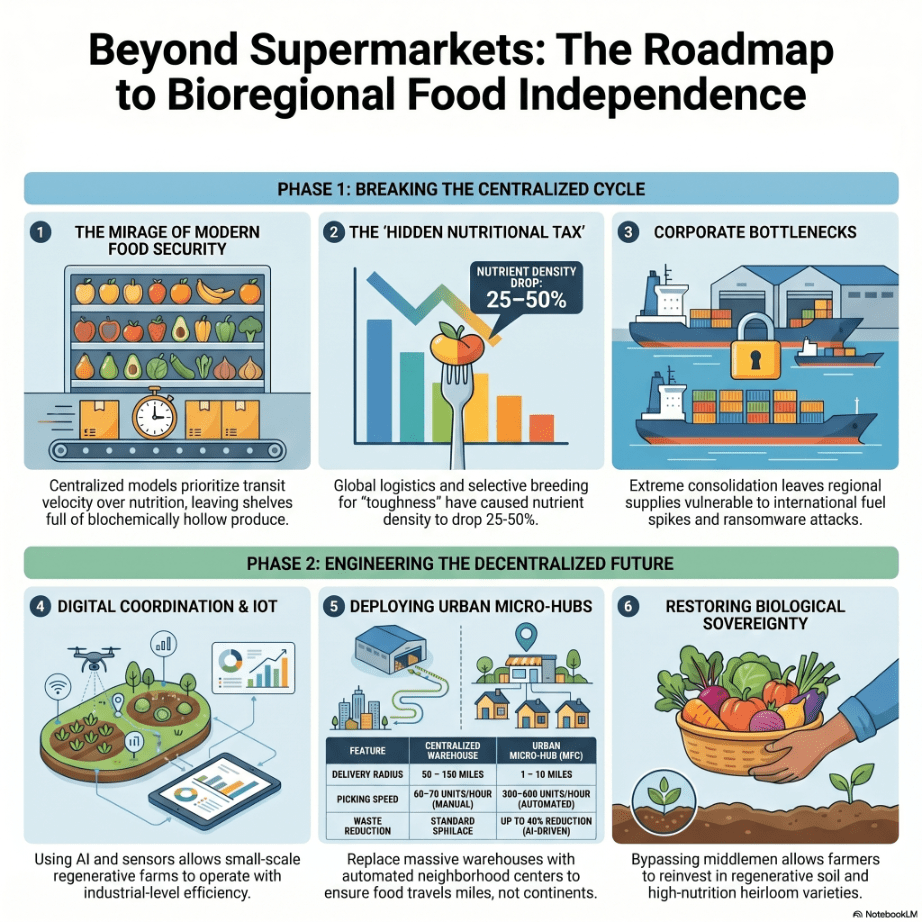
The global food system of the mid-2020s represents a brittle, centralized architecture plagued by a single-point-of-failure logic. We are witnessing a profound paradox: global production remains high, yet systemic fragility has pushed acute food insecurity to a breaking point. According to 2026 FAO data, 295 million people across 53 countries are now facing high acute food insecurity—a nearly threefold increase since 2016. This surge occurs as the Global Humanitarian Overview remains a mere 25% funded as of late 2025, signaling that the legacy model of “aid-as-redemption” is no longer a viable protocol for stability.
The crisis is not one of scarcity, but of a “shelf-life first” architectural failure. Conventional chains prioritize transport durability over biological integrity. Research from InspiraFarms and the Shell Foundation indicates that nearly half of all food produced never reaches a consumer. For instance, bananas harvested without immediate cold-chain access see their shelf life collapse from 14 days to just 5 days. This occurs because produce frequently remains at ambient temperatures (24–36°C) for up to 36 hours post-harvest, inducing rapid over-maturation and dehydration.
- Infrastructure Scarcity: A lack of first-mile cold storage nodes prevents the stabilization of biological assets at the source.
- Logistical Strain: The industry-standard “90-minute” last-mile delivery average is a legacy bottleneck that cannot accommodate modern urban density or e-commerce demand.
- Ecological Erosion: Conventional agriculture treats soil as a stagnant “medium for holding plants.” This extractive protocol has resulted in the 33% global soil degradation reported by the UN FAO, effectively liquidating the planet’s primary biological capital.
——————————————————————————–
2. The Architecture of Decentralized Networks
To insulate communities from global volatility, we must deconstruct fragile global chains and replace them with decentralized node networks. The transition is powered by digital coordination tools that allow for proactive rather than reactive management. The market for AI in agriculture is projected to hit $4.7 billion by 2028, underpinned by a massive hardware migration. In 2024 alone, over 30,000 high-precision LIDAR units and sensor fusion platforms were delivered to manufacturers, enabling autonomous navigation protocols that can bypass the traditional intermediaries that currently siphon value from the system.
Industrial incumbents are already attempting to bridge this gap. The “Home Grown by Sysco” pilot has identified 10,000 locally sourced products in regions including the Great Lakes, Montreal, and South Florida. Crucially, the architect of this program intends to expand this localized sourcing protocol across the entire United States within the next 12 months, acknowledging that the future of logistics is hyper-local.
For small-scale regenerative farms, this decentralized architecture offers a radical economic upgrade:
- Overhead Decoupling: Bypassing traditional distribution intermediaries allows producers to capture a higher percentage of the retail value.
- Operational Profitability: By leveraging precision coordination, small-holders are achieving profit increases of up to 120%.
- Input Independence: Distributed networks reduce the reliance on global commodity markets for fertilizers and fuels, favoring local nutrient cycles.
——————————————————————————–
3. Engineering Nutrient Density and Soil Health
In a decentralized system, the primary metric shifts from “truck-toughness” to biological ROI. Regenerative practices—minimum tillage, diverse cover cropping, and integrated biological cycles—actively rebuild the soil as a living asset layer. These systems typically realize a 0.5% to 1% annual increase in soil organic matter, sequestering 0.5–2 tons of carbon per hectare.
This biological health is the only hedge against the “quality issues due to dehydration” that plague conventional systems. When produce loses market value within days of harvest due to respiration and water loss, it is a failure of the system’s ability to preserve nutrient density. Heirloom varieties, grown in carbon-rich soil, are inherently more nutrient-dense; however, they require the specialized, rapid logistics provided by decentralized hubs to reach consumers before their biological peak fades.
Biological ROI: Conventional vs. Regenerative
| Metric | Conventional Farming | Regenerative Agriculture |
| Primary Input Cost | High recurring costs; heavy reliance on natural gas and synthetic fertilizers. | Investment in cover crops and compost; 50–70% reduction in external input costs. |
| Soil Value | Depleting capital; structural degradation and loss of biological life. | Long-term asset value; 0.5–1% annual increase in organic matter. |
| Climate Resilience | Vulnerable to drought; high sensitivity to global commodity price shocks. | Enhanced water retention and carbon sequestration; lower risk variance. |
| Financial Outlook | Increasing costs to maintain yields on degraded, biologically sterile land. | Declining operational costs and new revenue streams from carbon credits. |
——————————————————————————–
4. Building the Localized Distribution Hub
The physical layer of the new food economy consists of modular, off-grid infrastructure. Modular “first-mile” cooling facilities reduce postharvest losses by 25–50%, extending the shelf life of fresh products from days to weeks by stabilizing them immediately after harvest. This infrastructure layer acts as a buffer against the environmental heat that currently destroys 30–45% of produce value.
The true enabler of biological sovereignty, however, is the “Last-Mile” autonomous revolution. As of 2024, over 15,000 autonomous robots and drones are operational, slashing urban delivery times from 90 minutes to under 30 minutes.
Infrastructure Innovations:
- Peak Density Delivery: Sidewalk robots (20–40lb capacity) and VTOL drones (10lb payload within 10 miles) ensure that nutrient-dense crops can be harvested at peak ripeness rather than “shipping-green.”
- Precision Navigation: Sensor fusion platforms, utilizing the 30,000+ LIDAR units deployed in 2024, allow for contactless, same-hour delivery in over 60 cities.
- The 30-Minute Window: By reducing transit to under 30 minutes, we eliminate the need for crops to be bred for durability, allowing a return to high-nutrient heirloom varieties that were previously too fragile for the supermarket shelf.
——————————————————————————–
5. Securing a Resilient Future
Transitioning to bioregional resilience is an exercise in high-yield logic. The FAO’s “Local Investment Multiplier” confirms that every $1 invested in a local farmer yields $3 in local food value. Furthermore, the ROI on anticipatory action—investing in resilience before a shock occurs—is 1:7, meaning every dollar spent today saves seven dollars in avoided future losses.
The Roadmap to Bioregional Resilience
- Adopt “Fleet-as-a-Service” (FaaS): Small producers must utilize FaaS models to access autonomous logistics. This converts high capital expenditure (CapEx) into manageable operating expenses (OpEx), allowing small farms to utilize robots and drones without massive upfront debt.
- Architect Subscription-Based Harvest Cycles: Move toward direct-to-producer subscriptions. This protocol provides farmers with predictable income and ensures consumers receive food at peak nutrient density.
- Deploy Community-Managed Cold Storage: Invest in modular, off-grid cooling nodes at the neighborhood level to stabilize local market prices and eliminate postharvest loss at the source.
The current global food system is an extractive architecture nearing its end-of-life cycle. To protect our future, we must transition from passive consumers of global commodities to active stakeholders in decentralized, regenerative networks. By securing food at its biological source, we rebuild the planet’s soil and our own health simultaneously.