
For decades, industrial agriculture has operated under the illusion of a “free lunch.” By applying massive volumes of synthetic nitrogen (N) fertilizers, we have achieved record-breaking yields, but this success has come at a staggering biological cost. We have inadvertently severed the ancient symbiosis between plants and soil biology, transforming vibrant, living ecosystems into sterile, addicted substrates. The rhizosphere, once a sophisticated biological marketplace where carbon was the primary currency, has been reduced to a passive conduit for chemical delivery.
Key Thesis: Agricultural intensification has replaced natural biogeochemical regulation with prescriptive chemical and mechanical inputs. This transition has moved the soil from a state of biological self-sufficiency to a state of total chemical dependence, where the microbiome is no longer a partner in growth but a casualty of over-saturation.
1. The High Cost of the “Free Lunch”: Forcing Microbes into Retirement
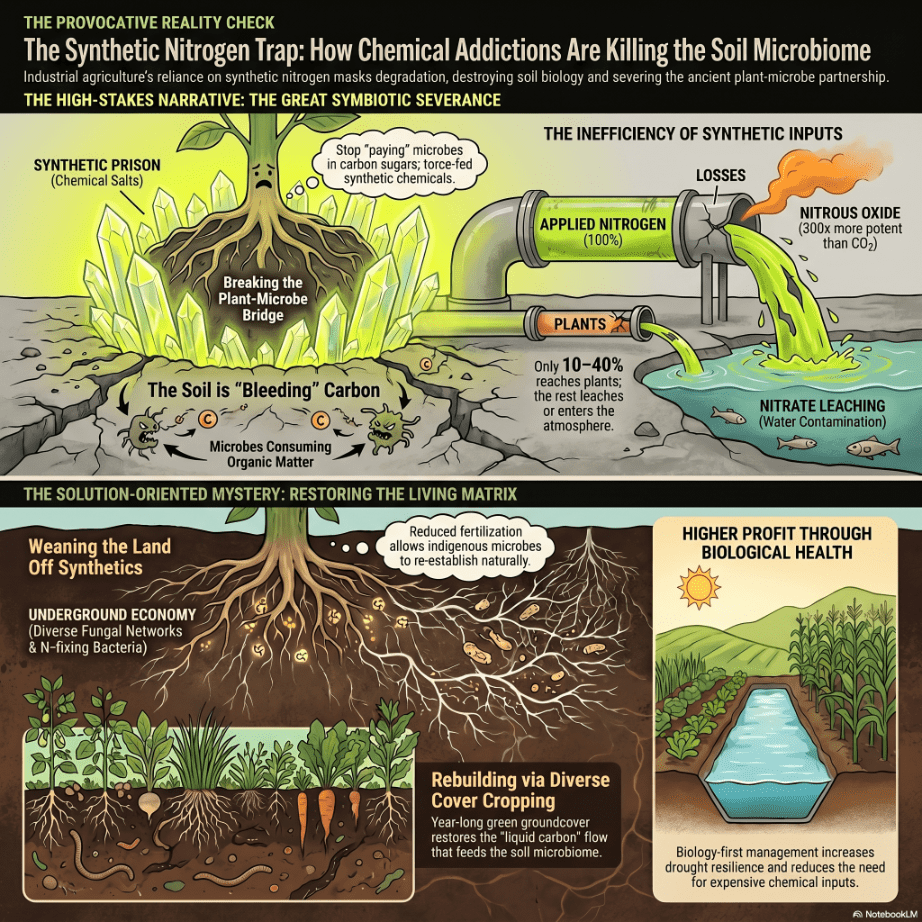
The fundamental mechanism of soil health is an underground economy based on trade. Plants allocate a significant portion of their photosynthetically derived carbon to the root zone as sugars and exudates—”payments” to the microbial community in exchange for mobilized nutrients, water access, and pathogen protection. However, when plants are “force-fed” high concentrations of soluble synthetic nitrogen, the metabolic incentive for this trade disappears.
As documented in the Australian sugar-cane industry (Case 1), yield declines persisted for years despite the introduction of new varieties and aggressive pesticide regimens. The underlying cause was a profound functional degradation of the soil. When plants receive an abundance of mineral nitrogen, they cease carbon payments to their fungal and bacterial partners, effectively forcing the soil’s most vital workers into “retirement.”
The Biological Cost of Force-Feeding
- Cessation of Carbon Payments: Plants terminate the flow of carbon sugars to the rhizosphere, starving the fungal and bacterial networks that manage long-term soil stability.
- Microbial “Retirement” and Dormancy: Essential organisms, no longer recruited for nutrient retrieval, either go dormant or die off, leading to a collapse of the underground economy.
- Masked Degradation: High chemical inputs mask the loss of Cation Exchange Capacity (CEC) and biological function until the system reaches a “Yield Plateau,” where even higher fertilizer rates are required to maintain baseline productivity.
2. The Evidence: 34 Years of Soil Degradation
Empirical proof of the “Nitrogen Trap” is found in a landmark 34-year longitudinal study of Illinois field trials (2019). The data reveals that chronic N fertilization at high rates (269 kg N/ha) does not merely “feed the plant”; it radically restructures the soil microbiome, selecting for fast-growing, nutrient-hungry “copiotrophs” while suppressing the resource-efficient “oligotrophs” that drive essential ecosystem services.
Table 1: Dominant Phyla (>1% RA) – Winners vs. Losers
| Status | Phyla | Ecological Role |
| Winners (Increased RA) | Proteobacteria (Alpha & Gamma), Gemmatimonadetes, Euryarchaeota | Copiotrophs: Rapidly respond to high nutrient pulses; often metabolic generalists. |
| Losers (Decreased RA) | Cyanobacteria, Chloroflexi, Firmicutes, Planctomycetes, Deltaproteobacteria | Oligotrophs/Specialists: Efficient nutrient cyclers; drive N-fixation and anaerobic ammonia oxidation. |
Table 2: Minor Phyla (<1% RA) – Winners vs. Losers
| Status | Phyla |
| Winners | Aquificae, WPS2, Parvarchaeota, AD3, FCPU426, Armatimonadetes, TM7, Chlamydiae, OD1 |
| Losers | Nitrospirae, WS3, Tenericutes, Lentisphaerae, OP3, Synergistetes, Thermotogae, Other |
Statistical Decline in Biological Diversity
The 2019 Illinois study highlights significant reductions in all primary alpha diversity and richness metrics at the 269 kg N/ha level:
- Observed OTUs: Dropped from 2258 to 2055.
- Shannon’s Diversity Index: Fell from 10.00 to 9.62.
- ACE Diversity Index: Significant reduction from 2340 to 2151.
- Chao1 Richness: Fell from 2379 to 2191.
- Fisher’s Alpha: Decreased from 420.3 to 370.3.
3. The Great Symbiotic Severance: Salt, Acid, and Sterile Soils
The transition from a vibrant ecosystem to a “Ghost Town” is accelerated by the chemical reality of synthetic inputs. High-salt fertilizer environments create a “biological divorce” through osmotic stress, physically dehydrating and killing sensitive microbes.
The Chemical Mechanism of Collapse
- Nitrogen-Induced Acidification: High N applications trigger the nitrification of ammonium, which released hydrogen ions into the soil. In the Illinois study, soil pH plummeted from a healthy 6.33 to an acidic 5.42. This acidification directly selects for acidophilic “Winners” while neutralizing the beneficial bacteria required for nutrient availability.
- C/N Ratio Imbalance: Excessive N shifts the carbon-to-nitrogen ratio, triggering a metabolic frenzy that “burns off” soil organic matter, destroying the very substrate required for biological resilience.
- Symbiotic Failure: Essential microsymbionts like Arbuscular Mycorrhizal Fungi (AMF) and Rhizobium (Case 6 and 24) are rendered redundant. When the plant no longer needs to work for its nitrogen, it stops supporting the fungi that provide phosphorus and the bacteria that fix atmospheric N.
4. The Addiction Loop and the Yield Plateau
As the microbiome degrades, farmers enter a state of diminishing returns. This is the “Addiction Loop”: as biological fertility declines, more synthetic inputs are required to replace the lost services, which in turn causes further biological decline.
The Sustainability Threshold
Soil health must be viewed through the “Pyramid of Soil Health Indicators,” where biological, chemical, and physical health are inextricably linked. Once a system falls below a specific “Threshold Value”—the lower limit of system performance—the land becomes unsustainable.
- Environmental Fallout: Sterile soil lacks the “biological glues” (biogenic structures) produced by fungi and macrofauna. This leads to massive erosion, loss of soil structure, and the leaching of nitrates into waterways, as there is no living matrix to hold nutrients in place.
- Economic Strain: Rising costs for “remedial” chemistry (pesticides to replace lost natural resistance) collide with plummeting nutrient density and a total loss of natural soil resilience.
5. The Microbic Revolution: A Phased Recovery Plan
Breaking the synthetic prison requires a shift toward “Biological Priming” and adaptive management. We must treat soil restoration not as a chemical problem, but as a phased rehabilitation of a living system.
- Phase 1: Biological Inoculation: Re-seeding the soil with “natural allies” like AMF and Rhizobium (Case 6) to re-establish the nutrient pathways severed by high-N applications.
- Phase 2: Physical Engineering: Managing “ecosystem engineers” like Termites (Case 12) and Earthworms (Case 13). These organisms repair the physical structure and porosity of crusted, degraded soils, facilitating water infiltration and air exchange.
- Phase 3: Structural Maintenance & Sequestration: Utilizing Vermicomposting and Bio-organic Fertilization (FBO) to increase Cation Exchange Capacity (CEC) and mitigate Al-toxicity (Case 13 and 14). This is paired with No-Till and Cover Cropping (the Brazilian model, Case 7) to maintain the surface mulch and ensure the underground economy has a steady supply of carbon “currency.”
6. Restoring the Living Matrix: A Roadmap for Food Security
A systemic pivot is required to ensure long-term food security and climate stability. The Soil Biodiversity Initiative (SBI) framework provides the strategic roadmap for this transition:
- Strategic Objective: Knowledge Synthesis: Compiling global case studies to raise public and policy awareness regarding the essential services provided by soil biodiversity.
- Strategic Objective: Capacity & Monitoring: Developing field-ready soil bioindicators (respiration, macrofauna density, and visual health kits) that allow farmers to monitor biological health as closely as they do N-P-K levels.
- Strategic Objective: Collaborative Mainstreaming: Strengthening partnerships between researchers, farmers, and policymakers to prioritize “biology-first” management over extractive chemistry in national agricultural programs.
The health of our soil is the foundation of our civilization. We must move beyond the era of chemical addiction and return to a management style that respects the complexity of the living matrix.
“The condition of our soils ultimately determines human health by serving as a major medium for food and fibre production and a primary interface with the environment, influencing the quality of the air we breathe and water we drink. Thus, there is a clear linkage between soil quality and human and environmental health.” — Acton and Gregorich (1995)